

568
13 Modeling Biological Systems
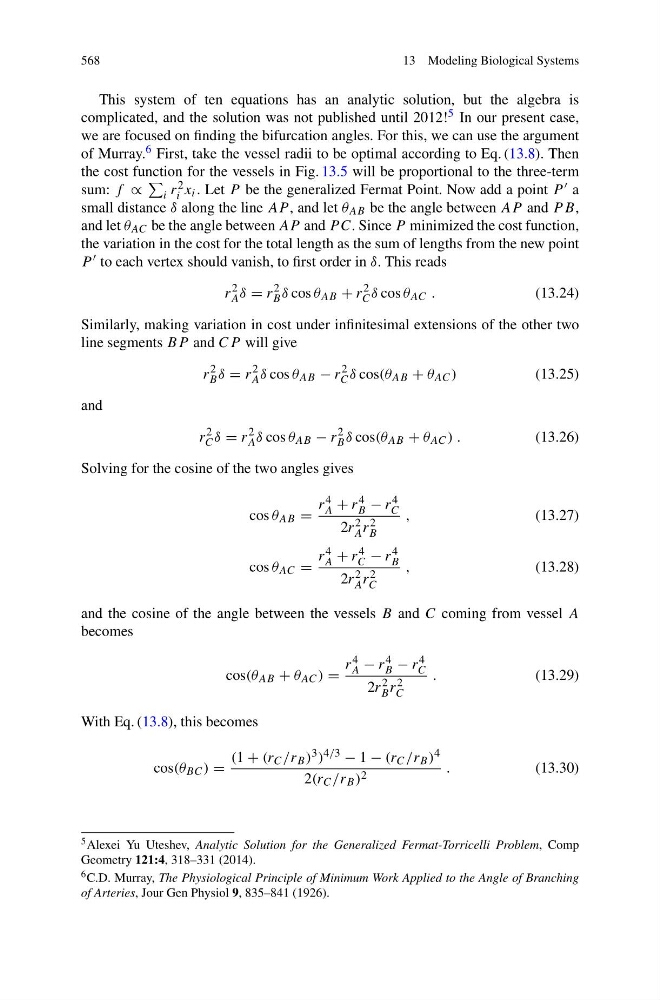
This system of ten equations has an analytic solution, but the algebra is
complicated, and the solution was not published until 2012! 5 In our present case,
we are focused on finding the bifurcation angles. For this, we can use the argument
of Murray. 6 First, take the vessel radii to be optimal according to Eq. (13.8). Then
the cost function for the vessels in Fig. 13.5 will be proportional to the three-term
sum: f ∝
i r 2
i x i . Let P be the generalized Fermat Point. Now add a point P a
small distance δ along the line AP , and let θ AB be the angle between AP and P B,
and let θ AC be the angle between AP and P C. Since P minimized the cost function,
the variation in the cost for the total length as the sum of lengths from the new point
P to each vertex should vanish, to first order in δ. This reads
r
2
A δ = r
2
B δ cos θ AB + r
2
C δ cos θ AC .
(13.24)
Similarly, making variation in cost under infinitesimal extensions of the other two
line segments BP and CP will give
r
2
B δ = r
2
A δ cos θ AB − r
2
C δ cos(θ AB + θ AC )
(13.25)
and
r
2
C δ = r
2
A δ cos θ AB − r
2
B δ cos(θ AB + θ AC ) .
(13.26)
Solving for the cosine of the two angles gives
cos θ AB =
r 4
A + r 4
B − r 4
C
2r 2
A r 2
B
,
(13.27)
cos θ AC =
r 4
A + r 4
C − r 4
B
2r 2
A r 2
C
,
(13.28)
and the cosine of the angle between the vessels B and C coming from vessel A
becomes
cos(θ AB + θ AC ) =
r 4
A − r 4
B − r 4
C
2r 2
B r 2
C
.
(13.29)
With Eq. (13.8), this becomes
cos(θ BC ) =
(1 + (r C /r B ) 3 ) 4/3 − 1 − (r C /r B ) 4
2(r C /r B ) 2
.
(13.30)
5 Alexei Yu Uteshev, Analytic Solution for the Generalized Fermat-Torricelli Problem, Comp
Geometry 121:4, 318–331 (2014).
6 C.D. Murray, The Physiological Principle of Minimum Work Applied to the Angle of Branching
of Arteries, Jour Gen Physiol 9, 835–841 (1926).