

550
12 Entropy and Information in Biology
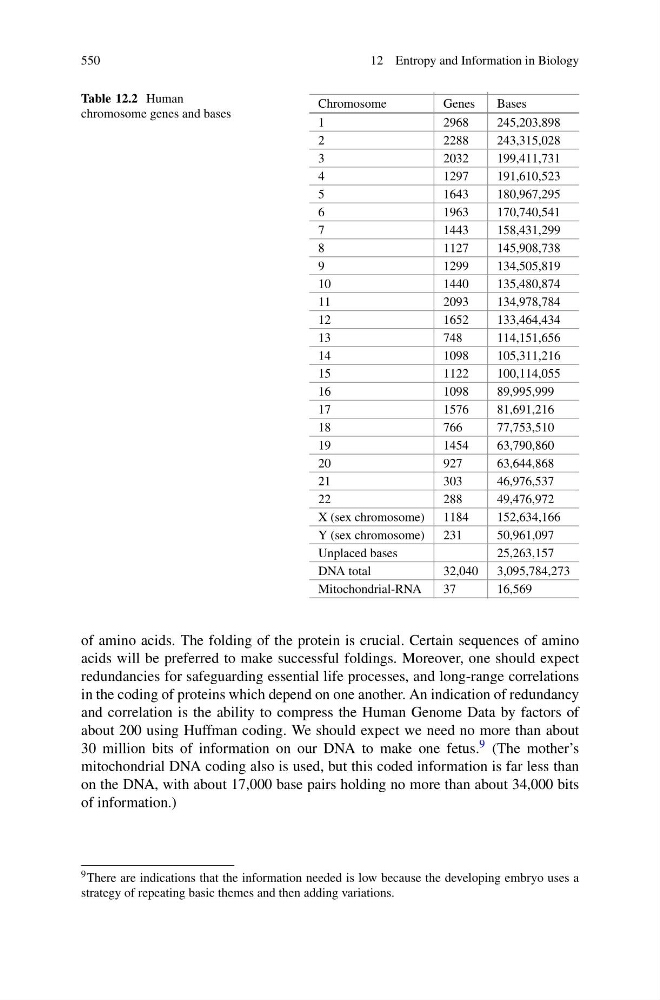
Table 12.2 Human
chromosome genes and bases
Chromosome
Genes
Bases
1
2968
245,203,898
2
2288
243,315,028
3
2032
199,411,731
4
1297
191,610,523
5
1643
180,967,295
6
1963
170,740,541
7
1443
158,431,299
8
1127
145,908,738
9
1299
134,505,819
10
1440
135,480,874
11
2093
134,978,784
12
1652
133,464,434
13
748
114,151,656
14
1098
105,311,216
15
1122
100,114,055
16
1098
89,995,999
17
1576
81,691,216
18
766
77,753,510
19
1454
63,790,860
20
927
63,644,868
21
303
46,976,537
22
288
49,476,972
X (sex chromosome) 1184
152,634,166
Y (sex chromosome) 231
50,961,097
Unplaced bases
25,263,157
DNA total
32,040 3,095,784,273
Mitochondrial-RNA
37
16,569
of amino acids. The folding of the protein is crucial. Certain sequences of amino
acids will be preferred to make successful foldings. Moreover, one should expect
redundancies for safeguarding essential life processes, and long-range correlations
in the coding of proteins which depend on one another. An indication of redundancy
and correlation is the ability to compress the Human Genome Data by factors of
about 200 using Huffman coding. We should expect we need no more than about
30 million bits of information on our DNA to make one fetus. 9 (The mother’s
mitochondrial DNA coding also is used, but this coded information is far less than
on the DNA, with about 17,000 base pairs holding no more than about 34,000 bits
of information.)
9 There are indications that the information needed is low because the developing embryo uses a
strategy of repeating basic themes and then adding variations.