

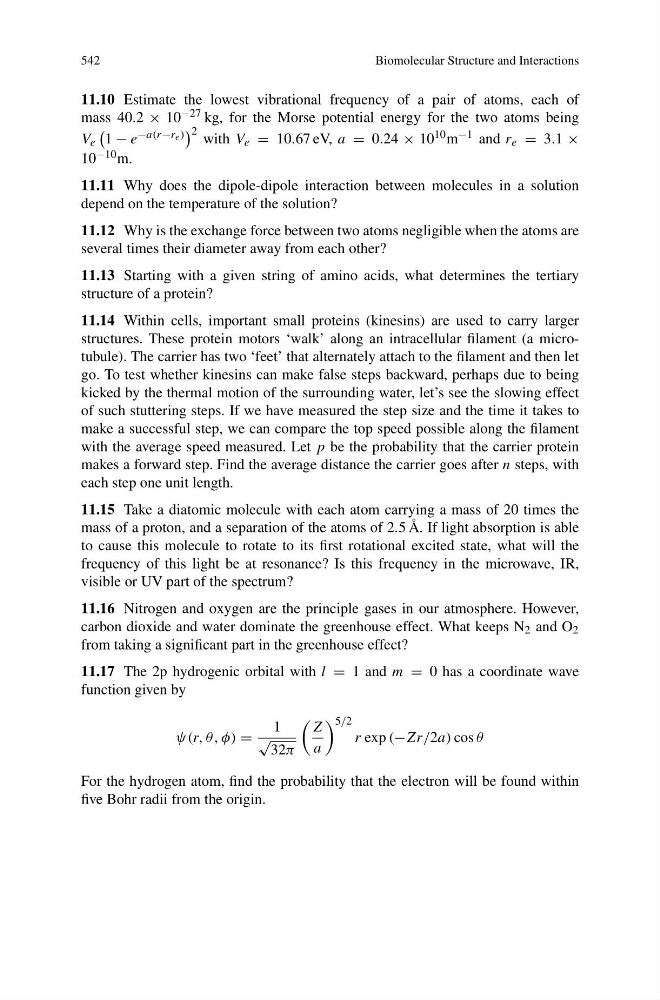
542
Biomolecular Structure and Interactions
11.10 Estimate the lowest vibrational frequency of a pair of atoms, each of
mass 40.2 × 10 −27 kg, for the Morse potential energy for the two atoms being
V e
1 − e −a(r−r e ) 2 with V e = 10.67 eV, a = 0.24 × 10 10 m −1 and r e = 3.1 ×
10 −10 m.
11.11 Why does the dipole-dipole interaction between molecules in a solution
depend on the temperature of the solution?
11.12 Why is the exchange force between two atoms negligible when the atoms are
several times their diameter away from each other?
11.13 Starting with a given string of amino acids, what determines the tertiary
structure of a protein?
11.14 Within cells, important small proteins (kinesins) are used to carry larger
structures. These protein motors ‘walk’ along an intracellular filament (a microtubule). The carrier has two ‘feet’ that alternately attach to the filament and then let
go. To test whether kinesins can make false steps backward, perhaps due to being
kicked by the thermal motion of the surrounding water, let’s see the slowing effect
of such stuttering steps. If we have measured the step size and the time it takes to
make a successful step, we can compare the top speed possible along the filament
with the average speed measured. Let p be the probability that the carrier protein
makes a forward step. Find the average distance the carrier goes after n steps, with
each step one unit length.
11.15 Take a diatomic molecule with each atom carrying a mass of 20 times the
mass of a proton, and a separation of the atoms of 2.5 Å. If light absorption is able
to cause this molecule to rotate to its first rotational excited state, what will the
frequency of this light be at resonance? Is this frequency in the microwave, IR,
visible or UV part of the spectrum?
11.16 Nitrogen and oxygen are the principle gases in our atmosphere. However,
carbon dioxide and water dominate the greenhouse effect. What keeps N 2 and O 2
from taking a significant part in the greenhouse effect?
11.17 The 2p hydrogenic orbital with l = 1 and m = 0 has a coordinate wave
function given by
ψ(r, θ, φ) =
1
√
32π
Z
a
5/2
r exp (−Zr/2a) cos θ
For the hydrogen atom, find the probability that the electron will be found within
five Bohr radii from the origin.