

Problems
541
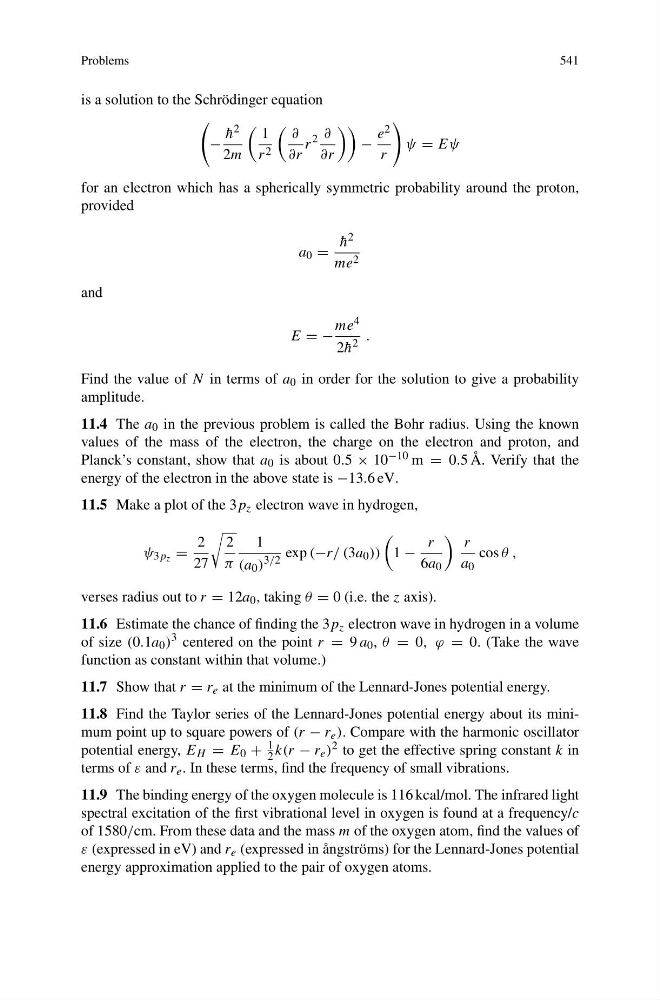
is a solution to the Schrödinger equation
−
¯
h 2
2m
1
r 2
∂
∂r
r
2 ∂
∂r
−
e 2
r
ψ = Eψ
for an electron which has a spherically symmetric probability around the proton,
provided
a 0 =
¯
h 2
me 2
and
E = −
me 4
2 ¯
h 2 .
Find the value of N in terms of a 0 in order for the solution to give a probability
amplitude.
11.4 The a 0 in the previous problem is called the Bohr radius. Using the known
values of the mass of the electron, the charge on the electron and proton, and
Planck’s constant, show that a 0 is about 0.5 × 10 −10 m = 0.5 Å. Verify that the
energy of the electron in the above state is −13.6 eV.
11.5 Make a plot of the 3p z electron wave in hydrogen,
ψ 3p z =
2
27
2
π
1
(a 0 )
3/2
exp (−r/ (3a 0 ))
1 −
r
6a 0
r
a 0
cos θ ,
verses radius out to r = 12a 0 , taking θ = 0 (i.e. the z axis).
11.6 Estimate the chance of finding the 3p z electron wave in hydrogen in a volume
of size (0.1a 0 )
3 centered on the point r = 9 a 0 , θ = 0, ϕ = 0. (Take the wave
function as constant within that volume.)
11.7 Show that r = r e at the minimum of the Lennard-Jones potential energy.
11.8 Find the Taylor series of the Lennard-Jones potential energy about its minimum point up to square powers of (r − r e ). Compare with the harmonic oscillator
potential energy, E H = E 0 +
1
2 k(r − r e ) 2 to get the effective spring constant k in
terms of ε and r e . In these terms, find the frequency of small vibrations.
11.9 The binding energy of the oxygen molecule is 116 kcal/mol. The infrared light
spectral excitation of the first vibrational level in oxygen is found at a frequency/c
of 1580/cm. From these data and the mass m of the oxygen atom, find the values of
ε (expressed in eV) and r e (expressed in ångströms) for the Lennard-Jones potential
energy approximation applied to the pair of oxygen atoms.