

Problems
511
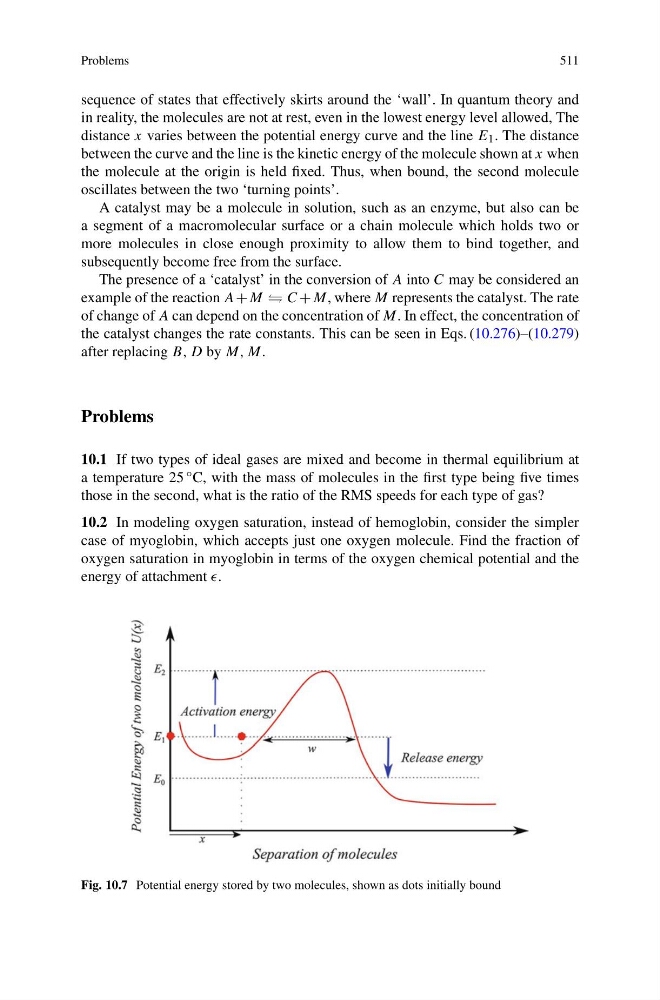
sequence of states that effectively skirts around the ‘wall’. In quantum theory and
in reality, the molecules are not at rest, even in the lowest energy level allowed, The
distance x varies between the potential energy curve and the line E 1 . The distance
between the curve and the line is the kinetic energy of the molecule shown at x when
the molecule at the origin is held fixed. Thus, when bound, the second molecule
oscillates between the two ‘turning points’.
A catalyst may be a molecule in solution, such as an enzyme, but also can be
a segment of a macromolecular surface or a chain molecule which holds two or
more molecules in close enough proximity to allow them to bind together, and
subsequently become free from the surface.
The presence of a ‘catalyst’ in the conversion of A into C may be considered an
example of the reaction A+M C +M, where M represents the catalyst. The rate
of change of A can depend on the concentration of M. In effect, the concentration of
the catalyst changes the rate constants. This can be seen in Eqs. (10.276)–(10.279)
after replacing B, D by M, M.
Problems
10.1 If two types of ideal gases are mixed and become in thermal equilibrium at
a temperature 25 ◦ C, with the mass of molecules in the first type being five times
those in the second, what is the ratio of the RMS speeds for each type of gas?
10.2 In modeling oxygen saturation, instead of hemoglobin, consider the simpler
case of myoglobin, which accepts just one oxygen molecule. Find the fraction of
oxygen saturation in myoglobin in terms of the oxygen chemical potential and the
energy of attachment .
Fig. 10.7 Potential energy stored by two molecules, shown as dots initially bound
511
sequence of states that effectively skirts around the ‘wall’. In quantum theory and
in reality, the molecules are not at rest, even in the lowest energy level allowed, The
distance x varies between the potential energy curve and the line E 1 . The distance
between the curve and the line is the kinetic energy of the molecule shown at x when
the molecule at the origin is held fixed. Thus, when bound, the second molecule
oscillates between the two ‘turning points’.
A catalyst may be a molecule in solution, such as an enzyme, but also can be
a segment of a macromolecular surface or a chain molecule which holds two or
more molecules in close enough proximity to allow them to bind together, and
subsequently become free from the surface.
The presence of a ‘catalyst’ in the conversion of A into C may be considered an
example of the reaction A+M C +M, where M represents the catalyst. The rate
of change of A can depend on the concentration of M. In effect, the concentration of
the catalyst changes the rate constants. This can be seen in Eqs. (10.276)–(10.279)
after replacing B, D by M, M.
Problems
10.1 If two types of ideal gases are mixed and become in thermal equilibrium at
a temperature 25 ◦ C, with the mass of molecules in the first type being five times
those in the second, what is the ratio of the RMS speeds for each type of gas?
10.2 In modeling oxygen saturation, instead of hemoglobin, consider the simpler
case of myoglobin, which accepts just one oxygen molecule. Find the fraction of
oxygen saturation in myoglobin in terms of the oxygen chemical potential and the
energy of attachment .
Fig. 10.7 Potential energy stored by two molecules, shown as dots initially bound