

510
10 The Statistical Basis of Bioenergetics
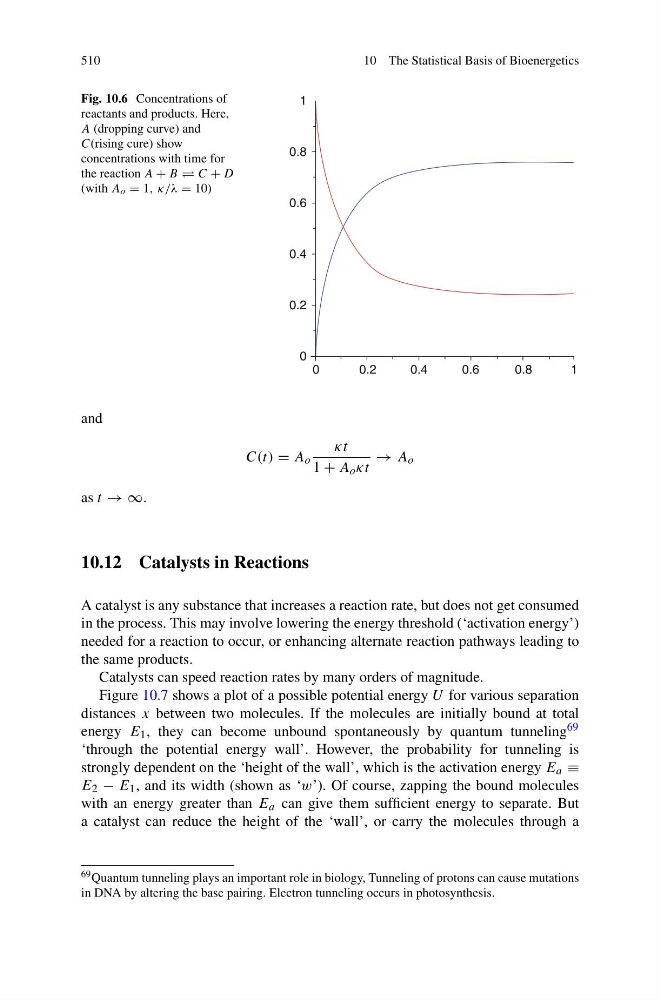
Fig. 10.6 Concentrations of
reactants and products. Here,
A (dropping curve) and
C(rising cure) show
concentrations with time for
the reaction A + B C + D
(with A o = 1, κ/λ = 10)
0
0
0.2
0.4
0.6
0.8
1
0.2
0.4
0.6
0.8
1
and
C(t) = A o
κt
1 + A o κt
→ A o
as t → ∞.
10.12 Catalysts in Reactions
A catalyst is any substance that increases a reaction rate, but does not get consumed
in the process. This may involve lowering the energy threshold (‘activation energy’)
needed for a reaction to occur, or enhancing alternate reaction pathways leading to
the same products.
Catalysts can speed reaction rates by many orders of magnitude.
Figure 10.7 shows a plot of a possible potential energy U for various separation
distances x between two molecules. If the molecules are initially bound at total
energy E 1 , they can become unbound spontaneously by quantum tunneling 69
‘through the potential energy wall’. However, the probability for tunneling is
strongly dependent on the ‘height of the wall’, which is the activation energy E a ≡
E 2 − E 1 , and its width (shown as ‘w’). Of course, zapping the bound molecules
with an energy greater than E a can give them sufficient energy to separate. But
a catalyst can reduce the height of the ‘wall’, or carry the molecules through a
69 Quantum tunneling plays an important role in biology, Tunneling of protons can cause mutations
in DNA by altering the base pairing. Electron tunneling occurs in photosynthesis.
10 The Statistical Basis of Bioenergetics
Fig. 10.6 Concentrations of
reactants and products. Here,
A (dropping curve) and
C(rising cure) show
concentrations with time for
the reaction A + B C + D
(with A o = 1, κ/λ = 10)
0
0
0.2
0.4
0.6
0.8
1
0.2
0.4
0.6
0.8
1
and
C(t) = A o
κt
1 + A o κt
→ A o
as t → ∞.
10.12 Catalysts in Reactions
A catalyst is any substance that increases a reaction rate, but does not get consumed
in the process. This may involve lowering the energy threshold (‘activation energy’)
needed for a reaction to occur, or enhancing alternate reaction pathways leading to
the same products.
Catalysts can speed reaction rates by many orders of magnitude.
Figure 10.7 shows a plot of a possible potential energy U for various separation
distances x between two molecules. If the molecules are initially bound at total
energy E 1 , they can become unbound spontaneously by quantum tunneling 69
‘through the potential energy wall’. However, the probability for tunneling is
strongly dependent on the ‘height of the wall’, which is the activation energy E a ≡
E 2 − E 1 , and its width (shown as ‘w’). Of course, zapping the bound molecules
with an energy greater than E a can give them sufficient energy to separate. But
a catalyst can reduce the height of the ‘wall’, or carry the molecules through a
69 Quantum tunneling plays an important role in biology, Tunneling of protons can cause mutations
in DNA by altering the base pairing. Electron tunneling occurs in photosynthesis.