

508
10 The Statistical Basis of Bioenergetics
Note that the reaction ‘goes to near completion’ if the relative rate of loss of
A-type particles (κ) is much larger than the relative rate of conversion of B-type
particles (λ) back to A-type. Also, the lifetime for the conversion is proportional
to the inverse of the sum of the relative rates: (κ + λ) −1 . These observations are
expected.
10.11.2 Pair Reactions with Reverse Rates
Kinetic analytics for reactions of the form
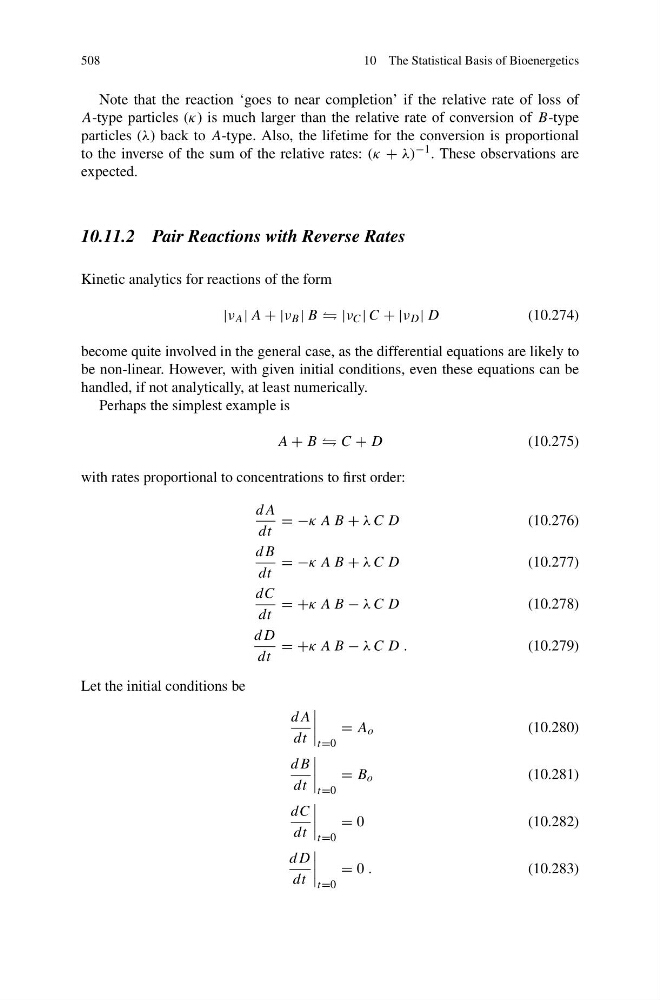
|ν A | A + |ν B | B |ν C | C + |ν D | D
(10.274)
become quite involved in the general case, as the differential equations are likely to
be non-linear. However, with given initial conditions, even these equations can be
handled, if not analytically, at least numerically.
Perhaps the simplest example is
A + B C + D
(10.275)
with rates proportional to concentrations to first order:
dA
dt
= −κ A B + λ C D
(10.276)
dB
dt
= −κ A B + λ C D
(10.277)
dC
dt
= +κ A B − λ C D
(10.278)
dD
dt
= +κ A B − λ C D .
(10.279)
Let the initial conditions be
dA
dt
t=0
= A o
(10.280)
dB
dt
t=0
= B o
(10.281)
dC
dt
t=0
= 0
(10.282)
dD
dt
t=0
= 0 .
(10.283)
10 The Statistical Basis of Bioenergetics
Note that the reaction ‘goes to near completion’ if the relative rate of loss of
A-type particles (κ) is much larger than the relative rate of conversion of B-type
particles (λ) back to A-type. Also, the lifetime for the conversion is proportional
to the inverse of the sum of the relative rates: (κ + λ) −1 . These observations are
expected.
10.11.2 Pair Reactions with Reverse Rates
Kinetic analytics for reactions of the form
|ν A | A + |ν B | B |ν C | C + |ν D | D
(10.274)
become quite involved in the general case, as the differential equations are likely to
be non-linear. However, with given initial conditions, even these equations can be
handled, if not analytically, at least numerically.
Perhaps the simplest example is
A + B C + D
(10.275)
with rates proportional to concentrations to first order:
dA
dt
= −κ A B + λ C D
(10.276)
dB
dt
= −κ A B + λ C D
(10.277)
dC
dt
= +κ A B − λ C D
(10.278)
dD
dt
= +κ A B − λ C D .
(10.279)
Let the initial conditions be
dA
dt
t=0
= A o
(10.280)
dB
dt
t=0
= B o
(10.281)
dC
dt
t=0
= 0
(10.282)
dD
dt
t=0
= 0 .
(10.283)