

10.11 Kinetic Theories for Chemical Reactions
507
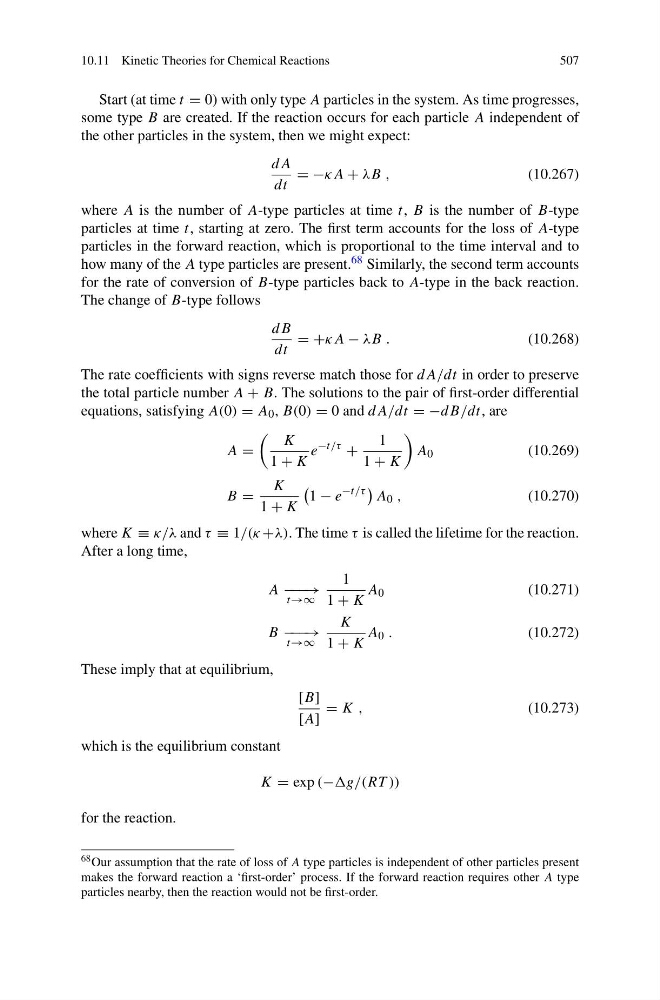
Start (at time t = 0) with only type A particles in the system. As time progresses,
some type B are created. If the reaction occurs for each particle A independent of
the other particles in the system, then we might expect:
dA
dt
= −κA + λB ,
(10.267)
where A is the number of A-type particles at time t, B is the number of B-type
particles at time t, starting at zero. The first term accounts for the loss of A-type
particles in the forward reaction, which is proportional to the time interval and to
how many of the A type particles are present. 68 Similarly, the second term accounts
for the rate of conversion of B-type particles back to A-type in the back reaction.
The change of B-type follows
dB
dt
= +κA − λB .
(10.268)
The rate coefficients with signs reverse match those for dA/dt in order to preserve
the total particle number A + B. The solutions to the pair of first-order differential
equations, satisfying A(0) = A 0 , B(0) = 0 and dA/dt = −dB/dt, are
A =
K
1 + K
e
−t/τ
+
1
1 + K
A 0
(10.269)
B =
K
1 + K
1 − e
−t/τ
A 0 ,
(10.270)
where K ≡ κ/λ and τ ≡ 1/(κ +λ). The time τ is called the lifetime for the reaction.
After a long time,
A − −− →
t→∞
1
1 + K
A 0
(10.271)
B − −− →
t→∞
K
1 + K
A 0 .
(10.272)
These imply that at equilibrium,
[B]
[A]
= K ,
(10.273)
which is the equilibrium constant
K = exp (−g/(RT ))
for the reaction.
68 Our assumption that the rate of loss of A type particles is independent of other particles present
makes the forward reaction a ‘first-order’ process. If the forward reaction requires other A type
particles nearby, then the reaction would not be first-order.
507
Start (at time t = 0) with only type A particles in the system. As time progresses,
some type B are created. If the reaction occurs for each particle A independent of
the other particles in the system, then we might expect:
dA
dt
= −κA + λB ,
(10.267)
where A is the number of A-type particles at time t, B is the number of B-type
particles at time t, starting at zero. The first term accounts for the loss of A-type
particles in the forward reaction, which is proportional to the time interval and to
how many of the A type particles are present. 68 Similarly, the second term accounts
for the rate of conversion of B-type particles back to A-type in the back reaction.
The change of B-type follows
dB
dt
= +κA − λB .
(10.268)
The rate coefficients with signs reverse match those for dA/dt in order to preserve
the total particle number A + B. The solutions to the pair of first-order differential
equations, satisfying A(0) = A 0 , B(0) = 0 and dA/dt = −dB/dt, are
A =
K
1 + K
e
−t/τ
+
1
1 + K
A 0
(10.269)
B =
K
1 + K
1 − e
−t/τ
A 0 ,
(10.270)
where K ≡ κ/λ and τ ≡ 1/(κ +λ). The time τ is called the lifetime for the reaction.
After a long time,
A − −− →
t→∞
1
1 + K
A 0
(10.271)
B − −− →
t→∞
K
1 + K
A 0 .
(10.272)
These imply that at equilibrium,
[B]
[A]
= K ,
(10.273)
which is the equilibrium constant
K = exp (−g/(RT ))
for the reaction.
68 Our assumption that the rate of loss of A type particles is independent of other particles present
makes the forward reaction a ‘first-order’ process. If the forward reaction requires other A type
particles nearby, then the reaction would not be first-order.