

10.10 Fluctuations
505
10.10.3 Correlations Between Fluctuations at Two Times
Fluctuations extend over time, so that if we know that at one time the fluctuation in
some thermodynamic variable, such as temperature, in some small subsystem, were
above the average, then if we pick a time short enough later, that thermodynamic
variable should still be high. After a relaxation time, this kind of correlation in time
should die out. These ideas are supported by the following.
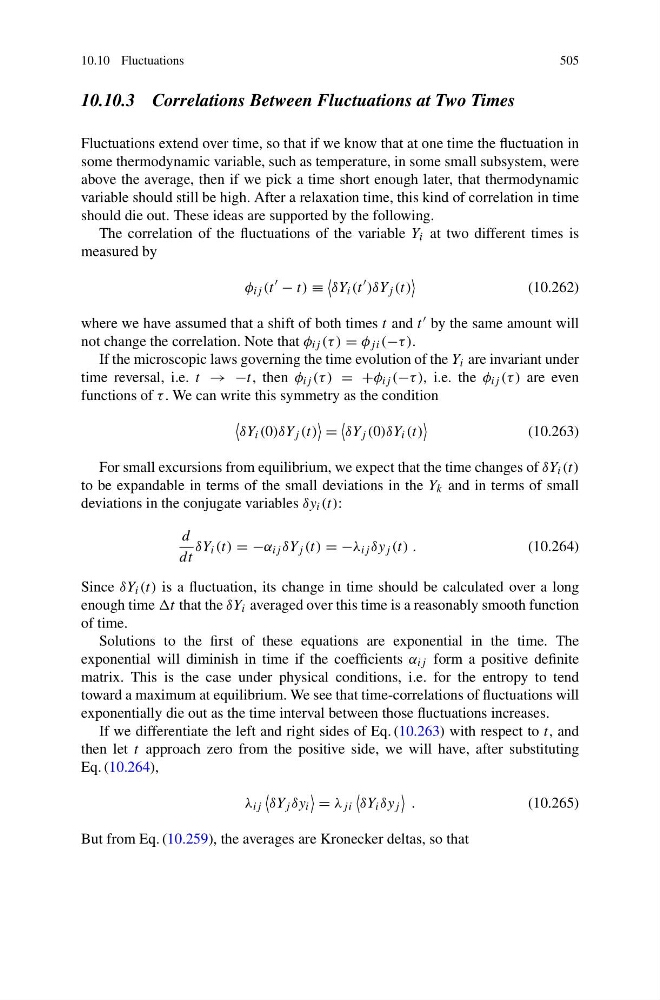
The correlation of the fluctuations of the variable Y i at two different times is
measured by
φ ij (t
− t) ≡
δY i (t
)δY j (t)
(10.262)
where we have assumed that a shift of both times t and t by the same amount will
not change the correlation. Note that φ ij (τ ) = φ ji (−τ ).
If the microscopic laws governing the time evolution of the Y i are invariant under
time reversal, i.e. t → −t, then φ ij (τ ) = +φ ij (−τ ), i.e. the φ ij (τ ) are even
functions of τ . We can write this symmetry as the condition
δY i (0)δY j (t)
=
δY j (0)δY i (t)
(10.263)
For small excursions from equilibrium, we expect that the time changes of δY i (t)
to be expandable in terms of the small deviations in the Y k and in terms of small
deviations in the conjugate variables δy i (t):
d
dt
δY i (t) = −α ij δY j (t) = −λ ij δy j (t) .
(10.264)
Since δY i (t) is a fluctuation, its change in time should be calculated over a long
enough time t that the δY i averaged over this time is a reasonably smooth function
of time.
Solutions to the first of these equations are exponential in the time. The
exponential will diminish in time if the coefficients α ij form a positive definite
matrix. This is the case under physical conditions, i.e. for the entropy to tend
toward a maximum at equilibrium. We see that time-correlations of fluctuations will
exponentially die out as the time interval between those fluctuations increases.
If we differentiate the left and right sides of Eq. (10.263) with respect to t, and
then let t approach zero from the positive side, we will have, after substituting
Eq. (10.264),
λ ij
δY j δy i
= λ ji
δY i δy j
.
(10.265)
But from Eq. (10.259), the averages are Kronecker deltas, so that
505
10.10.3 Correlations Between Fluctuations at Two Times
Fluctuations extend over time, so that if we know that at one time the fluctuation in
some thermodynamic variable, such as temperature, in some small subsystem, were
above the average, then if we pick a time short enough later, that thermodynamic
variable should still be high. After a relaxation time, this kind of correlation in time
should die out. These ideas are supported by the following.
The correlation of the fluctuations of the variable Y i at two different times is
measured by
φ ij (t
− t) ≡
δY i (t
)δY j (t)
(10.262)
where we have assumed that a shift of both times t and t by the same amount will
not change the correlation. Note that φ ij (τ ) = φ ji (−τ ).
If the microscopic laws governing the time evolution of the Y i are invariant under
time reversal, i.e. t → −t, then φ ij (τ ) = +φ ij (−τ ), i.e. the φ ij (τ ) are even
functions of τ . We can write this symmetry as the condition
δY i (0)δY j (t)
=
δY j (0)δY i (t)
(10.263)
For small excursions from equilibrium, we expect that the time changes of δY i (t)
to be expandable in terms of the small deviations in the Y k and in terms of small
deviations in the conjugate variables δy i (t):
d
dt
δY i (t) = −α ij δY j (t) = −λ ij δy j (t) .
(10.264)
Since δY i (t) is a fluctuation, its change in time should be calculated over a long
enough time t that the δY i averaged over this time is a reasonably smooth function
of time.
Solutions to the first of these equations are exponential in the time. The
exponential will diminish in time if the coefficients α ij form a positive definite
matrix. This is the case under physical conditions, i.e. for the entropy to tend
toward a maximum at equilibrium. We see that time-correlations of fluctuations will
exponentially die out as the time interval between those fluctuations increases.
If we differentiate the left and right sides of Eq. (10.263) with respect to t, and
then let t approach zero from the positive side, we will have, after substituting
Eq. (10.264),
λ ij
δY j δy i
= λ ji
δY i δy j
.
(10.265)
But from Eq. (10.259), the averages are Kronecker deltas, so that