

504
10 The Statistical Basis of Bioenergetics
We see that the root-mean-square fluctuations in the internal energy per particle
decreases with N as the inverse square root of N . 66 The behavior E ∝ E/
√
N is
typical of RMS fluctuations in a large system of particles near equilibrium, except
when collective effects become important, such as during condensation of a gas or
the freezing of a liquid.
10.10.2 Correlations Between Fluctuations at One Time
We should expect that in a system near thermodynamic equilibrium, fluctuations in
temperature will be associated with fluctuations in pressure. The two fluctuations
are correlated. Statistically, if the fluctuations in the variables have no connection,
then the average of their product should vanish. If not, we say the variables are
correlated.
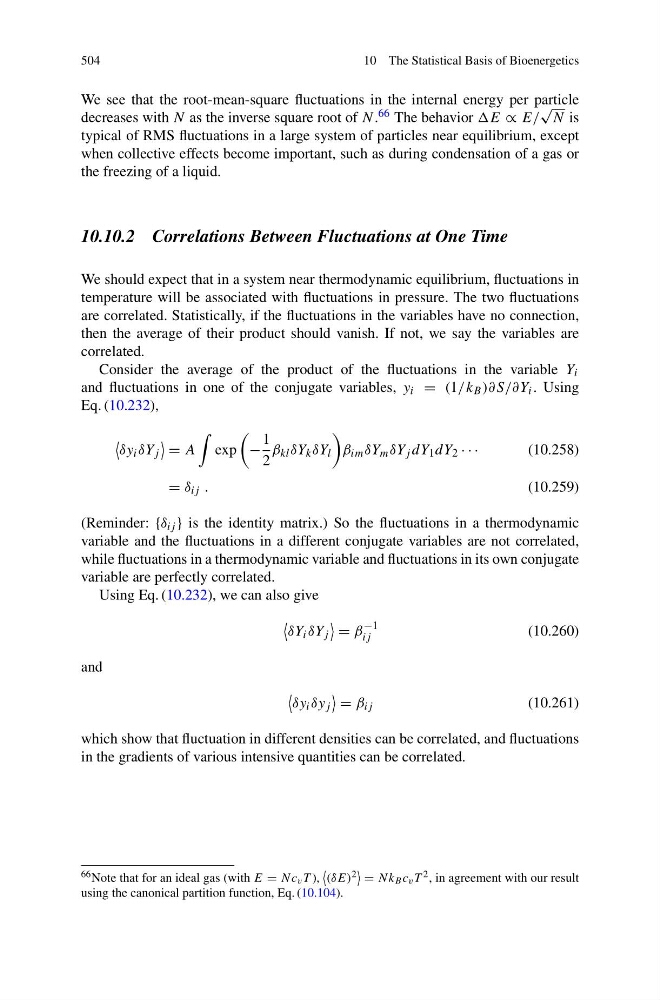
Consider the average of the product of the fluctuations in the variable Y i
and fluctuations in one of the conjugate variables, y i = (1/k B )∂S/∂Y i . Using
Eq. (10.232),
δy i δY j
= A
exp
−
1
2
β kl δY k δY l
β im δY m δY j dY 1 dY 2 · · ·
(10.258)
= δ ij .
(10.259)
(Reminder: {δ ij } is the identity matrix.) So the fluctuations in a thermodynamic
variable and the fluctuations in a different conjugate variables are not correlated,
while fluctuations in a thermodynamic variable and fluctuations in its own conjugate
variable are perfectly correlated.
Using Eq. (10.232), we can also give
δY i δY j
= β
−1
ij
(10.260)
and
δy i δy j
= β ij
(10.261)
which show that fluctuation in different densities can be correlated, and fluctuations
in the gradients of various intensive quantities can be correlated.
66 Note that for an ideal gas (with E = Nc v T ),
(δE) 2 = Nk B c v T 2 , in agreement with our result
using the canonical partition function, Eq. (10.104).
10 The Statistical Basis of Bioenergetics
We see that the root-mean-square fluctuations in the internal energy per particle
decreases with N as the inverse square root of N . 66 The behavior E ∝ E/
√
N is
typical of RMS fluctuations in a large system of particles near equilibrium, except
when collective effects become important, such as during condensation of a gas or
the freezing of a liquid.
10.10.2 Correlations Between Fluctuations at One Time
We should expect that in a system near thermodynamic equilibrium, fluctuations in
temperature will be associated with fluctuations in pressure. The two fluctuations
are correlated. Statistically, if the fluctuations in the variables have no connection,
then the average of their product should vanish. If not, we say the variables are
correlated.
Consider the average of the product of the fluctuations in the variable Y i
and fluctuations in one of the conjugate variables, y i = (1/k B )∂S/∂Y i . Using
Eq. (10.232),
δy i δY j
= A
exp
−
1
2
β kl δY k δY l
β im δY m δY j dY 1 dY 2 · · ·
(10.258)
= δ ij .
(10.259)
(Reminder: {δ ij } is the identity matrix.) So the fluctuations in a thermodynamic
variable and the fluctuations in a different conjugate variables are not correlated,
while fluctuations in a thermodynamic variable and fluctuations in its own conjugate
variable are perfectly correlated.
Using Eq. (10.232), we can also give
δY i δY j
= β
−1
ij
(10.260)
and
δy i δy j
= β ij
(10.261)
which show that fluctuation in different densities can be correlated, and fluctuations
in the gradients of various intensive quantities can be correlated.
66 Note that for an ideal gas (with E = Nc v T ),
(δE) 2 = Nk B c v T 2 , in agreement with our result
using the canonical partition function, Eq. (10.104).