

498
10 The Statistical Basis of Bioenergetics
than a solid clump. They found how the activity of each ion can be related to its
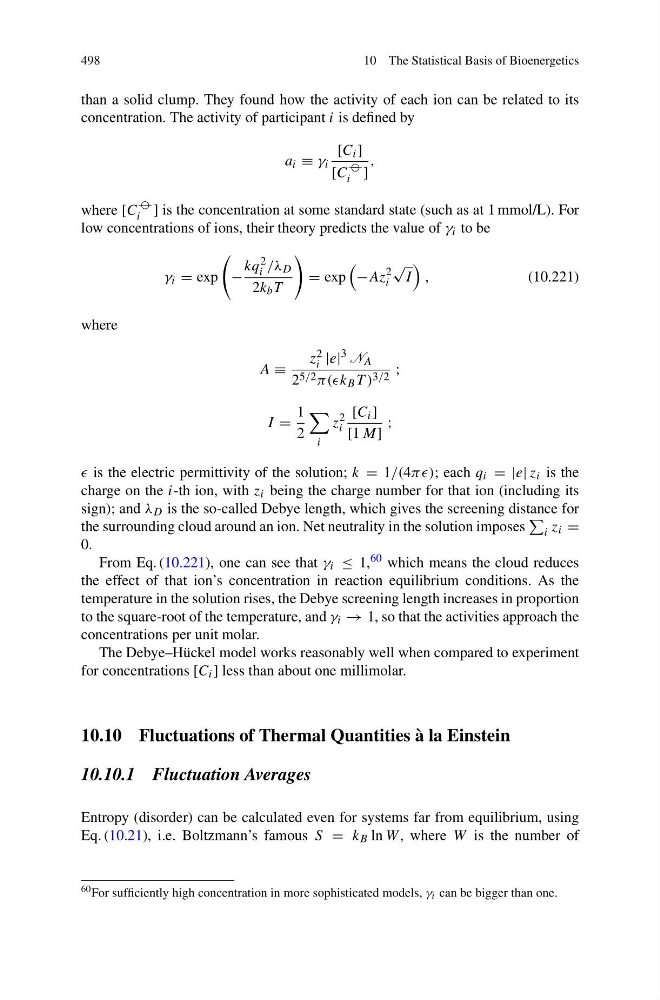
concentration. The activity of participant i is defined by
a i ≡ γ i
[C i ]
[C
− −
i ]
,
where [C
− −
i ] is the concentration at some standard state (such as at 1 mmol/L). For
low concentrations of ions, their theory predicts the value of γ i to be
γ i = exp
−
kq 2
i /λ D
2k b T
= exp
−Az
2
i
√
I
,
(10.221)
where
A ≡
z 2
i |e| 3 N A
2 5/2 π((k B T ) 3/2 ;
I =
1
2
i
z
2
i
[C i ]
[1 M]
;
is the electric permittivity of the solution; k = 1/(4ππ); each q i = |e| z i is the
charge on the i-th ion, with z i being the charge number for that ion (including its
sign); and λ D is the so-called Debye length, which gives the screening distance for
the surrounding cloud around an ion. Net neutrality in the solution imposes
i z i =
0.
From Eq. (10.221), one can see that γ i ≤ 1, 60 which means the cloud reduces
the effect of that ion’s concentration in reaction equilibrium conditions. As the
temperature in the solution rises, the Debye screening length increases in proportion
to the square-root of the temperature, and γ i → 1, so that the activities approach the
concentrations per unit molar.
The Debye–Hückel model works reasonably well when compared to experiment
for concentrations [C i ] less than about one millimolar.
10.10 Fluctuations of Thermal Quantities à la Einstein
10.10.1 Fluctuation Averages
Entropy (disorder) can be calculated even for systems far from equilibrium, using
Eq. (10.21), i.e. Boltzmann’s famous S = k B ln W , where W is the number of
60 For sufficiently high concentration in more sophisticated models, γ i can be bigger than one.
10 The Statistical Basis of Bioenergetics
than a solid clump. They found how the activity of each ion can be related to its
concentration. The activity of participant i is defined by
a i ≡ γ i
[C i ]
[C
− −
i ]
,
where [C
− −
i ] is the concentration at some standard state (such as at 1 mmol/L). For
low concentrations of ions, their theory predicts the value of γ i to be
γ i = exp
−
kq 2
i /λ D
2k b T
= exp
−Az
2
i
√
I
,
(10.221)
where
A ≡
z 2
i |e| 3 N A
2 5/2 π((k B T ) 3/2 ;
I =
1
2
i
z
2
i
[C i ]
[1 M]
;
is the electric permittivity of the solution; k = 1/(4ππ); each q i = |e| z i is the
charge on the i-th ion, with z i being the charge number for that ion (including its
sign); and λ D is the so-called Debye length, which gives the screening distance for
the surrounding cloud around an ion. Net neutrality in the solution imposes
i z i =
0.
From Eq. (10.221), one can see that γ i ≤ 1, 60 which means the cloud reduces
the effect of that ion’s concentration in reaction equilibrium conditions. As the
temperature in the solution rises, the Debye screening length increases in proportion
to the square-root of the temperature, and γ i → 1, so that the activities approach the
concentrations per unit molar.
The Debye–Hückel model works reasonably well when compared to experiment
for concentrations [C i ] less than about one millimolar.
10.10 Fluctuations of Thermal Quantities à la Einstein
10.10.1 Fluctuation Averages
Entropy (disorder) can be calculated even for systems far from equilibrium, using
Eq. (10.21), i.e. Boltzmann’s famous S = k B ln W , where W is the number of
60 For sufficiently high concentration in more sophisticated models, γ i can be bigger than one.