

10.9 Statistics Applied to Biochemical Reactions
497
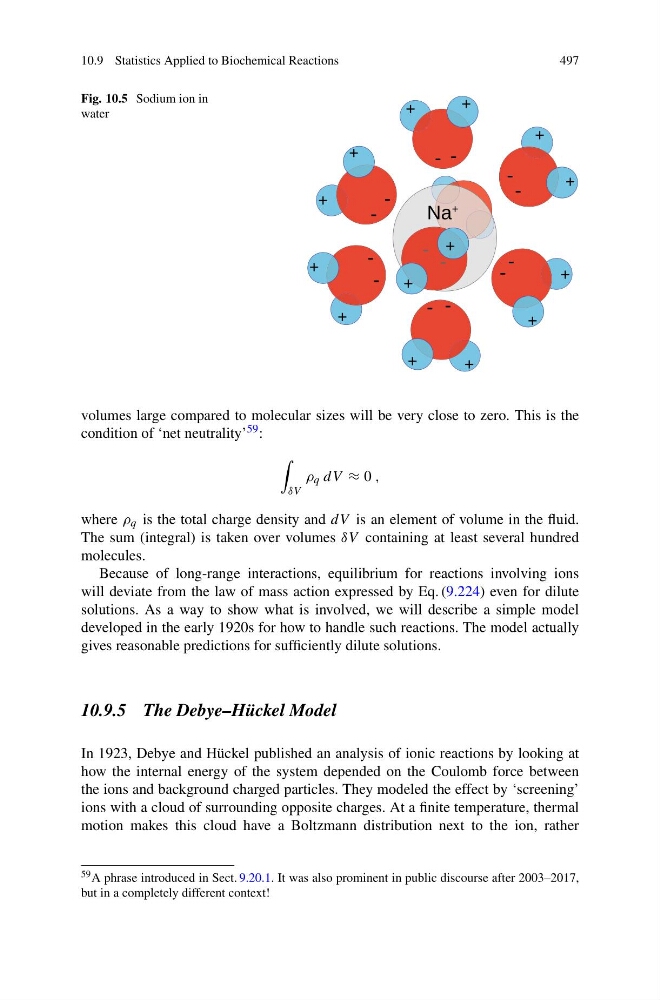
Fig. 10.5 Sodium ion in
water
volumes large compared to molecular sizes will be very close to zero. This is the
condition of ‘net neutrality’ 59 :
δV
ρ q dV ≈ 0 ,
where ρ q is the total charge density and dV is an element of volume in the fluid.
The sum (integral) is taken over volumes δV containing at least several hundred
molecules.
Because of long-range interactions, equilibrium for reactions involving ions
will deviate from the law of mass action expressed by Eq. (9.224) even for dilute
solutions. As a way to show what is involved, we will describe a simple model
developed in the early 1920s for how to handle such reactions. The model actually
gives reasonable predictions for sufficiently dilute solutions.
10.9.5 The Debye–Hückel Model
In 1923, Debye and Hückel published an analysis of ionic reactions by looking at
how the internal energy of the system depended on the Coulomb force between
the ions and background charged particles. They modeled the effect by ‘screening’
ions with a cloud of surrounding opposite charges. At a finite temperature, thermal
motion makes this cloud have a Boltzmann distribution next to the ion, rather
59 A phrase introduced in Sect. 9.20.1. It was also prominent in public discourse after 2003–2017,
but in a completely different context!
497
Fig. 10.5 Sodium ion in
water
volumes large compared to molecular sizes will be very close to zero. This is the
condition of ‘net neutrality’ 59 :
δV
ρ q dV ≈ 0 ,
where ρ q is the total charge density and dV is an element of volume in the fluid.
The sum (integral) is taken over volumes δV containing at least several hundred
molecules.
Because of long-range interactions, equilibrium for reactions involving ions
will deviate from the law of mass action expressed by Eq. (9.224) even for dilute
solutions. As a way to show what is involved, we will describe a simple model
developed in the early 1920s for how to handle such reactions. The model actually
gives reasonable predictions for sufficiently dilute solutions.
10.9.5 The Debye–Hückel Model
In 1923, Debye and Hückel published an analysis of ionic reactions by looking at
how the internal energy of the system depended on the Coulomb force between
the ions and background charged particles. They modeled the effect by ‘screening’
ions with a cloud of surrounding opposite charges. At a finite temperature, thermal
motion makes this cloud have a Boltzmann distribution next to the ion, rather
59 A phrase introduced in Sect. 9.20.1. It was also prominent in public discourse after 2003–2017,
but in a completely different context!