

490
10 The Statistical Basis of Bioenergetics
=
N 1 ,N 2 ,···N M
∞
i=0
exp
⎛
⎝ β
⎛
⎝
M
J =1
μ J N J − E N 1 ,N 2 ,···N M ,i
⎞
⎠
⎞
⎠ , (10.188)
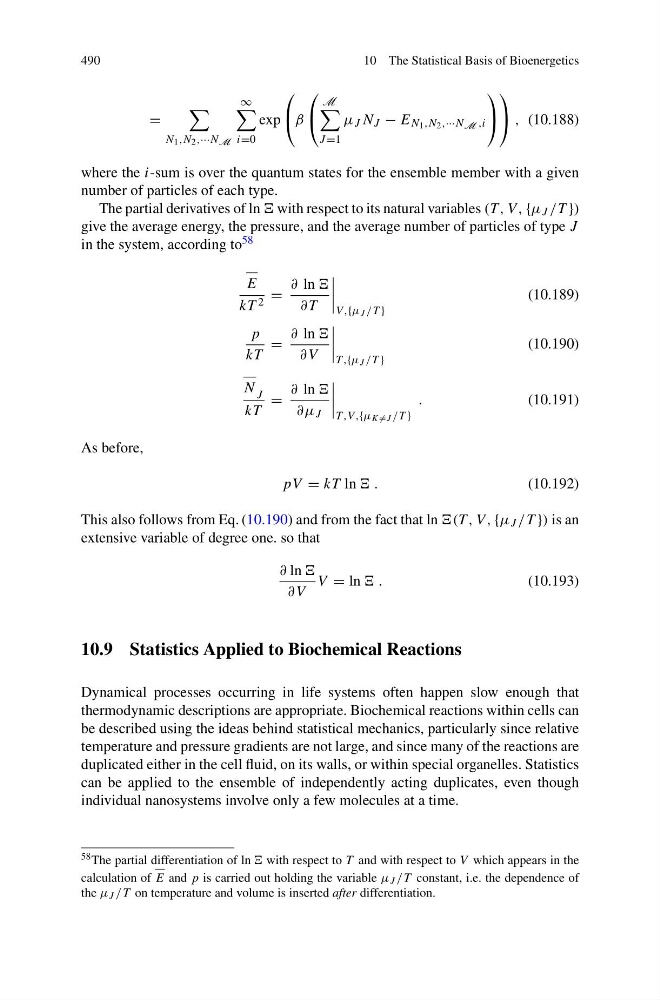
where the i-sum is over the quantum states for the ensemble member with a given
number of particles of each type.
The partial derivatives of ln with respect to its natural variables (T , V , {μ J /T })
give the average energy, the pressure, and the average number of particles of type J
in the system, according to 58
E
kT 2 =
∂ ln
∂T
V ,{μ J /T }
(10.189)
p
kT
=
∂ ln
∂V
T ,{μ J /T }
(10.190)
N J
kT
=
∂ ln
∂μ J
T ,V ,{μ K =J /T }
.
(10.191)
As before,
pV = kT ln .
(10.192)
This also follows from Eq. (10.190) and from the fact that ln (T , V , {μ J /T }) is an
extensive variable of degree one. so that
∂ ln
∂V
V = ln .
(10.193)
10.9 Statistics Applied to Biochemical Reactions
Dynamical processes occurring in life systems often happen slow enough that
thermodynamic descriptions are appropriate. Biochemical reactions within cells can
be described using the ideas behind statistical mechanics, particularly since relative
temperature and pressure gradients are not large, and since many of the reactions are
duplicated either in the cell fluid, on its walls, or within special organelles. Statistics
can be applied to the ensemble of independently acting duplicates, even though
individual nanosystems involve only a few molecules at a time.
58 The partial differentiation of ln with respect to T and with respect to V which appears in the
calculation of E and p is carried out holding the variable μ J /T constant, i.e. the dependence of
the μ J /T on temperature and volume is inserted after differentiation.
10 The Statistical Basis of Bioenergetics
=
N 1 ,N 2 ,···N M
∞
i=0
exp
⎛
⎝ β
⎛
⎝
M
J =1
μ J N J − E N 1 ,N 2 ,···N M ,i
⎞
⎠
⎞
⎠ , (10.188)
where the i-sum is over the quantum states for the ensemble member with a given
number of particles of each type.
The partial derivatives of ln with respect to its natural variables (T , V , {μ J /T })
give the average energy, the pressure, and the average number of particles of type J
in the system, according to 58
E
kT 2 =
∂ ln
∂T
V ,{μ J /T }
(10.189)
p
kT
=
∂ ln
∂V
T ,{μ J /T }
(10.190)
N J
kT
=
∂ ln
∂μ J
T ,V ,{μ K =J /T }
.
(10.191)
As before,
pV = kT ln .
(10.192)
This also follows from Eq. (10.190) and from the fact that ln (T , V , {μ J /T }) is an
extensive variable of degree one. so that
∂ ln
∂V
V = ln .
(10.193)
10.9 Statistics Applied to Biochemical Reactions
Dynamical processes occurring in life systems often happen slow enough that
thermodynamic descriptions are appropriate. Biochemical reactions within cells can
be described using the ideas behind statistical mechanics, particularly since relative
temperature and pressure gradients are not large, and since many of the reactions are
duplicated either in the cell fluid, on its walls, or within special organelles. Statistics
can be applied to the ensemble of independently acting duplicates, even though
individual nanosystems involve only a few molecules at a time.
58 The partial differentiation of ln with respect to T and with respect to V which appears in the
calculation of E and p is carried out holding the variable μ J /T constant, i.e. the dependence of
the μ J /T on temperature and volume is inserted after differentiation.