

10.8 The Partition Function for Ensembles
489
((N) 2
N
2
=
1
N
2
∂N
∂γ
T
=
k B T
V
1
ρ
∂ρ
∂p
T
=
k B T
N
ρ κ T ,
(10.183)
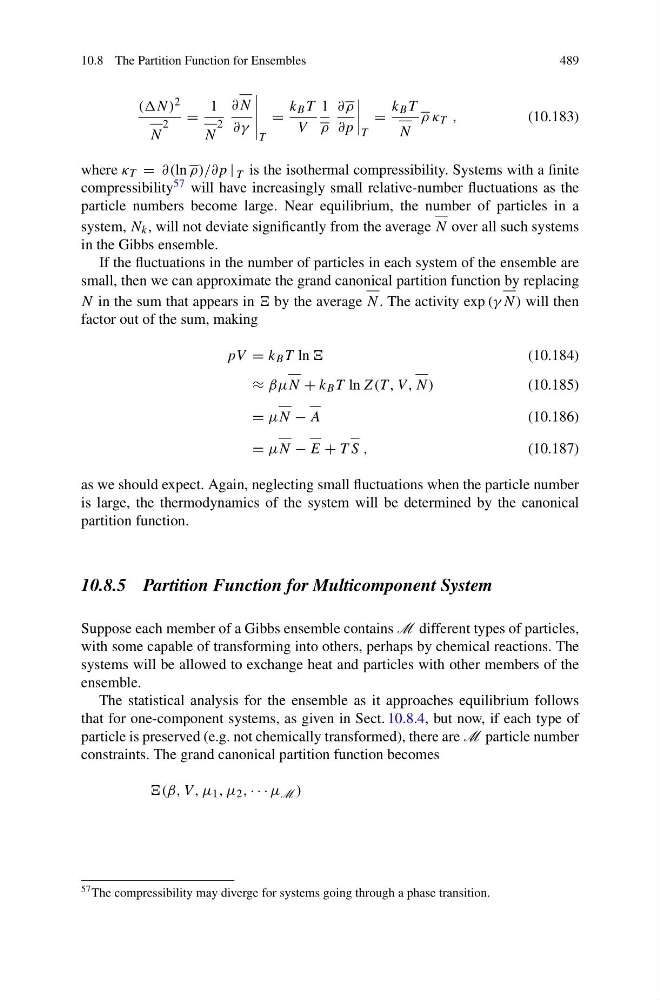
where κ T = ∂(ln ρ)/∂p | T is the isothermal compressibility. Systems with a finite
compressibility 57 will have increasingly small relative-number fluctuations as the
particle numbers become large. Near equilibrium, the number of particles in a
system, N k , will not deviate significantly from the average N over all such systems
in the Gibbs ensemble.
If the fluctuations in the number of particles in each system of the ensemble are
small, then we can approximate the grand canonical partition function by replacing
N in the sum that appears in by the average N . The activity exp (γ N) will then
factor out of the sum, making
pV = k B T ln
(10.184)
≈ βμN + k B T ln Z(T , V , N)
(10.185)
= μN − A
(10.186)
= μN − E + T S ,
(10.187)
as we should expect. Again, neglecting small fluctuations when the particle number
is large, the thermodynamics of the system will be determined by the canonical
partition function.
10.8.5 Partition Function for Multicomponent System
Suppose each member of a Gibbs ensemble contains M different types of particles,
with some capable of transforming into others, perhaps by chemical reactions. The
systems will be allowed to exchange heat and particles with other members of the
ensemble.
The statistical analysis for the ensemble as it approaches equilibrium follows
that for one-component systems, as given in Sect. 10.8.4, but now, if each type of
particle is preserved (e.g. not chemically transformed), there are M particle number
constraints. The grand canonical partition function becomes
(β, V , μ 1 , μ 2 , · · · μ M )
57 The compressibility may diverge for systems going through a phase transition.
489
((N) 2
N
2
=
1
N
2
∂N
∂γ
T
=
k B T
V
1
ρ
∂ρ
∂p
T
=
k B T
N
ρ κ T ,
(10.183)
where κ T = ∂(ln ρ)/∂p | T is the isothermal compressibility. Systems with a finite
compressibility 57 will have increasingly small relative-number fluctuations as the
particle numbers become large. Near equilibrium, the number of particles in a
system, N k , will not deviate significantly from the average N over all such systems
in the Gibbs ensemble.
If the fluctuations in the number of particles in each system of the ensemble are
small, then we can approximate the grand canonical partition function by replacing
N in the sum that appears in by the average N . The activity exp (γ N) will then
factor out of the sum, making
pV = k B T ln
(10.184)
≈ βμN + k B T ln Z(T , V , N)
(10.185)
= μN − A
(10.186)
= μN − E + T S ,
(10.187)
as we should expect. Again, neglecting small fluctuations when the particle number
is large, the thermodynamics of the system will be determined by the canonical
partition function.
10.8.5 Partition Function for Multicomponent System
Suppose each member of a Gibbs ensemble contains M different types of particles,
with some capable of transforming into others, perhaps by chemical reactions. The
systems will be allowed to exchange heat and particles with other members of the
ensemble.
The statistical analysis for the ensemble as it approaches equilibrium follows
that for one-component systems, as given in Sect. 10.8.4, but now, if each type of
particle is preserved (e.g. not chemically transformed), there are M particle number
constraints. The grand canonical partition function becomes
(β, V , μ 1 , μ 2 , · · · μ M )
57 The compressibility may diverge for systems going through a phase transition.