

486
10 The Statistical Basis of Bioenergetics
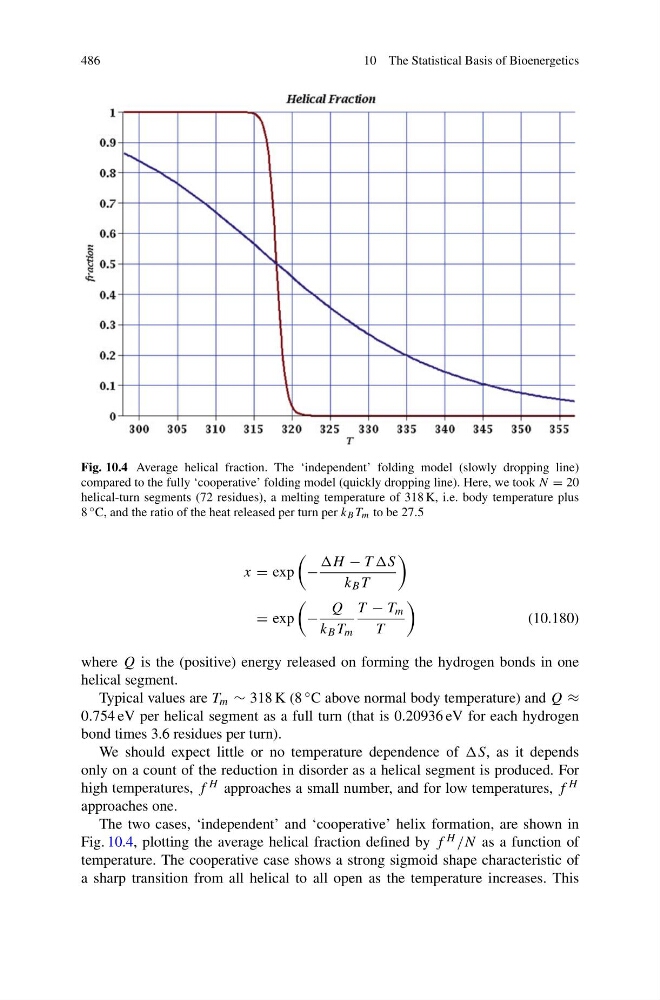
Fig. 10.4 Average helical fraction. The ‘independent’ folding model (slowly dropping line)
compared to the fully ‘cooperative’ folding model (quickly dropping line). Here, we took N = 20
helical-turn segments (72 residues), a melting temperature of 318 K, i.e. body temperature plus
8 ◦ C, and the ratio of the heat released per turn per k B T m to be 27.5
x = exp
−
H − T TS
k B T
= exp
−
Q
k B T m
T − T m
T
(10.180)
where Q is the (positive) energy released on forming the hydrogen bonds in one
helical segment.
Typical values are T m ∼ 318 K (8 ◦ C above normal body temperature) and Q ≈
0.754 eV per helical segment as a full turn (that is 0.20936 eV for each hydrogen
bond times 3.6 residues per turn).
We should expect little or no temperature dependence of S, as it depends
only on a count of the reduction in disorder as a helical segment is produced. For
high temperatures, f H approaches a small number, and for low temperatures, f H
approaches one.
The two cases, ‘independent’ and ‘cooperative’ helix formation, are shown in
Fig. 10.4, plotting the average helical fraction defined by f H /N as a function of
temperature. The cooperative case shows a strong sigmoid shape characteristic of
a sharp transition from all helical to all open as the temperature increases. This
10 The Statistical Basis of Bioenergetics
Fig. 10.4 Average helical fraction. The ‘independent’ folding model (slowly dropping line)
compared to the fully ‘cooperative’ folding model (quickly dropping line). Here, we took N = 20
helical-turn segments (72 residues), a melting temperature of 318 K, i.e. body temperature plus
8 ◦ C, and the ratio of the heat released per turn per k B T m to be 27.5
x = exp
−
H − T TS
k B T
= exp
−
Q
k B T m
T − T m
T
(10.180)
where Q is the (positive) energy released on forming the hydrogen bonds in one
helical segment.
Typical values are T m ∼ 318 K (8 ◦ C above normal body temperature) and Q ≈
0.754 eV per helical segment as a full turn (that is 0.20936 eV for each hydrogen
bond times 3.6 residues per turn).
We should expect little or no temperature dependence of S, as it depends
only on a count of the reduction in disorder as a helical segment is produced. For
high temperatures, f H approaches a small number, and for low temperatures, f H
approaches one.
The two cases, ‘independent’ and ‘cooperative’ helix formation, are shown in
Fig. 10.4, plotting the average helical fraction defined by f H /N as a function of
temperature. The cooperative case shows a strong sigmoid shape characteristic of
a sharp transition from all helical to all open as the temperature increases. This