

10.8 The Partition Function for Ensembles
485
above which the transition to an open chain configuration is favored, while below
that temperature, the formation of helical segments will be favored.
Suppose there are k ‘h’ regions on the chain. The number of ways of distributing
‘h’ segments in a chain with N smallest segments (which can form a helical
segment) will be N(N − 1)(N − 2) · · · (N − k + 1)/k! =
N
k
. Assuming the
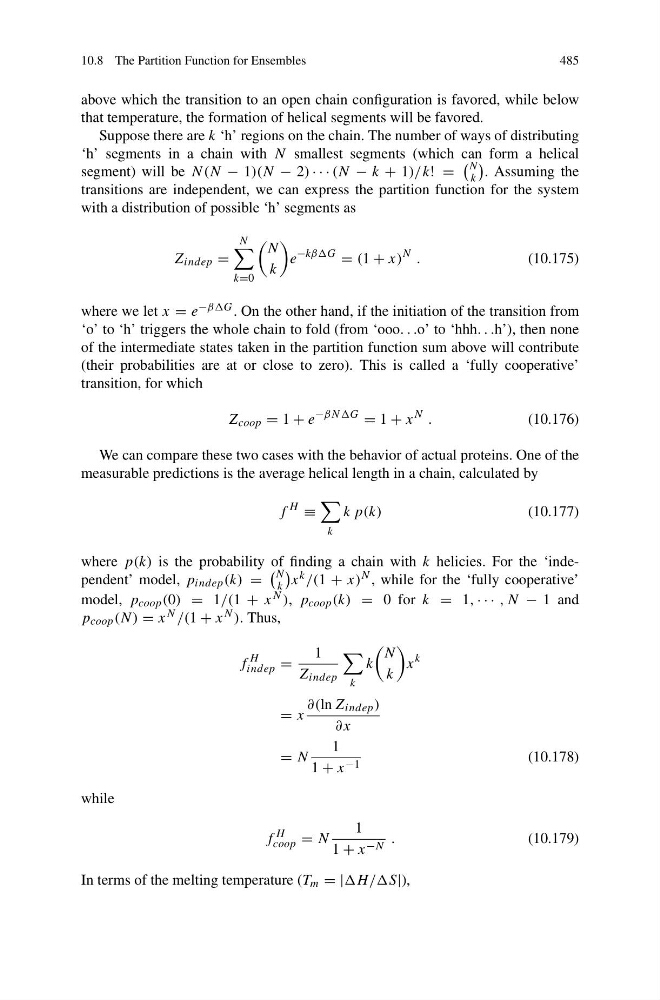
transitions are independent, we can express the partition function for the system
with a distribution of possible ‘h’ segments as
Z indep =
N
k=0
N
k
e
−kββG
= (1 + x)
N .
(10.175)
where we let x = e −ββG . On the other hand, if the initiation of the transition from
‘o’ to ‘h’ triggers the whole chain to fold (from ‘ooo. . .o’ to ‘hhh. . .h’), then none
of the intermediate states taken in the partition function sum above will contribute
(their probabilities are at or close to zero). This is called a ‘fully cooperative’
transition, for which
Z coop = 1 + e
−βNNG
= 1 + x
N .
(10.176)
We can compare these two cases with the behavior of actual proteins. One of the
measurable predictions is the average helical length in a chain, calculated by
f
H
≡
k
k p(k)
(10.177)
where p(k) is the probability of finding a chain with k helicies. For the ‘independent’ model, p indep (k) =
N
k
x k /(1 + x) N , while for the ‘fully cooperative’
model, p coop (0) = 1/(1 + x N ), p coop (k) = 0 for k = 1, · · · , N − 1 and
p coop (N) = x N /(1 + x N ). Thus,
f
H
indep =
1
Z indep
k
k
N
k
x
k
= x
∂(ln Z indep )
∂x
= N
1
1 + x −1
(10.178)
while
f
H
coop = N
1
1 + x −N .
(10.179)
In terms of the melting temperature (T m = | //S|),
485
above which the transition to an open chain configuration is favored, while below
that temperature, the formation of helical segments will be favored.
Suppose there are k ‘h’ regions on the chain. The number of ways of distributing
‘h’ segments in a chain with N smallest segments (which can form a helical
segment) will be N(N − 1)(N − 2) · · · (N − k + 1)/k! =
N
k
. Assuming the
transitions are independent, we can express the partition function for the system
with a distribution of possible ‘h’ segments as
Z indep =
N
k=0
N
k
e
−kββG
= (1 + x)
N .
(10.175)
where we let x = e −ββG . On the other hand, if the initiation of the transition from
‘o’ to ‘h’ triggers the whole chain to fold (from ‘ooo. . .o’ to ‘hhh. . .h’), then none
of the intermediate states taken in the partition function sum above will contribute
(their probabilities are at or close to zero). This is called a ‘fully cooperative’
transition, for which
Z coop = 1 + e
−βNNG
= 1 + x
N .
(10.176)
We can compare these two cases with the behavior of actual proteins. One of the
measurable predictions is the average helical length in a chain, calculated by
f
H
≡
k
k p(k)
(10.177)
where p(k) is the probability of finding a chain with k helicies. For the ‘independent’ model, p indep (k) =
N
k
x k /(1 + x) N , while for the ‘fully cooperative’
model, p coop (0) = 1/(1 + x N ), p coop (k) = 0 for k = 1, · · · , N − 1 and
p coop (N) = x N /(1 + x N ). Thus,
f
H
indep =
1
Z indep
k
k
N
k
x
k
= x
∂(ln Z indep )
∂x
= N
1
1 + x −1
(10.178)
while
f
H
coop = N
1
1 + x −N .
(10.179)
In terms of the melting temperature (T m = | //S|),