

10.3 Independent and Indistinguishable Particles
425
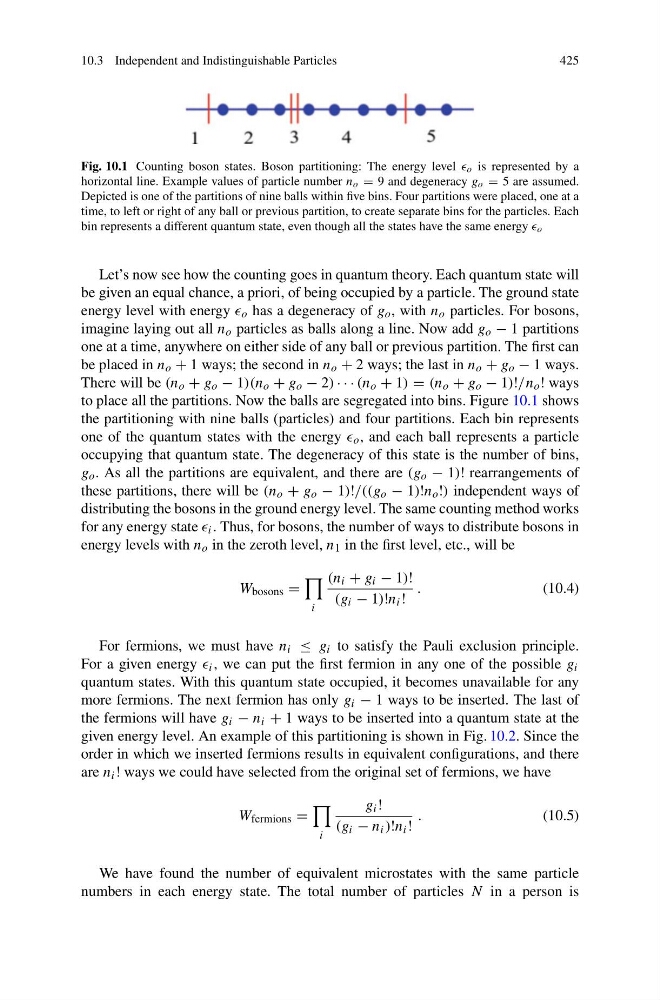
Fig. 10.1 Counting boson states. Boson partitioning: The energy level o is represented by a
horizontal line. Example values of particle number n o = 9 and degeneracy g o = 5 are assumed.
Depicted is one of the partitions of nine balls within five bins. Four partitions were placed, one at a
time, to left or right of any ball or previous partition, to create separate bins for the particles. Each
bin represents a different quantum state, even though all the states have the same energy o
Let’s now see how the counting goes in quantum theory. Each quantum state will
be given an equal chance, a priori, of being occupied by a particle. The ground state
energy level with energy o has a degeneracy of g o , with n o particles. For bosons,
imagine laying out all n o particles as balls along a line. Now add g o − 1 partitions
one at a time, anywhere on either side of any ball or previous partition. The first can
be placed in n o + 1 ways; the second in n o + 2 ways; the last in n o + g o − 1 ways.
There will be (n o + g o − 1)(n o + g o − 2) · · · (n o + 1) = (n o + g o − 1)!/n o ! ways
to place all the partitions. Now the balls are segregated into bins. Figure 10.1 shows
the partitioning with nine balls (particles) and four partitions. Each bin represents
one of the quantum states with the energy o , and each ball represents a particle
occupying that quantum state. The degeneracy of this state is the number of bins,
g o . As all the partitions are equivalent, and there are (g o − 1)! rearrangements of
these partitions, there will be (n o + g o − 1)!/((g o − 1)!n o !) independent ways of
distributing the bosons in the ground energy level. The same counting method works
for any energy state i . Thus, for bosons, the number of ways to distribute bosons in
energy levels with n o in the zeroth level, n 1 in the first level, etc., will be
W bosons =
i
(n i + g i − 1)!
(g i − 1)!n i !
.
(10.4)
For fermions, we must have n i ≤ g i to satisfy the Pauli exclusion principle.
For a given energy i , we can put the first fermion in any one of the possible g i
quantum states. With this quantum state occupied, it becomes unavailable for any
more fermions. The next fermion has only g i − 1 ways to be inserted. The last of
the fermions will have g i − n i + 1 ways to be inserted into a quantum state at the
given energy level. An example of this partitioning is shown in Fig. 10.2. Since the
order in which we inserted fermions results in equivalent configurations, and there
are n i ! ways we could have selected from the original set of fermions, we have
W fermions =
i
g i !
(g i − n i )!n i !
.
(10.5)
We have found the number of equivalent microstates with the same particle
numbers in each energy state. The total number of particles N in a person is
425
Fig. 10.1 Counting boson states. Boson partitioning: The energy level o is represented by a
horizontal line. Example values of particle number n o = 9 and degeneracy g o = 5 are assumed.
Depicted is one of the partitions of nine balls within five bins. Four partitions were placed, one at a
time, to left or right of any ball or previous partition, to create separate bins for the particles. Each
bin represents a different quantum state, even though all the states have the same energy o
Let’s now see how the counting goes in quantum theory. Each quantum state will
be given an equal chance, a priori, of being occupied by a particle. The ground state
energy level with energy o has a degeneracy of g o , with n o particles. For bosons,
imagine laying out all n o particles as balls along a line. Now add g o − 1 partitions
one at a time, anywhere on either side of any ball or previous partition. The first can
be placed in n o + 1 ways; the second in n o + 2 ways; the last in n o + g o − 1 ways.
There will be (n o + g o − 1)(n o + g o − 2) · · · (n o + 1) = (n o + g o − 1)!/n o ! ways
to place all the partitions. Now the balls are segregated into bins. Figure 10.1 shows
the partitioning with nine balls (particles) and four partitions. Each bin represents
one of the quantum states with the energy o , and each ball represents a particle
occupying that quantum state. The degeneracy of this state is the number of bins,
g o . As all the partitions are equivalent, and there are (g o − 1)! rearrangements of
these partitions, there will be (n o + g o − 1)!/((g o − 1)!n o !) independent ways of
distributing the bosons in the ground energy level. The same counting method works
for any energy state i . Thus, for bosons, the number of ways to distribute bosons in
energy levels with n o in the zeroth level, n 1 in the first level, etc., will be
W bosons =
i
(n i + g i − 1)!
(g i − 1)!n i !
.
(10.4)
For fermions, we must have n i ≤ g i to satisfy the Pauli exclusion principle.
For a given energy i , we can put the first fermion in any one of the possible g i
quantum states. With this quantum state occupied, it becomes unavailable for any
more fermions. The next fermion has only g i − 1 ways to be inserted. The last of
the fermions will have g i − n i + 1 ways to be inserted into a quantum state at the
given energy level. An example of this partitioning is shown in Fig. 10.2. Since the
order in which we inserted fermions results in equivalent configurations, and there
are n i ! ways we could have selected from the original set of fermions, we have
W fermions =
i
g i !
(g i − n i )!n i !
.
(10.5)
We have found the number of equivalent microstates with the same particle
numbers in each energy state. The total number of particles N in a person is