

9.21 Biochemical Reactions
403
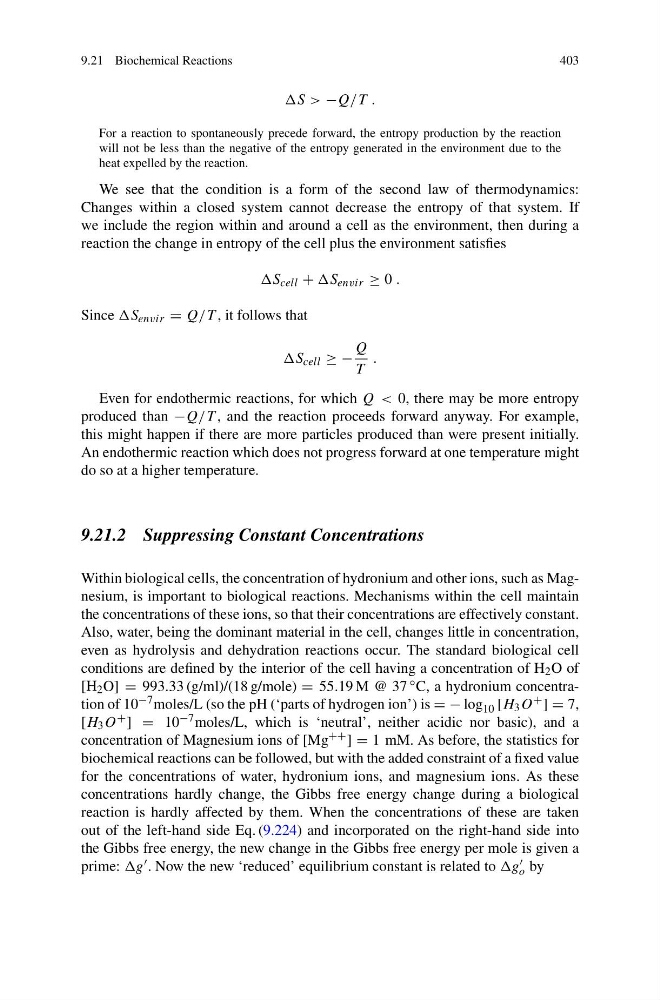
> −Q/T .
For a reaction to spontaneously precede forward, the entropy production by the reaction
will not be less than the negative of the entropy generated in the environment due to the
heat expelled by the reaction.
We see that the condition is a form of the second law of thermodynamics:
Changes within a closed system cannot decrease the entropy of that system. If
we include the region within and around a cell as the environment, then during a
reaction the change in entropy of the cell plus the environment satisfies
S cell + S envir ≥ 0 .
Since S envir = Q/T , it follows that
S cell ≥ −
Q
T
.
Even for endothermic reactions, for which Q < 0, there may be more entropy
produced than −Q/T , and the reaction proceeds forward anyway. For example,
this might happen if there are more particles produced than were present initially.
An endothermic reaction which does not progress forward at one temperature might
do so at a higher temperature.
9.21.2 Suppressing Constant Concentrations
Within biological cells, the concentration of hydronium and other ions, such as Magnesium, is important to biological reactions. Mechanisms within the cell maintain
the concentrations of these ions, so that their concentrations are effectively constant.
Also, water, being the dominant material in the cell, changes little in concentration,
even as hydrolysis and dehydration reactions occur. The standard biological cell
conditions are defined by the interior of the cell having a concentration of H 2 O of
[H 2 O] = 993.33 (g/ml)/(18 g/mole) = 55.19 M @ 37 ◦ C, a hydronium concentration of 10 −7 moles/L (so the pH (‘parts of hydrogen ion’) is = − log 10 [H 3 O + ] = 7,
[H 3 O + ] = 10 −7 moles/L, which is ‘neutral’, neither acidic nor basic), and a
concentration of Magnesium ions of [Mg
++
] = 1 mM. As before, the statistics for
biochemical reactions can be followed, but with the added constraint of a fixed value
for the concentrations of water, hydronium ions, and magnesium ions. As these
concentrations hardly change, the Gibbs free energy change during a biological
reaction is hardly affected by them. When the concentrations of these are taken
out of the left-hand side Eq. (9.224) and incorporated on the right-hand side into
the Gibbs free energy, the new change in the Gibbs free energy per mole is given a
prime: g . Now the new ‘reduced’ equilibrium constant is related to g
o by
403
> −Q/T .
For a reaction to spontaneously precede forward, the entropy production by the reaction
will not be less than the negative of the entropy generated in the environment due to the
heat expelled by the reaction.
We see that the condition is a form of the second law of thermodynamics:
Changes within a closed system cannot decrease the entropy of that system. If
we include the region within and around a cell as the environment, then during a
reaction the change in entropy of the cell plus the environment satisfies
S cell + S envir ≥ 0 .
Since S envir = Q/T , it follows that
S cell ≥ −
Q
T
.
Even for endothermic reactions, for which Q < 0, there may be more entropy
produced than −Q/T , and the reaction proceeds forward anyway. For example,
this might happen if there are more particles produced than were present initially.
An endothermic reaction which does not progress forward at one temperature might
do so at a higher temperature.
9.21.2 Suppressing Constant Concentrations
Within biological cells, the concentration of hydronium and other ions, such as Magnesium, is important to biological reactions. Mechanisms within the cell maintain
the concentrations of these ions, so that their concentrations are effectively constant.
Also, water, being the dominant material in the cell, changes little in concentration,
even as hydrolysis and dehydration reactions occur. The standard biological cell
conditions are defined by the interior of the cell having a concentration of H 2 O of
[H 2 O] = 993.33 (g/ml)/(18 g/mole) = 55.19 M @ 37 ◦ C, a hydronium concentration of 10 −7 moles/L (so the pH (‘parts of hydrogen ion’) is = − log 10 [H 3 O + ] = 7,
[H 3 O + ] = 10 −7 moles/L, which is ‘neutral’, neither acidic nor basic), and a
concentration of Magnesium ions of [Mg
++
] = 1 mM. As before, the statistics for
biochemical reactions can be followed, but with the added constraint of a fixed value
for the concentrations of water, hydronium ions, and magnesium ions. As these
concentrations hardly change, the Gibbs free energy change during a biological
reaction is hardly affected by them. When the concentrations of these are taken
out of the left-hand side Eq. (9.224) and incorporated on the right-hand side into
the Gibbs free energy, the new change in the Gibbs free energy per mole is given a
prime: g . Now the new ‘reduced’ equilibrium constant is related to g
o by