

402
9 Bioenergetics
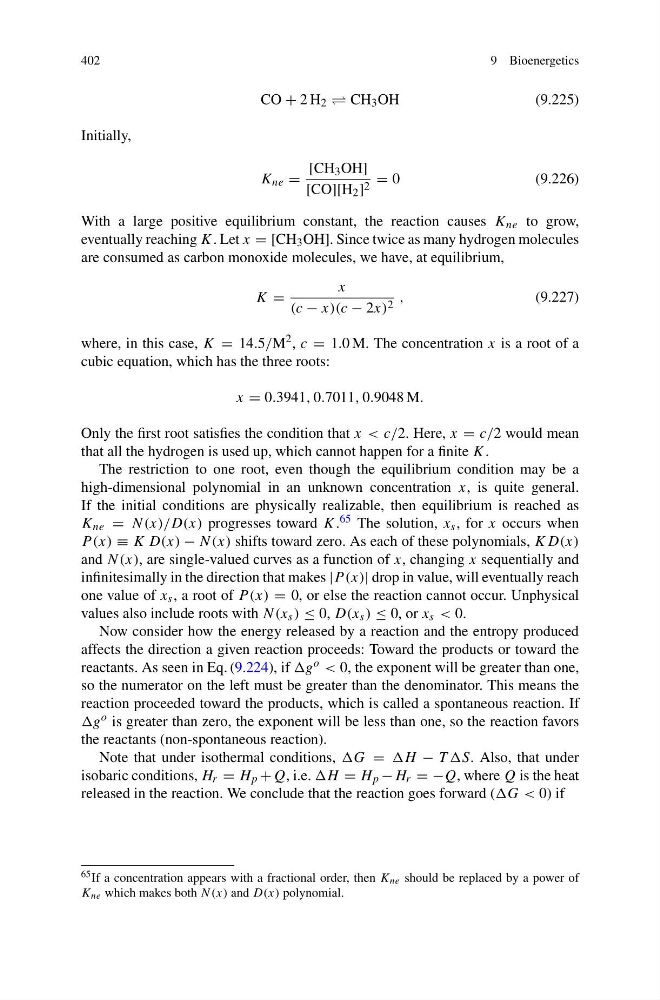
CO + 2 H 2 CH 3 OH
(9.225)
Initially,
K ne =
[CH 3 OH]
[CO][H 2 ] 2 = 0
(9.226)
With a large positive equilibrium constant, the reaction causes K ne to grow,
eventually reaching K. Let x = [CH 3 OH]. Since twice as many hydrogen molecules
are consumed as carbon monoxide molecules, we have, at equilibrium,
K =
x
(c − x)(c − 2x) 2 ,
(9.227)
where, in this case, K = 14.5/M
2 , c = 1.0 M. The concentration x is a root of a
cubic equation, which has the three roots:
x = 0.3941, 0.7011, 0.9048 M.
Only the first root satisfies the condition that x < c/2. Here, x = c/2 would mean
that all the hydrogen is used up, which cannot happen for a finite K.
The restriction to one root, even though the equilibrium condition may be a
high-dimensional polynomial in an unknown concentration x, is quite general.
If the initial conditions are physically realizable, then equilibrium is reached as
K ne = N(x)/D(x) progresses toward K. 65 The solution, x s , for x occurs when
P (x) ≡ K D(x) − N(x) shifts toward zero. As each of these polynomials, KD(x)
and N(x), are single-valued curves as a function of x, changing x sequentially and
infinitesimally in the direction that makes |P (x)| drop in value, will eventually reach
one value of x s , a root of P (x) = 0, or else the reaction cannot occur. Unphysical
values also include roots with N(x s ) ≤ 0, D(x s ) ≤ 0, or x s < 0.
Now consider how the energy released by a reaction and the entropy produced
affects the direction a given reaction proceeds: Toward the products or toward the
reactants. As seen in Eq. (9.224), if g o < 0, the exponent will be greater than one,
so the numerator on the left must be greater than the denominator. This means the
reaction proceeded toward the products, which is called a spontaneous reaction. If
g o is greater than zero, the exponent will be less than one, so the reaction favors
the reactants (non-spontaneous reaction).
Note that under isothermal conditions, G = H − T TS. Also, that under
isobaric conditions, H r = H p + Q, i.e. H = H p − H r = −Q, where Q is the heat
released in the reaction. We conclude that the reaction goes forward (G < 0) if
65 If a concentration appears with a fractional order, then K ne should be replaced by a power of
K ne which makes both N(x) and D(x) polynomial.
9 Bioenergetics
CO + 2 H 2 CH 3 OH
(9.225)
Initially,
K ne =
[CH 3 OH]
[CO][H 2 ] 2 = 0
(9.226)
With a large positive equilibrium constant, the reaction causes K ne to grow,
eventually reaching K. Let x = [CH 3 OH]. Since twice as many hydrogen molecules
are consumed as carbon monoxide molecules, we have, at equilibrium,
K =
x
(c − x)(c − 2x) 2 ,
(9.227)
where, in this case, K = 14.5/M
2 , c = 1.0 M. The concentration x is a root of a
cubic equation, which has the three roots:
x = 0.3941, 0.7011, 0.9048 M.
Only the first root satisfies the condition that x < c/2. Here, x = c/2 would mean
that all the hydrogen is used up, which cannot happen for a finite K.
The restriction to one root, even though the equilibrium condition may be a
high-dimensional polynomial in an unknown concentration x, is quite general.
If the initial conditions are physically realizable, then equilibrium is reached as
K ne = N(x)/D(x) progresses toward K. 65 The solution, x s , for x occurs when
P (x) ≡ K D(x) − N(x) shifts toward zero. As each of these polynomials, KD(x)
and N(x), are single-valued curves as a function of x, changing x sequentially and
infinitesimally in the direction that makes |P (x)| drop in value, will eventually reach
one value of x s , a root of P (x) = 0, or else the reaction cannot occur. Unphysical
values also include roots with N(x s ) ≤ 0, D(x s ) ≤ 0, or x s < 0.
Now consider how the energy released by a reaction and the entropy produced
affects the direction a given reaction proceeds: Toward the products or toward the
reactants. As seen in Eq. (9.224), if g o < 0, the exponent will be greater than one,
so the numerator on the left must be greater than the denominator. This means the
reaction proceeded toward the products, which is called a spontaneous reaction. If
g o is greater than zero, the exponent will be less than one, so the reaction favors
the reactants (non-spontaneous reaction).
Note that under isothermal conditions, G = H − T TS. Also, that under
isobaric conditions, H r = H p + Q, i.e. H = H p − H r = −Q, where Q is the heat
released in the reaction. We conclude that the reaction goes forward (G < 0) if
65 If a concentration appears with a fractional order, then K ne should be replaced by a power of
K ne which makes both N(x) and D(x) polynomial.