

9.21 Biochemical Reactions
399
μ i = k B T ln
p i
p o
+ μ
o
i (T )
(9.217)
where μ o
i (T ) is the chemical potential of the i-th component at pressure p io .
The p i is the partial pressure of the i-th component, defined by p i ≡ (N i /N )p.
Relation (9.217) is a generalization of Eq. (9.83) for a mixture of ideal gases. We
derived it using the Gibbs–Duhem relation.
For a mixture of ideal gases in a chemical reaction, or for substances in a dilute
solution acting like an ideal gas, the equilibrium condition now reads
μ i ν i = k B T
ν i ln
p i
p o
+
ν i μ
o
i = 0 .
(9.218)
Exponentiating, we have
i
p i
p o
ν i
= exp
−
ν i μ
o
i /(k B T )
= exp
−G
o /(k B T )
≡ K (T )
(9.219)
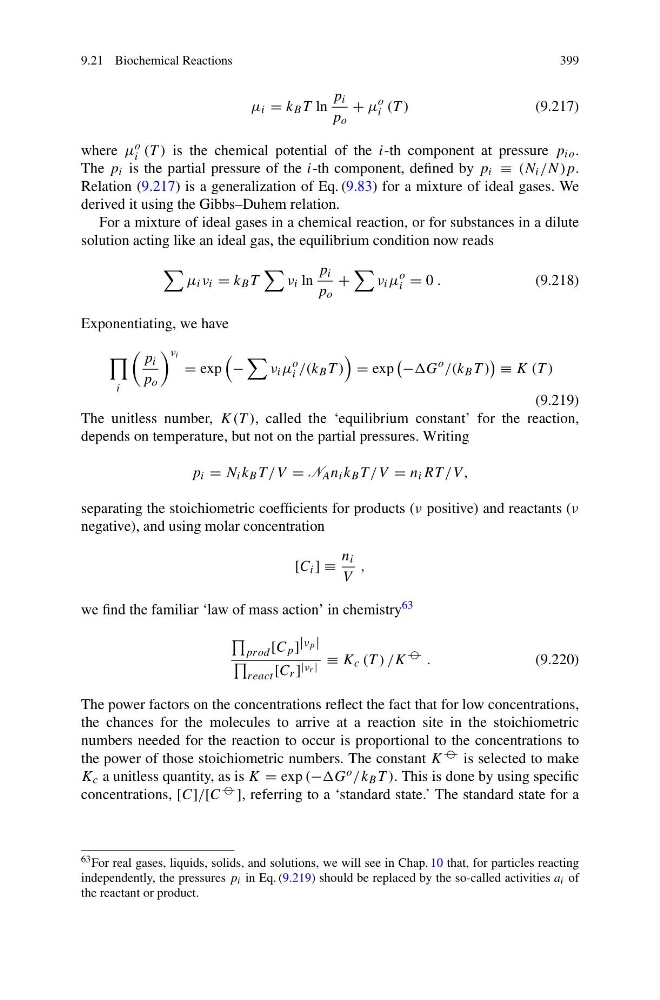
The unitless number, K(T ), called the ‘equilibrium constant’ for the reaction,
depends on temperature, but not on the partial pressures. Writing
p i = N i k B T /V = N A n i k B T /V = n i RT /V ,
separating the stoichiometric coefficients for products (ν positive) and reactants (ν
negative), and using molar concentration
[C i ] ≡
n i
V
,
we find the familiar ‘law of mass action’ in chemistry 63
prod [C p ] |νp|
react [C r ] |ν r | ≡ K c (T ) /K
− − .
(9.220)
The power factors on the concentrations reflect the fact that for low concentrations,
the chances for the molecules to arrive at a reaction site in the stoichiometric
numbers needed for the reaction to occur is proportional to the concentrations to
the power of those stoichiometric numbers. The constant K − − is selected to make
K c a unitless quantity, as is K = exp (−G o /k B T ). This is done by using specific
concentrations, [C]/[C − − ], referring to a ‘standard state.’ The standard state for a
63 For real gases, liquids, solids, and solutions, we will see in Chap. 10 that, for particles reacting
independently, the pressures p i in Eq. (9.219) should be replaced by the so-called activities a i of
the reactant or product.
399
μ i = k B T ln
p i
p o
+ μ
o
i (T )
(9.217)
where μ o
i (T ) is the chemical potential of the i-th component at pressure p io .
The p i is the partial pressure of the i-th component, defined by p i ≡ (N i /N )p.
Relation (9.217) is a generalization of Eq. (9.83) for a mixture of ideal gases. We
derived it using the Gibbs–Duhem relation.
For a mixture of ideal gases in a chemical reaction, or for substances in a dilute
solution acting like an ideal gas, the equilibrium condition now reads
μ i ν i = k B T
ν i ln
p i
p o
+
ν i μ
o
i = 0 .
(9.218)
Exponentiating, we have
i
p i
p o
ν i
= exp
−
ν i μ
o
i /(k B T )
= exp
−G
o /(k B T )
≡ K (T )
(9.219)
The unitless number, K(T ), called the ‘equilibrium constant’ for the reaction,
depends on temperature, but not on the partial pressures. Writing
p i = N i k B T /V = N A n i k B T /V = n i RT /V ,
separating the stoichiometric coefficients for products (ν positive) and reactants (ν
negative), and using molar concentration
[C i ] ≡
n i
V
,
we find the familiar ‘law of mass action’ in chemistry 63
prod [C p ] |νp|
react [C r ] |ν r | ≡ K c (T ) /K
− − .
(9.220)
The power factors on the concentrations reflect the fact that for low concentrations,
the chances for the molecules to arrive at a reaction site in the stoichiometric
numbers needed for the reaction to occur is proportional to the concentrations to
the power of those stoichiometric numbers. The constant K − − is selected to make
K c a unitless quantity, as is K = exp (−G o /k B T ). This is done by using specific
concentrations, [C]/[C − − ], referring to a ‘standard state.’ The standard state for a
63 For real gases, liquids, solids, and solutions, we will see in Chap. 10 that, for particles reacting
independently, the pressures p i in Eq. (9.219) should be replaced by the so-called activities a i of
the reactant or product.