

376
9 Bioenergetics
The total Gibbs free energy for the cell and the volume of surrounding water (the
‘bath’ water!) will be a sum of the energies for each subsystem:
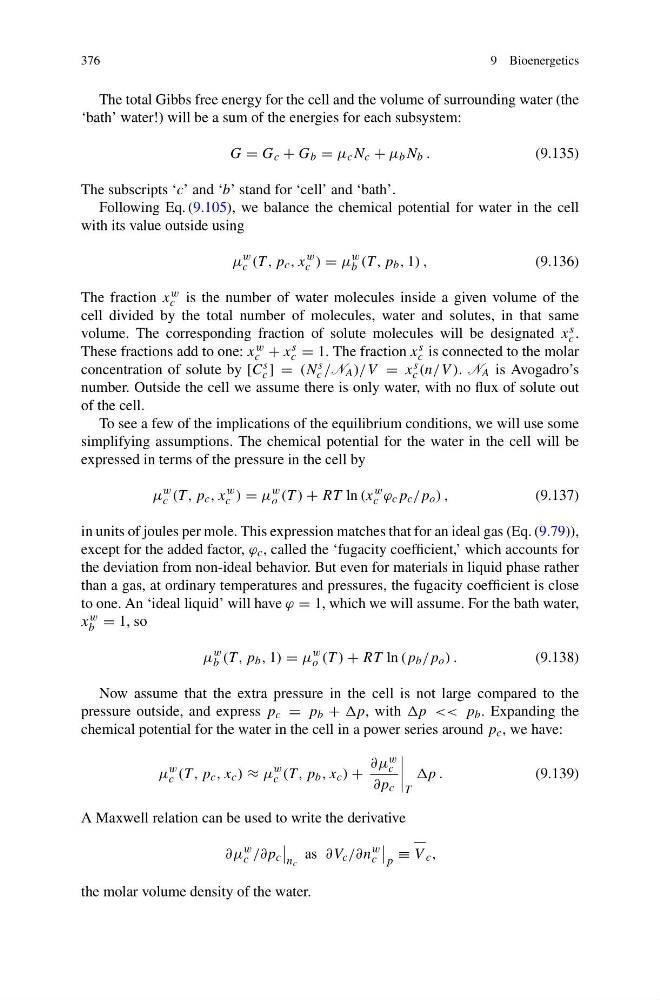
G = G c + G b = μ c N c + μ b N b .
(9.135)
The subscripts ‘c’ and ‘b’ stand for ‘cell’ and ‘bath’.
Following Eq. (9.105), we balance the chemical potential for water in the cell
with its value outside using
μ
w
c (T , p c , x
w
c ) = μ
w
b (T , p b , 1) ,
(9.136)
The fraction x w
c is the number of water molecules inside a given volume of the
cell divided by the total number of molecules, water and solutes, in that same
volume. The corresponding fraction of solute molecules will be designated x s
c .
These fractions add to one: x w
c + x s
c = 1. The fraction x s
c is connected to the molar
concentration of solute by [C s
c ] = (N s
c /N A )/V = x s
c (n/V ). N A is Avogadro’s
number. Outside the cell we assume there is only water, with no flux of solute out
of the cell.
To see a few of the implications of the equilibrium conditions, we will use some
simplifying assumptions. The chemical potential for the water in the cell will be
expressed in terms of the pressure in the cell by
μ
w
c (T , p c , x
w
c ) = μ
w
o (T ) + RT ln (x
w
c ϕ c p c /p o ) ,
(9.137)
in units of joules per mole. This expression matches that for an ideal gas (Eq. (9.79)),
except for the added factor, ϕ c , called the ‘fugacity coefficient,’ which accounts for
the deviation from non-ideal behavior. But even for materials in liquid phase rather
than a gas, at ordinary temperatures and pressures, the fugacity coefficient is close
to one. An ‘ideal liquid’ will have ϕ = 1, which we will assume. For the bath water,
x w
b = 1, so
μ
w
b (T , p b , 1) = μ
w
o (T ) + RT ln (p b /p o ) .
(9.138)
Now assume that the extra pressure in the cell is not large compared to the
pressure outside, and express p c = p b + p, with << p b . Expanding the
chemical potential for the water in the cell in a power series around p c , we have:
μ
w
c (T , p c , x c ) ≈ μ
w
c (T , p b , x c ) +
∂μ w
c
∂p c
T
p .
(9.139)
A Maxwell relation can be used to write the derivative
∂μ
w
c /∂p c
n c
as ∂V c /∂n
w
c
p
≡ V c ,
the molar volume density of the water.
9 Bioenergetics
The total Gibbs free energy for the cell and the volume of surrounding water (the
‘bath’ water!) will be a sum of the energies for each subsystem:
G = G c + G b = μ c N c + μ b N b .
(9.135)
The subscripts ‘c’ and ‘b’ stand for ‘cell’ and ‘bath’.
Following Eq. (9.105), we balance the chemical potential for water in the cell
with its value outside using
μ
w
c (T , p c , x
w
c ) = μ
w
b (T , p b , 1) ,
(9.136)
The fraction x w
c is the number of water molecules inside a given volume of the
cell divided by the total number of molecules, water and solutes, in that same
volume. The corresponding fraction of solute molecules will be designated x s
c .
These fractions add to one: x w
c + x s
c = 1. The fraction x s
c is connected to the molar
concentration of solute by [C s
c ] = (N s
c /N A )/V = x s
c (n/V ). N A is Avogadro’s
number. Outside the cell we assume there is only water, with no flux of solute out
of the cell.
To see a few of the implications of the equilibrium conditions, we will use some
simplifying assumptions. The chemical potential for the water in the cell will be
expressed in terms of the pressure in the cell by
μ
w
c (T , p c , x
w
c ) = μ
w
o (T ) + RT ln (x
w
c ϕ c p c /p o ) ,
(9.137)
in units of joules per mole. This expression matches that for an ideal gas (Eq. (9.79)),
except for the added factor, ϕ c , called the ‘fugacity coefficient,’ which accounts for
the deviation from non-ideal behavior. But even for materials in liquid phase rather
than a gas, at ordinary temperatures and pressures, the fugacity coefficient is close
to one. An ‘ideal liquid’ will have ϕ = 1, which we will assume. For the bath water,
x w
b = 1, so
μ
w
b (T , p b , 1) = μ
w
o (T ) + RT ln (p b /p o ) .
(9.138)
Now assume that the extra pressure in the cell is not large compared to the
pressure outside, and express p c = p b + p, with << p b . Expanding the
chemical potential for the water in the cell in a power series around p c , we have:
μ
w
c (T , p c , x c ) ≈ μ
w
c (T , p b , x c ) +
∂μ w
c
∂p c
T
p .
(9.139)
A Maxwell relation can be used to write the derivative
∂μ
w
c /∂p c
n c
as ∂V c /∂n
w
c
p
≡ V c ,
the molar volume density of the water.