

9.18 Vapor Pressure
369
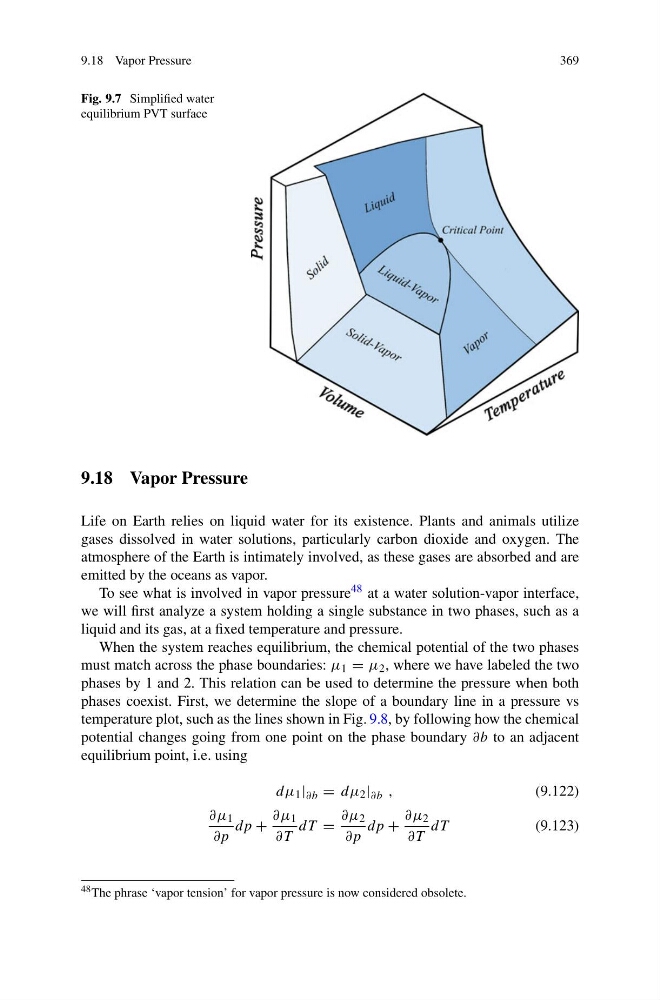
Fig. 9.7 Simplified water
equilibrium PVT surface
9.18 Vapor Pressure
Life on Earth relies on liquid water for its existence. Plants and animals utilize
gases dissolved in water solutions, particularly carbon dioxide and oxygen. The
atmosphere of the Earth is intimately involved, as these gases are absorbed and are
emitted by the oceans as vapor.
To see what is involved in vapor pressure 48 at a water solution-vapor interface,
we will first analyze a system holding a single substance in two phases, such as a
liquid and its gas, at a fixed temperature and pressure.
When the system reaches equilibrium, the chemical potential of the two phases
must match across the phase boundaries: μ 1 = μ 2 , where we have labeled the two
phases by 1 and 2. This relation can be used to determine the pressure when both
phases coexist. First, we determine the slope of a boundary line in a pressure vs
temperature plot, such as the lines shown in Fig. 9.8, by following how the chemical
potential changes going from one point on the phase boundary ∂b to an adjacent
equilibrium point, i.e. using
dμ 1 | ∂b = dμ 2 | ∂b ,
(9.122)
∂μ 1
∂p
dp +
∂μ 1
∂T
dT =
∂μ 2
∂p
dp +
∂μ 2
∂T
dT
(9.123)
48 The phrase ‘vapor tension’ for vapor pressure is now considered obsolete.
369
Fig. 9.7 Simplified water
equilibrium PVT surface
9.18 Vapor Pressure
Life on Earth relies on liquid water for its existence. Plants and animals utilize
gases dissolved in water solutions, particularly carbon dioxide and oxygen. The
atmosphere of the Earth is intimately involved, as these gases are absorbed and are
emitted by the oceans as vapor.
To see what is involved in vapor pressure 48 at a water solution-vapor interface,
we will first analyze a system holding a single substance in two phases, such as a
liquid and its gas, at a fixed temperature and pressure.
When the system reaches equilibrium, the chemical potential of the two phases
must match across the phase boundaries: μ 1 = μ 2 , where we have labeled the two
phases by 1 and 2. This relation can be used to determine the pressure when both
phases coexist. First, we determine the slope of a boundary line in a pressure vs
temperature plot, such as the lines shown in Fig. 9.8, by following how the chemical
potential changes going from one point on the phase boundary ∂b to an adjacent
equilibrium point, i.e. using
dμ 1 | ∂b = dμ 2 | ∂b ,
(9.122)
∂μ 1
∂p
dp +
∂μ 1
∂T
dT =
∂μ 2
∂p
dp +
∂μ 2
∂T
dT
(9.123)
48 The phrase ‘vapor tension’ for vapor pressure is now considered obsolete.