

9.10 The Laws of Thermodynamics
349
Now, because 0 ≤ E ≤ 1, we have 0 ≤ η ≤ 1. Also, T ≤ T H . Thus, with h positive,
f or all x > y, h(x) ≥ h (y) > 0, i.e. h(x) is any non-zero smooth non-decreasing
function of x.
To find h(T ), consider a reversible heat engine running with an ideal gas confined
by a cylinder, a fixed wall, and a piston. By slowly changing the gas along either
adiabatic or isothermal conditions, the process can be made reversible. One then
finds h(T ) is proportional to the temperature T .
Here’s the argument: For an ideal gas, the internal energy depends only on the
temperature of the gas
E = nc v T
(9.49)
(c v is the heat capacity per mole) and
pV = nRT
(9.50)
In general, the 1st Law of Thermodynamics, i.e. energy conservation for a system
exchanging heat and work with its environment, reads
dE = δQ − δW
(9.51)
But here E depends only on T . For any isothermal process of an idea gas, dE = 0,
so we must have
W = Q .
(9.52)
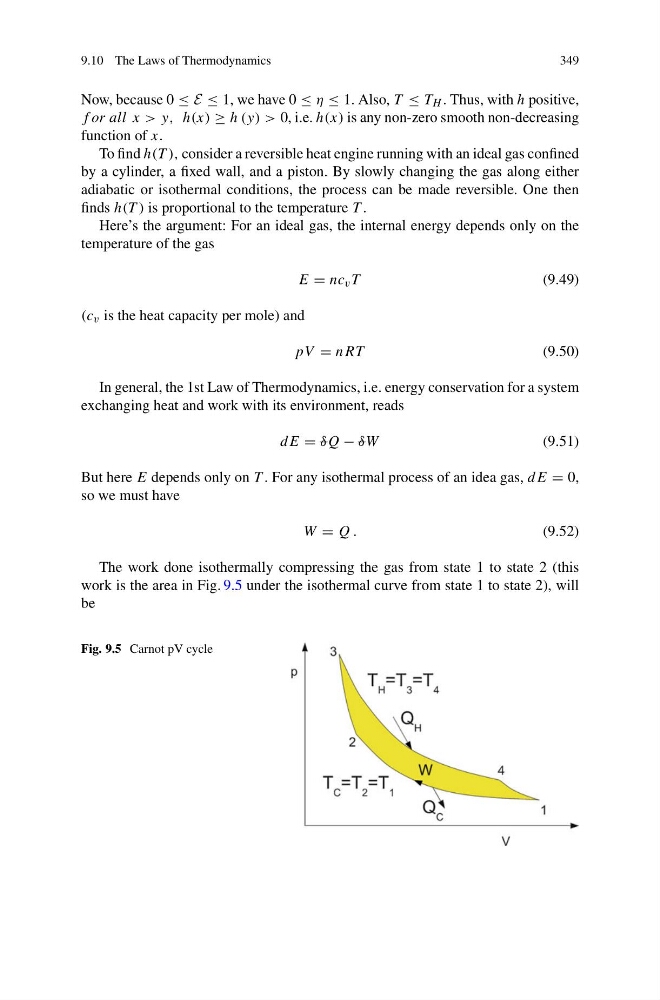
The work done isothermally compressing the gas from state 1 to state 2 (this
work is the area in Fig. 9.5 under the isothermal curve from state 1 to state 2), will
be
Fig. 9.5 Carnot pV cycle
349
Now, because 0 ≤ E ≤ 1, we have 0 ≤ η ≤ 1. Also, T ≤ T H . Thus, with h positive,
f or all x > y, h(x) ≥ h (y) > 0, i.e. h(x) is any non-zero smooth non-decreasing
function of x.
To find h(T ), consider a reversible heat engine running with an ideal gas confined
by a cylinder, a fixed wall, and a piston. By slowly changing the gas along either
adiabatic or isothermal conditions, the process can be made reversible. One then
finds h(T ) is proportional to the temperature T .
Here’s the argument: For an ideal gas, the internal energy depends only on the
temperature of the gas
E = nc v T
(9.49)
(c v is the heat capacity per mole) and
pV = nRT
(9.50)
In general, the 1st Law of Thermodynamics, i.e. energy conservation for a system
exchanging heat and work with its environment, reads
dE = δQ − δW
(9.51)
But here E depends only on T . For any isothermal process of an idea gas, dE = 0,
so we must have
W = Q .
(9.52)
The work done isothermally compressing the gas from state 1 to state 2 (this
work is the area in Fig. 9.5 under the isothermal curve from state 1 to state 2), will
be
Fig. 9.5 Carnot pV cycle