

348
9 Bioenergetics
E =
W 1 + W 2
Q H
=
Q H − Q C
Q H
= 1 −
Q C
Q H
(9.39)
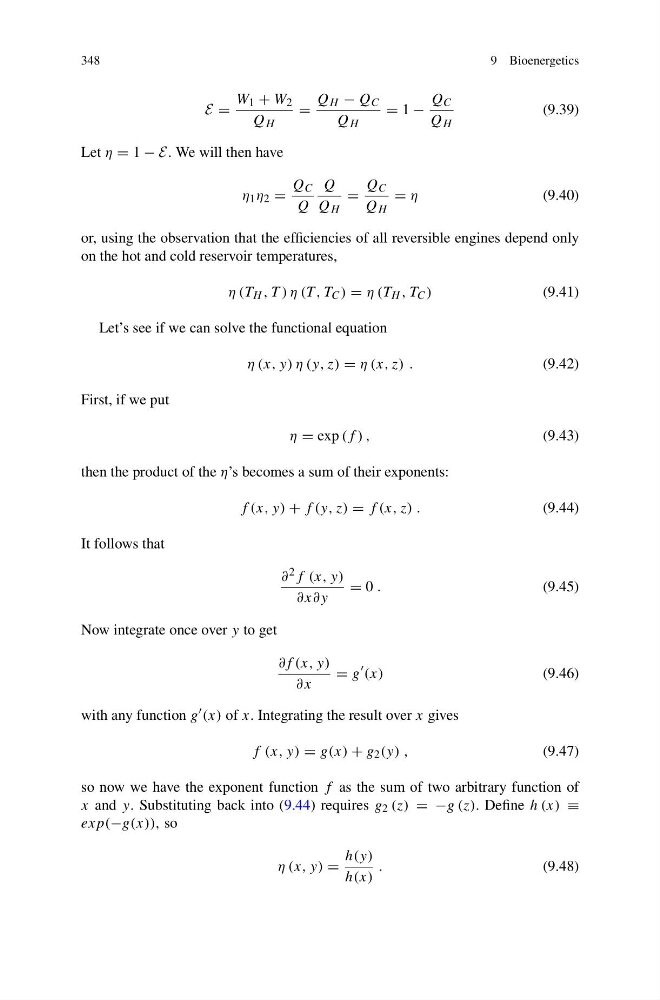
Let η = 1 − E. We will then have
η 1 η 2 =
Q C
Q
Q
Q H
=
Q C
Q H
= η
(9.40)
or, using the observation that the efficiencies of all reversible engines depend only
on the hot and cold reservoir temperatures,
η (T H , T ) η (T , T C ) = η (T H , T C )
(9.41)
Let’s see if we can solve the functional equation
η (x, y) η (y, z) = η (x, z) .
(9.42)
First, if we put
η = exp (f ) ,
(9.43)
then the product of the η’s becomes a sum of their exponents:
f (x, y) + f (y, z) = f (x, z) .
(9.44)
It follows that
∂ 2 f (x, y)
∂x∂y
= 0 .
(9.45)
Now integrate once over y to get
∂f (x, y)
∂x
= g
(x)
(9.46)
with any function g (x) of x. Integrating the result over x gives
f (x, y) = g(x) + g 2 (y) ,
(9.47)
so now we have the exponent function f as the sum of two arbitrary function of
x and y. Substituting back into (9.44) requires g 2 (z) = −g (z). Define h (x) ≡
exp(−g(x)), so
η (x, y) =
h(y)
h(x)
.
(9.48)
9 Bioenergetics
E =
W 1 + W 2
Q H
=
Q H − Q C
Q H
= 1 −
Q C
Q H
(9.39)
Let η = 1 − E. We will then have
η 1 η 2 =
Q C
Q
Q
Q H
=
Q C
Q H
= η
(9.40)
or, using the observation that the efficiencies of all reversible engines depend only
on the hot and cold reservoir temperatures,
η (T H , T ) η (T , T C ) = η (T H , T C )
(9.41)
Let’s see if we can solve the functional equation
η (x, y) η (y, z) = η (x, z) .
(9.42)
First, if we put
η = exp (f ) ,
(9.43)
then the product of the η’s becomes a sum of their exponents:
f (x, y) + f (y, z) = f (x, z) .
(9.44)
It follows that
∂ 2 f (x, y)
∂x∂y
= 0 .
(9.45)
Now integrate once over y to get
∂f (x, y)
∂x
= g
(x)
(9.46)
with any function g (x) of x. Integrating the result over x gives
f (x, y) = g(x) + g 2 (y) ,
(9.47)
so now we have the exponent function f as the sum of two arbitrary function of
x and y. Substituting back into (9.44) requires g 2 (z) = −g (z). Define h (x) ≡
exp(−g(x)), so
η (x, y) =
h(y)
h(x)
.
(9.48)