

338
9 Bioenergetics
If the temperature of our body is lowered much below 30 ◦ C (hypothermia),
muscles can no longer properly function. In deep hypothermia, the temperature
drops to below 20 ◦ C (but above 0 ◦ C). People can survive without breathing air
(but in an unconscious state) under water near 0 ◦ C for up to 45 min. Hypothermia
is sometimes used by surgeons to operate (for up to an hour) with a stopped heart
and brain. Temporary induced hypothermia can help preserve nerve cells when there
is trauma in the brain.
Above 42 ◦ C (hyperthermia), the central nervous system breaks down, and at
about 44 ◦ C, our free protein begins to undergo denaturalization, i.e. open from its
folded shape and lose function, causing death.
For warm-blooded animals, exposure to cold and wind adds to the chances
for hypothermia, since wind not only displaces the warmed air next to the body,
held by hair or clothing, but also increases skin evaporation, a cooling effect.
Meteorologists, as a way to warn of the dangers, have devised various ‘heat indices’,
‘feels like temperatures, and ‘wind chill’ indices to communicate the temperature a
human would perceive. 21
9.8 Basal Metabolic Rate
For humans, internal heat is generated by metabolic activity. Empirical formulae
have been devised for the ‘Basal Metabolism Rate’ applied to the average adult
human. The BMR is the rate of heat production dQ/dt in the body due to minimal
metabolism for life functions. Perhaps the simplest reasonably accurate empirical
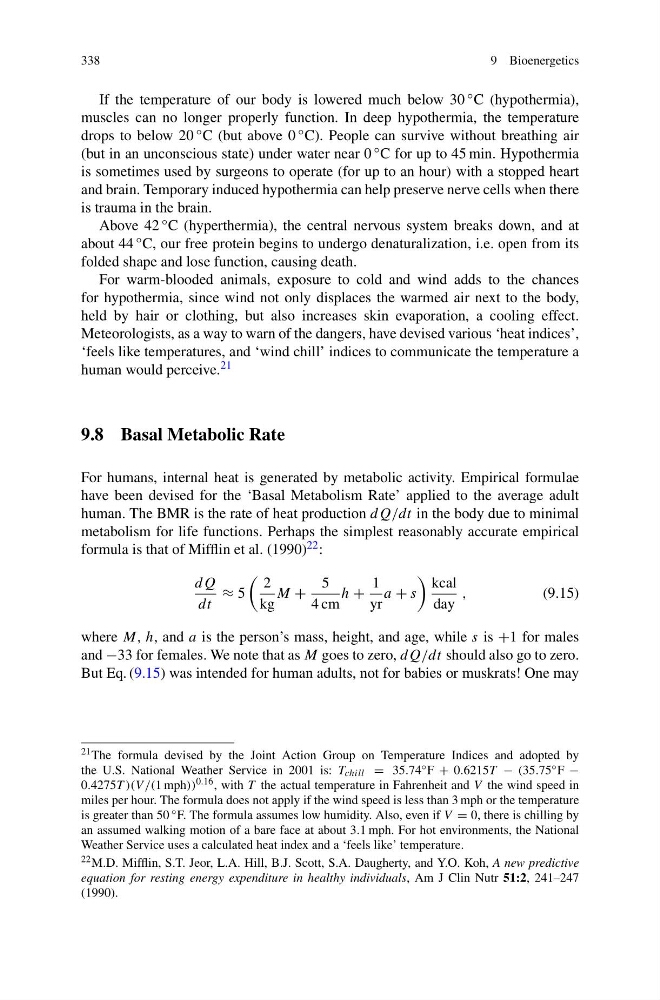
formula is that of Mifflin et al. (1990) 22 :
dQ
dt
≈ 5
2
kg
M +
5
4 cm
h +
1
yr
a + s
kcal
day
,
(9.15)
where M, h, and a is the person’s mass, height, and age, while s is +1 for males
and −33 for females. We note that as M goes to zero, dQ/dt should also go to zero.
But Eq. (9.15) was intended for human adults, not for babies or muskrats! One may
21 The formula devised by the Joint Action Group on Temperature Indices and adopted by
the U.S. National Weather Service in 2001 is: T chill = 35.74 ◦ F + 0.6215T − (35.75 ◦ F −
0.4275T )(V /(1 mph)) 0.16 , with T the actual temperature in Fahrenheit and V the wind speed in
miles per hour. The formula does not apply if the wind speed is less than 3 mph or the temperature
is greater than 50 ◦ F. The formula assumes low humidity. Also, even if V = 0, there is chilling by
an assumed walking motion of a bare face at about 3.1 mph. For hot environments, the National
Weather Service uses a calculated heat index and a ‘feels like’ temperature.
22 M.D. Mifflin, S.T. Jeor, L.A. Hill, B.J. Scott, S.A. Daugherty, and Y.O. Koh, A new predictive
equation for resting energy expenditure in healthy individuals, Am J Clin Nutr 51:2, 241–247
(1990).
9 Bioenergetics
If the temperature of our body is lowered much below 30 ◦ C (hypothermia),
muscles can no longer properly function. In deep hypothermia, the temperature
drops to below 20 ◦ C (but above 0 ◦ C). People can survive without breathing air
(but in an unconscious state) under water near 0 ◦ C for up to 45 min. Hypothermia
is sometimes used by surgeons to operate (for up to an hour) with a stopped heart
and brain. Temporary induced hypothermia can help preserve nerve cells when there
is trauma in the brain.
Above 42 ◦ C (hyperthermia), the central nervous system breaks down, and at
about 44 ◦ C, our free protein begins to undergo denaturalization, i.e. open from its
folded shape and lose function, causing death.
For warm-blooded animals, exposure to cold and wind adds to the chances
for hypothermia, since wind not only displaces the warmed air next to the body,
held by hair or clothing, but also increases skin evaporation, a cooling effect.
Meteorologists, as a way to warn of the dangers, have devised various ‘heat indices’,
‘feels like temperatures, and ‘wind chill’ indices to communicate the temperature a
human would perceive. 21
9.8 Basal Metabolic Rate
For humans, internal heat is generated by metabolic activity. Empirical formulae
have been devised for the ‘Basal Metabolism Rate’ applied to the average adult
human. The BMR is the rate of heat production dQ/dt in the body due to minimal
metabolism for life functions. Perhaps the simplest reasonably accurate empirical
formula is that of Mifflin et al. (1990) 22 :
dQ
dt
≈ 5
2
kg
M +
5
4 cm
h +
1
yr
a + s
kcal
day
,
(9.15)
where M, h, and a is the person’s mass, height, and age, while s is +1 for males
and −33 for females. We note that as M goes to zero, dQ/dt should also go to zero.
But Eq. (9.15) was intended for human adults, not for babies or muskrats! One may
21 The formula devised by the Joint Action Group on Temperature Indices and adopted by
the U.S. National Weather Service in 2001 is: T chill = 35.74 ◦ F + 0.6215T − (35.75 ◦ F −
0.4275T )(V /(1 mph)) 0.16 , with T the actual temperature in Fahrenheit and V the wind speed in
miles per hour. The formula does not apply if the wind speed is less than 3 mph or the temperature
is greater than 50 ◦ F. The formula assumes low humidity. Also, even if V = 0, there is chilling by
an assumed walking motion of a bare face at about 3.1 mph. For hot environments, the National
Weather Service uses a calculated heat index and a ‘feels like’ temperature.
22 M.D. Mifflin, S.T. Jeor, L.A. Hill, B.J. Scott, S.A. Daugherty, and Y.O. Koh, A new predictive
equation for resting energy expenditure in healthy individuals, Am J Clin Nutr 51:2, 241–247
(1990).