

9.7 Temperature Regulation in Humans
337
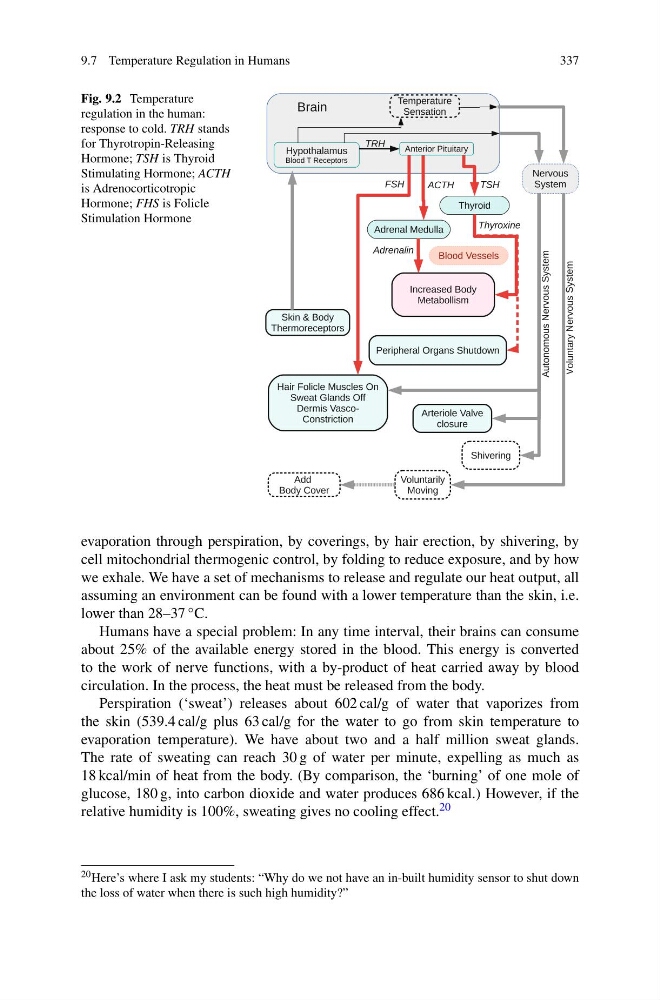
Fig. 9.2 Temperature
regulation in the human:
response to cold. TRH stands
for Thyrotropin-Releasing
Hormone; TSH is Thyroid
Stimulating Hormone; ACTH
is Adrenocorticotropic
Hormone; FHS is Folicle
Stimulation Hormone
N
N
evaporation through perspiration, by coverings, by hair erection, by shivering, by
cell mitochondrial thermogenic control, by folding to reduce exposure, and by how
we exhale. We have a set of mechanisms to release and regulate our heat output, all
assuming an environment can be found with a lower temperature than the skin, i.e.
lower than 28–37 ◦ C.
Humans have a special problem: In any time interval, their brains can consume
about 25% of the available energy stored in the blood. This energy is converted
to the work of nerve functions, with a by-product of heat carried away by blood
circulation. In the process, the heat must be released from the body.
Perspiration (‘sweat’) releases about 602 cal/g of water that vaporizes from
the skin (539.4 cal/g plus 63 cal/g for the water to go from skin temperature to
evaporation temperature). We have about two and a half million sweat glands.
The rate of sweating can reach 30 g of water per minute, expelling as much as
18 kcal/min of heat from the body. (By comparison, the ‘burning’ of one mole of
glucose, 180 g, into carbon dioxide and water produces 686 kcal.) However, if the
relative humidity is 100%, sweating gives no cooling effect. 20
20 Here’s where I ask my students: “Why do we not have an in-built humidity sensor to shut down
the loss of water when there is such high humidity?”
337
Fig. 9.2 Temperature
regulation in the human:
response to cold. TRH stands
for Thyrotropin-Releasing
Hormone; TSH is Thyroid
Stimulating Hormone; ACTH
is Adrenocorticotropic
Hormone; FHS is Folicle
Stimulation Hormone
N
N
evaporation through perspiration, by coverings, by hair erection, by shivering, by
cell mitochondrial thermogenic control, by folding to reduce exposure, and by how
we exhale. We have a set of mechanisms to release and regulate our heat output, all
assuming an environment can be found with a lower temperature than the skin, i.e.
lower than 28–37 ◦ C.
Humans have a special problem: In any time interval, their brains can consume
about 25% of the available energy stored in the blood. This energy is converted
to the work of nerve functions, with a by-product of heat carried away by blood
circulation. In the process, the heat must be released from the body.
Perspiration (‘sweat’) releases about 602 cal/g of water that vaporizes from
the skin (539.4 cal/g plus 63 cal/g for the water to go from skin temperature to
evaporation temperature). We have about two and a half million sweat glands.
The rate of sweating can reach 30 g of water per minute, expelling as much as
18 kcal/min of heat from the body. (By comparison, the ‘burning’ of one mole of
glucose, 180 g, into carbon dioxide and water produces 686 kcal.) However, if the
relative humidity is 100%, sweating gives no cooling effect. 20
20 Here’s where I ask my students: “Why do we not have an in-built humidity sensor to shut down
the loss of water when there is such high humidity?”