

8.15 Radiation Dosimetry
319
Table 8.5 Ionizing radiation
dose
Federal Limits (except medical)
Adult occupational worker/yr
50 mSv
Under 18 years old worker/yr
5 mSv
Fetus during gestation (9 months)
5 mSv
All man-made radiation on an average adult/yr 1 mSv
Medical radiation doses
Hand X-ray
0.001 mSv
Dental X-ray (flat)
0.005 mSv
Dental X-ray (3-D)
0.05 mSv
Chest X-ray
0.65 mSv
Spinal X-ray
1.5 mSv
Radiotracer (Barium)
7.7 mSv
Radiotracer (Tc-99m)
15 mSv
CT abdominal scan
20 mSv
PET/CT scan
25 mSv
Therapy X-ray dose to eye
150 mSv
Therapy X-ray dose to a body organ
500 mSv
Other Ionizing Radiation Doses
Airport X-ray scanner
0.0001 mSv
Airplane trip Paris-Tokyo
0.08 mSv
Ingested radioactive minerals/yr
0.35 mSv
Cosmic radiation background
0.3 mSv
Background radiation from rocks/yr
0.2–0.5 mSv
Inhalation of home radon gas/yr
0.1–2.3 mSv
Space Station 6 mo mission
160 mSv
Projected Mars mission (6 yrs)
1200 mSv
Lethal body dose (50% death in 30 days)
5000 mSv
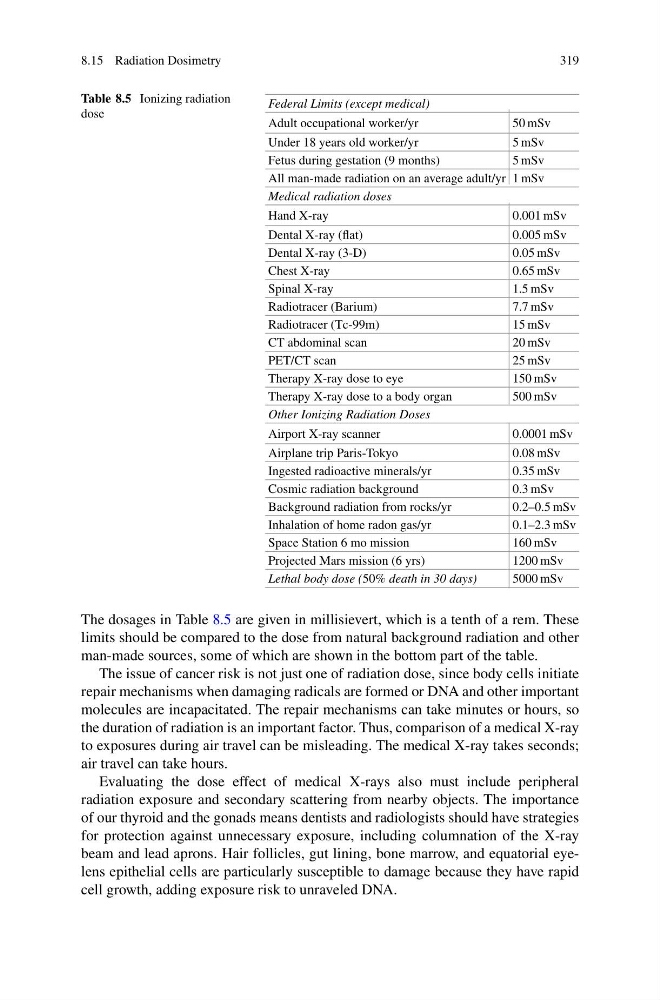
The dosages in Table 8.5 are given in millisievert, which is a tenth of a rem. These
limits should be compared to the dose from natural background radiation and other
man-made sources, some of which are shown in the bottom part of the table.
The issue of cancer risk is not just one of radiation dose, since body cells initiate
repair mechanisms when damaging radicals are formed or DNA and other important
molecules are incapacitated. The repair mechanisms can take minutes or hours, so
the duration of radiation is an important factor. Thus, comparison of a medical X-ray
to exposures during air travel can be misleading. The medical X-ray takes seconds;
air travel can take hours.
Evaluating the dose effect of medical X-rays also must include peripheral
radiation exposure and secondary scattering from nearby objects. The importance
of our thyroid and the gonads means dentists and radiologists should have strategies
for protection against unnecessary exposure, including columnation of the X-ray
beam and lead aprons. Hair follicles, gut lining, bone marrow, and equatorial eyelens epithelial cells are particularly susceptible to damage because they have rapid
cell growth, adding exposure risk to unraveled DNA.
319
Table 8.5 Ionizing radiation
dose
Federal Limits (except medical)
Adult occupational worker/yr
50 mSv
Under 18 years old worker/yr
5 mSv
Fetus during gestation (9 months)
5 mSv
All man-made radiation on an average adult/yr 1 mSv
Medical radiation doses
Hand X-ray
0.001 mSv
Dental X-ray (flat)
0.005 mSv
Dental X-ray (3-D)
0.05 mSv
Chest X-ray
0.65 mSv
Spinal X-ray
1.5 mSv
Radiotracer (Barium)
7.7 mSv
Radiotracer (Tc-99m)
15 mSv
CT abdominal scan
20 mSv
PET/CT scan
25 mSv
Therapy X-ray dose to eye
150 mSv
Therapy X-ray dose to a body organ
500 mSv
Other Ionizing Radiation Doses
Airport X-ray scanner
0.0001 mSv
Airplane trip Paris-Tokyo
0.08 mSv
Ingested radioactive minerals/yr
0.35 mSv
Cosmic radiation background
0.3 mSv
Background radiation from rocks/yr
0.2–0.5 mSv
Inhalation of home radon gas/yr
0.1–2.3 mSv
Space Station 6 mo mission
160 mSv
Projected Mars mission (6 yrs)
1200 mSv
Lethal body dose (50% death in 30 days)
5000 mSv
The dosages in Table 8.5 are given in millisievert, which is a tenth of a rem. These
limits should be compared to the dose from natural background radiation and other
man-made sources, some of which are shown in the bottom part of the table.
The issue of cancer risk is not just one of radiation dose, since body cells initiate
repair mechanisms when damaging radicals are formed or DNA and other important
molecules are incapacitated. The repair mechanisms can take minutes or hours, so
the duration of radiation is an important factor. Thus, comparison of a medical X-ray
to exposures during air travel can be misleading. The medical X-ray takes seconds;
air travel can take hours.
Evaluating the dose effect of medical X-rays also must include peripheral
radiation exposure and secondary scattering from nearby objects. The importance
of our thyroid and the gonads means dentists and radiologists should have strategies
for protection against unnecessary exposure, including columnation of the X-ray
beam and lead aprons. Hair follicles, gut lining, bone marrow, and equatorial eyelens epithelial cells are particularly susceptible to damage because they have rapid
cell growth, adding exposure risk to unraveled DNA.