

318
8 Ionizing Radiation and Life
8.15.4 Ionizing Radiation Exposure to Humans
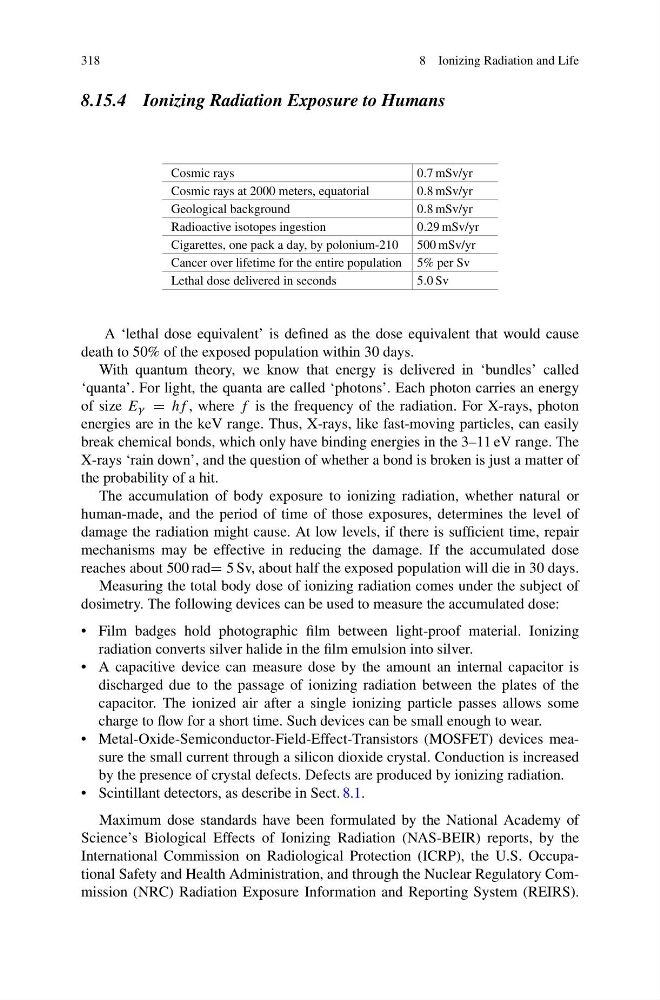
Cosmic rays
0.7 mSv/yr
Cosmic rays at 2000 meters, equatorial
0.8 mSv/yr
Geological background
0.8 mSv/yr
Radioactive isotopes ingestion
0.29 mSv/yr
Cigarettes, one pack a day, by polonium-210 500 mSv/yr
Cancer over lifetime for the entire population 5% per Sv
Lethal dose delivered in seconds
5.0 Sv
A ‘lethal dose equivalent’ is defined as the dose equivalent that would cause
death to 50% of the exposed population within 30 days.
With quantum theory, we know that energy is delivered in ‘bundles’ called
‘quanta’. For light, the quanta are called ‘photons’. Each photon carries an energy
of size E γ = hf , where f is the frequency of the radiation. For X-rays, photon
energies are in the keV range. Thus, X-rays, like fast-moving particles, can easily
break chemical bonds, which only have binding energies in the 3–11 eV range. The
X-rays ‘rain down’, and the question of whether a bond is broken is just a matter of
the probability of a hit.
The accumulation of body exposure to ionizing radiation, whether natural or
human-made, and the period of time of those exposures, determines the level of
damage the radiation might cause. At low levels, if there is sufficient time, repair
mechanisms may be effective in reducing the damage. If the accumulated dose
reaches about 500 rad= 5 Sv, about half the exposed population will die in 30 days.
Measuring the total body dose of ionizing radiation comes under the subject of
dosimetry. The following devices can be used to measure the accumulated dose:
• Film badges hold photographic film between light-proof material. Ionizing
radiation converts silver halide in the film emulsion into silver.
• A capacitive device can measure dose by the amount an internal capacitor is
discharged due to the passage of ionizing radiation between the plates of the
capacitor. The ionized air after a single ionizing particle passes allows some
charge to flow for a short time. Such devices can be small enough to wear.
• Metal-Oxide-Semiconductor-Field-Effect-Transistors (MOSFET) devices measure the small current through a silicon dioxide crystal. Conduction is increased
by the presence of crystal defects. Defects are produced by ionizing radiation.
• Scintillant detectors, as describe in Sect. 8.1.
Maximum dose standards have been formulated by the National Academy of
Science’s Biological Effects of Ionizing Radiation (NAS-BEIR) reports, by the
International Commission on Radiological Protection (ICRP), the U.S. Occupational Safety and Health Administration, and through the Nuclear Regulatory Commission (NRC) Radiation Exposure Information and Reporting System (REIRS).
8 Ionizing Radiation and Life
8.15.4 Ionizing Radiation Exposure to Humans
Cosmic rays
0.7 mSv/yr
Cosmic rays at 2000 meters, equatorial
0.8 mSv/yr
Geological background
0.8 mSv/yr
Radioactive isotopes ingestion
0.29 mSv/yr
Cigarettes, one pack a day, by polonium-210 500 mSv/yr
Cancer over lifetime for the entire population 5% per Sv
Lethal dose delivered in seconds
5.0 Sv
A ‘lethal dose equivalent’ is defined as the dose equivalent that would cause
death to 50% of the exposed population within 30 days.
With quantum theory, we know that energy is delivered in ‘bundles’ called
‘quanta’. For light, the quanta are called ‘photons’. Each photon carries an energy
of size E γ = hf , where f is the frequency of the radiation. For X-rays, photon
energies are in the keV range. Thus, X-rays, like fast-moving particles, can easily
break chemical bonds, which only have binding energies in the 3–11 eV range. The
X-rays ‘rain down’, and the question of whether a bond is broken is just a matter of
the probability of a hit.
The accumulation of body exposure to ionizing radiation, whether natural or
human-made, and the period of time of those exposures, determines the level of
damage the radiation might cause. At low levels, if there is sufficient time, repair
mechanisms may be effective in reducing the damage. If the accumulated dose
reaches about 500 rad= 5 Sv, about half the exposed population will die in 30 days.
Measuring the total body dose of ionizing radiation comes under the subject of
dosimetry. The following devices can be used to measure the accumulated dose:
• Film badges hold photographic film between light-proof material. Ionizing
radiation converts silver halide in the film emulsion into silver.
• A capacitive device can measure dose by the amount an internal capacitor is
discharged due to the passage of ionizing radiation between the plates of the
capacitor. The ionized air after a single ionizing particle passes allows some
charge to flow for a short time. Such devices can be small enough to wear.
• Metal-Oxide-Semiconductor-Field-Effect-Transistors (MOSFET) devices measure the small current through a silicon dioxide crystal. Conduction is increased
by the presence of crystal defects. Defects are produced by ionizing radiation.
• Scintillant detectors, as describe in Sect. 8.1.
Maximum dose standards have been formulated by the National Academy of
Science’s Biological Effects of Ionizing Radiation (NAS-BEIR) reports, by the
International Commission on Radiological Protection (ICRP), the U.S. Occupational Safety and Health Administration, and through the Nuclear Regulatory Commission (NRC) Radiation Exposure Information and Reporting System (REIRS).