

314
8 Ionizing Radiation and Life
Penetration (cm)
Relative Linear Energy Transfer
Proton Bragg Peak
0
5
10
15
20
25
30
35
0.0
0.5
1.0
1.5
2.0
2.5
3.0
3.5
4.0
4.5
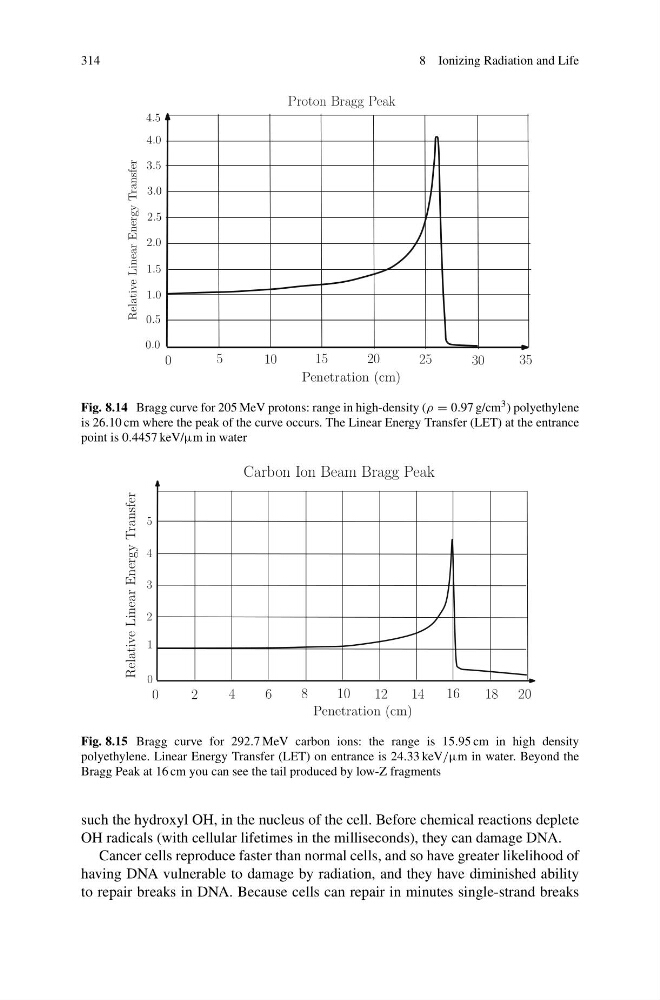
Fig. 8.14 Bragg curve for 205 MeV protons: range in high-density (ρ = 0.97 g/cm 3 ) polyethylene
is 26.10 cm where the peak of the curve occurs. The Linear Energy Transfer (LET) at the entrance
point is 0.4457 keV/μm in water
Carbon Ion Beam Bragg Peak
0
2
4
6
8
10
12
14
16
18
Penetration (cm)
Relative Linear Energy Transfer
0
1
2
3
4
5
20
Fig. 8.15 Bragg curve for 292.7 MeV carbon ions: the range is 15.95 cm in high density
polyethylene. Linear Energy Transfer (LET) on entrance is 24.33 keV/μm in water. Beyond the
Bragg Peak at 16 cm you can see the tail produced by low-Z fragments
such the hydroxyl OH, in the nucleus of the cell. Before chemical reactions deplete
OH radicals (with cellular lifetimes in the milliseconds), they can damage DNA.
Cancer cells reproduce faster than normal cells, and so have greater likelihood of
having DNA vulnerable to damage by radiation, and they have diminished ability
to repair breaks in DNA. Because cells can repair in minutes single-strand breaks
8 Ionizing Radiation and Life
Penetration (cm)
Relative Linear Energy Transfer
Proton Bragg Peak
0
5
10
15
20
25
30
35
0.0
0.5
1.0
1.5
2.0
2.5
3.0
3.5
4.0
4.5
Fig. 8.14 Bragg curve for 205 MeV protons: range in high-density (ρ = 0.97 g/cm 3 ) polyethylene
is 26.10 cm where the peak of the curve occurs. The Linear Energy Transfer (LET) at the entrance
point is 0.4457 keV/μm in water
Carbon Ion Beam Bragg Peak
0
2
4
6
8
10
12
14
16
18
Penetration (cm)
Relative Linear Energy Transfer
0
1
2
3
4
5
20
Fig. 8.15 Bragg curve for 292.7 MeV carbon ions: the range is 15.95 cm in high density
polyethylene. Linear Energy Transfer (LET) on entrance is 24.33 keV/μm in water. Beyond the
Bragg Peak at 16 cm you can see the tail produced by low-Z fragments
such the hydroxyl OH, in the nucleus of the cell. Before chemical reactions deplete
OH radicals (with cellular lifetimes in the milliseconds), they can damage DNA.
Cancer cells reproduce faster than normal cells, and so have greater likelihood of
having DNA vulnerable to damage by radiation, and they have diminished ability
to repair breaks in DNA. Because cells can repair in minutes single-strand breaks