

8.14 Radiation Therapy
313
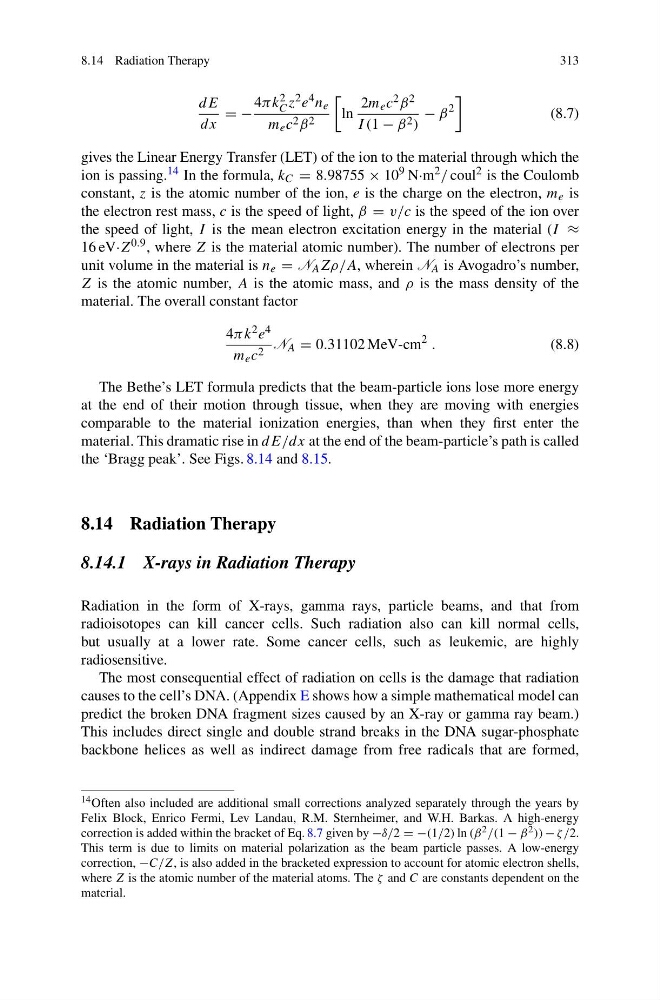
dE
dx
= −
4πk 2
C z 2 e 4 n e
m e c 2 β 2
ln
2m e c 2 β 2
I (1 − β 2 )
− β
2
(8.7)
gives the Linear Energy Transfer (LET) of the ion to the material through which the
ion is passing. 14 In the formula, k C = 8.98755 × 10 9 N·m 2 / coul 2 is the Coulomb
constant, z is the atomic number of the ion, e is the charge on the electron, m e is
the electron rest mass, c is the speed of light, β = v/c is the speed of the ion over
the speed of light, I is the mean electron excitation energy in the material (I ≈
16 eV·Z 0.9 , where Z is the material atomic number). The number of electrons per
unit volume in the material is n e = N A Zρ/A, wherein N A is Avogadro’s number,
Z is the atomic number, A is the atomic mass, and ρ is the mass density of the
material. The overall constant factor
4πk 2 e 4
m e c 2 N A = 0.31102 MeV-cm
2 .
(8.8)
The Bethe’s LET formula predicts that the beam-particle ions lose more energy
at the end of their motion through tissue, when they are moving with energies
comparable to the material ionization energies, than when they first enter the
material. This dramatic rise in dE/dx at the end of the beam-particle’s path is called
the ‘Bragg peak’. See Figs. 8.14 and 8.15.
8.14 Radiation Therapy
8.14.1 X-rays in Radiation Therapy
Radiation in the form of X-rays, gamma rays, particle beams, and that from
radioisotopes can kill cancer cells. Such radiation also can kill normal cells,
but usually at a lower rate. Some cancer cells, such as leukemic, are highly
radiosensitive.
The most consequential effect of radiation on cells is the damage that radiation
causes to the cell’s DNA. (Appendix E shows how a simple mathematical model can
predict the broken DNA fragment sizes caused by an X-ray or gamma ray beam.)
This includes direct single and double strand breaks in the DNA sugar-phosphate
backbone helices as well as indirect damage from free radicals that are formed,
14 Often also included are additional small corrections analyzed separately through the years by
Felix Block, Enrico Fermi, Lev Landau, R.M. Sternheimer, and W.H. Barkas. A high-energy
correction is added within the bracket of Eq. 8.7 given by −δ/2 = −(1/2) ln (β 2 /(1 − β 2 )) − ζ /2.
This term is due to limits on material polarization as the beam particle passes. A low-energy
correction, −C/Z, is also added in the bracketed expression to account for atomic electron shells,
where Z is the atomic number of the material atoms. The ζ and C are constants dependent on the
material.
313
dE
dx
= −
4πk 2
C z 2 e 4 n e
m e c 2 β 2
ln
2m e c 2 β 2
I (1 − β 2 )
− β
2
(8.7)
gives the Linear Energy Transfer (LET) of the ion to the material through which the
ion is passing. 14 In the formula, k C = 8.98755 × 10 9 N·m 2 / coul 2 is the Coulomb
constant, z is the atomic number of the ion, e is the charge on the electron, m e is
the electron rest mass, c is the speed of light, β = v/c is the speed of the ion over
the speed of light, I is the mean electron excitation energy in the material (I ≈
16 eV·Z 0.9 , where Z is the material atomic number). The number of electrons per
unit volume in the material is n e = N A Zρ/A, wherein N A is Avogadro’s number,
Z is the atomic number, A is the atomic mass, and ρ is the mass density of the
material. The overall constant factor
4πk 2 e 4
m e c 2 N A = 0.31102 MeV-cm
2 .
(8.8)
The Bethe’s LET formula predicts that the beam-particle ions lose more energy
at the end of their motion through tissue, when they are moving with energies
comparable to the material ionization energies, than when they first enter the
material. This dramatic rise in dE/dx at the end of the beam-particle’s path is called
the ‘Bragg peak’. See Figs. 8.14 and 8.15.
8.14 Radiation Therapy
8.14.1 X-rays in Radiation Therapy
Radiation in the form of X-rays, gamma rays, particle beams, and that from
radioisotopes can kill cancer cells. Such radiation also can kill normal cells,
but usually at a lower rate. Some cancer cells, such as leukemic, are highly
radiosensitive.
The most consequential effect of radiation on cells is the damage that radiation
causes to the cell’s DNA. (Appendix E shows how a simple mathematical model can
predict the broken DNA fragment sizes caused by an X-ray or gamma ray beam.)
This includes direct single and double strand breaks in the DNA sugar-phosphate
backbone helices as well as indirect damage from free radicals that are formed,
14 Often also included are additional small corrections analyzed separately through the years by
Felix Block, Enrico Fermi, Lev Landau, R.M. Sternheimer, and W.H. Barkas. A high-energy
correction is added within the bracket of Eq. 8.7 given by −δ/2 = −(1/2) ln (β 2 /(1 − β 2 )) − ζ /2.
This term is due to limits on material polarization as the beam particle passes. A low-energy
correction, −C/Z, is also added in the bracketed expression to account for atomic electron shells,
where Z is the atomic number of the material atoms. The ζ and C are constants dependent on the
material.