

274
7 Light in Biology and Medicine
Table 7.7 Some electrical
properties of human tissue
Frequency
Permittivity
Conductivity
(MHz)
(V/m)
(S/m)
Skin
900
41.4 0
0.87
1800
38.9 0
1.18
2450
38.0 0
1.46
Muscle
433
53 0
1.4
915
51 0
1.6
2450
49 0
2.2
5800
43 0
4.7
Fat
433
5.6 0
0.08
915
5.6 0
0.10
2450
5.5 0
0.16
5800
5.1 0
0.26
Table 7.8 FCC microwave
limits (f in MHz)
Frequency
E-field
B-field
Power density
(MHz)
(V/m)
(A/m)
(mW/cm 2 )
0.3–1.34
614
1.63
100
1.34–30
824/f
2.19/f
180/f 2
30–300
27.5
0 .073
0.2
300–1500
–
–
f/1500
1500–100,000 –
–
1.0
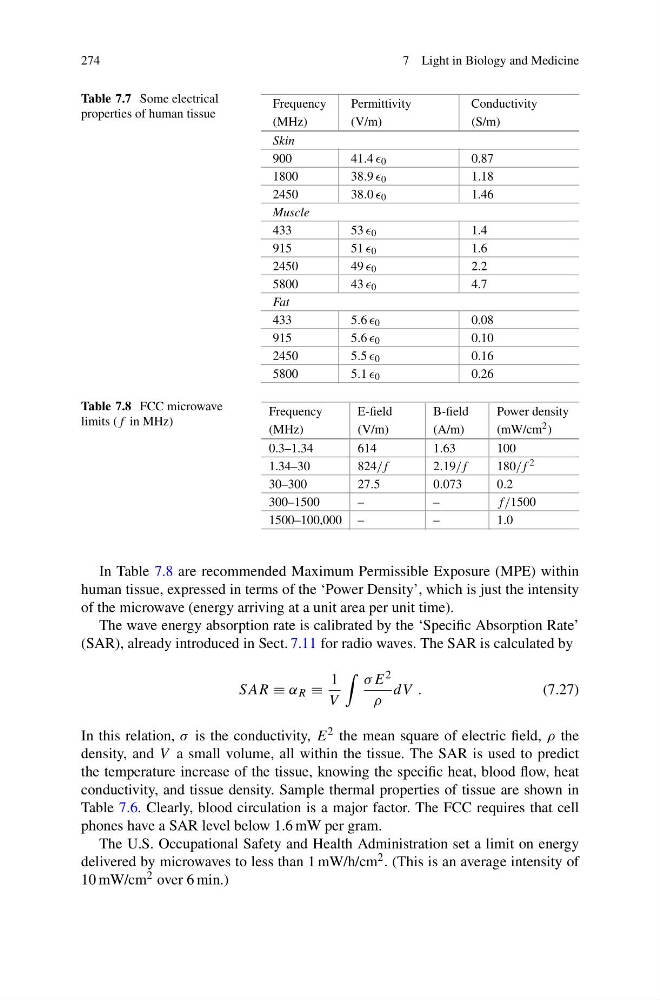
In Table 7.8 are recommended Maximum Permissible Exposure (MPE) within
human tissue, expressed in terms of the ‘Power Density’, which is just the intensity
of the microwave (energy arriving at a unit area per unit time).
The wave energy absorption rate is calibrated by the ‘Specific Absorption Rate’
(SAR), already introduced in Sect. 7.11 for radio waves. The SAR is calculated by
SAR ≡ α R ≡
1
V
σ E 2
ρ
dV .
(7.27)
In this relation, σ is the conductivity, E 2 the mean square of electric field, ρ the
density, and V a small volume, all within the tissue. The SAR is used to predict
the temperature increase of the tissue, knowing the specific heat, blood flow, heat
conductivity, and tissue density. Sample thermal properties of tissue are shown in
Table 7.6. Clearly, blood circulation is a major factor. The FCC requires that cell
phones have a SAR level below 1.6 mW per gram.
The U.S. Occupational Safety and Health Administration set a limit on energy
delivered by microwaves to less than 1 mW/h/cm 2 . (This is an average intensity of
10 mW/cm 2 over 6 min.)
7 Light in Biology and Medicine
Table 7.7 Some electrical
properties of human tissue
Frequency
Permittivity
Conductivity
(MHz)
(V/m)
(S/m)
Skin
900
41.4 0
0.87
1800
38.9 0
1.18
2450
38.0 0
1.46
Muscle
433
53 0
1.4
915
51 0
1.6
2450
49 0
2.2
5800
43 0
4.7
Fat
433
5.6 0
0.08
915
5.6 0
0.10
2450
5.5 0
0.16
5800
5.1 0
0.26
Table 7.8 FCC microwave
limits (f in MHz)
Frequency
E-field
B-field
Power density
(MHz)
(V/m)
(A/m)
(mW/cm 2 )
0.3–1.34
614
1.63
100
1.34–30
824/f
2.19/f
180/f 2
30–300
27.5
0 .073
0.2
300–1500
–
–
f/1500
1500–100,000 –
–
1.0
In Table 7.8 are recommended Maximum Permissible Exposure (MPE) within
human tissue, expressed in terms of the ‘Power Density’, which is just the intensity
of the microwave (energy arriving at a unit area per unit time).
The wave energy absorption rate is calibrated by the ‘Specific Absorption Rate’
(SAR), already introduced in Sect. 7.11 for radio waves. The SAR is calculated by
SAR ≡ α R ≡
1
V
σ E 2
ρ
dV .
(7.27)
In this relation, σ is the conductivity, E 2 the mean square of electric field, ρ the
density, and V a small volume, all within the tissue. The SAR is used to predict
the temperature increase of the tissue, knowing the specific heat, blood flow, heat
conductivity, and tissue density. Sample thermal properties of tissue are shown in
Table 7.6. Clearly, blood circulation is a major factor. The FCC requires that cell
phones have a SAR level below 1.6 mW per gram.
The U.S. Occupational Safety and Health Administration set a limit on energy
delivered by microwaves to less than 1 mW/h/cm 2 . (This is an average intensity of
10 mW/cm 2 over 6 min.)