

7.31 Dosimetry for Non-ionizing Electromagnetic Waves
273
fields as low as 5 mT at 20 Hz can induce faint flickering in vision, called magnetic
phosphenes. Evidence suggests the cause is induced electric current in the retina.
7.31.2 Special Considerations for Microwaves
As can be seen in Table 7.5, limitations on microwave intensities are more severe
than those of the adjacent bands of frequencies. This follows from two facts: (1)
Microwaves are easily absorbed by human wet tissue and (2) Microwaves penetrate
millimeters to centimeters into the body when incident on the skin.
Since microwave photons are much too low in energy to directly cause chemical
bond breakage, the predominant mechanism for energy loss from the wave is the
stimulation of oscillations of polar molecules, vibration of polarized membranes
and ionic motion. The kinetic energy of these oscillations and motions dissipates
into heat. It is the consequent excessive rise in temperature that can cause damage,
particularly to organs with low blood circulation, such as cornea of the eye. A small
rise, less than a degree Celsius, is easily tolerable, and may even be helpful as a
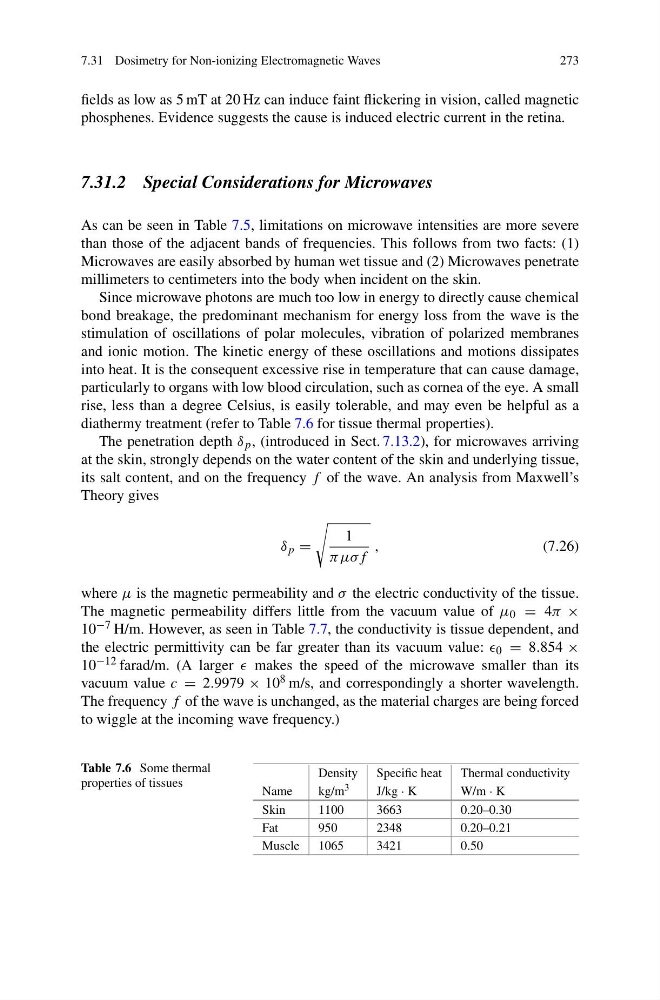
diathermy treatment (refer to Table 7.6 for tissue thermal properties).
The penetration depth δ p , (introduced in Sect. 7.13.2), for microwaves arriving
at the skin, strongly depends on the water content of the skin and underlying tissue,
its salt content, and on the frequency f of the wave. An analysis from Maxwell’s
Theory gives
δ p =
1
πμσf
,
(7.26)
where μ is the magnetic permeability and σ the electric conductivity of the tissue.
The magnetic permeability differs little from the vacuum value of μ 0 = 4π ×
10 −7 H/m. However, as seen in Table 7.7, the conductivity is tissue dependent, and
the electric permittivity can be far greater than its vacuum value: 0 = 8.854 ×
10 −12 farad/m. (A larger makes the speed of the microwave smaller than its
vacuum value c = 2.9979 × 10 8 m/s, and correspondingly a shorter wavelength.
The frequency f of the wave is unchanged, as the material charges are being forced
to wiggle at the incoming wave frequency.)
Table 7.6 Some thermal
properties of tissues
Density Specific heat Thermal conductivity
Name
kg/m 3
J/kg · K
W / m· K
Skin
1100
3663
0.20–0.30
Fat
950
2348
0.20–0.21
Muscle 1065
3421
0.50
273
fields as low as 5 mT at 20 Hz can induce faint flickering in vision, called magnetic
phosphenes. Evidence suggests the cause is induced electric current in the retina.
7.31.2 Special Considerations for Microwaves
As can be seen in Table 7.5, limitations on microwave intensities are more severe
than those of the adjacent bands of frequencies. This follows from two facts: (1)
Microwaves are easily absorbed by human wet tissue and (2) Microwaves penetrate
millimeters to centimeters into the body when incident on the skin.
Since microwave photons are much too low in energy to directly cause chemical
bond breakage, the predominant mechanism for energy loss from the wave is the
stimulation of oscillations of polar molecules, vibration of polarized membranes
and ionic motion. The kinetic energy of these oscillations and motions dissipates
into heat. It is the consequent excessive rise in temperature that can cause damage,
particularly to organs with low blood circulation, such as cornea of the eye. A small
rise, less than a degree Celsius, is easily tolerable, and may even be helpful as a
diathermy treatment (refer to Table 7.6 for tissue thermal properties).
The penetration depth δ p , (introduced in Sect. 7.13.2), for microwaves arriving
at the skin, strongly depends on the water content of the skin and underlying tissue,
its salt content, and on the frequency f of the wave. An analysis from Maxwell’s
Theory gives
δ p =
1
πμσf
,
(7.26)
where μ is the magnetic permeability and σ the electric conductivity of the tissue.
The magnetic permeability differs little from the vacuum value of μ 0 = 4π ×
10 −7 H/m. However, as seen in Table 7.7, the conductivity is tissue dependent, and
the electric permittivity can be far greater than its vacuum value: 0 = 8.854 ×
10 −12 farad/m. (A larger makes the speed of the microwave smaller than its
vacuum value c = 2.9979 × 10 8 m/s, and correspondingly a shorter wavelength.
The frequency f of the wave is unchanged, as the material charges are being forced
to wiggle at the incoming wave frequency.)
Table 7.6 Some thermal
properties of tissues
Density Specific heat Thermal conductivity
Name
kg/m 3
J/kg · K
W / m· K
Skin
1100
3663
0.20–0.30
Fat
950
2348
0.20–0.21
Muscle 1065
3421
0.50