

7.21 Light Absorption Characterization
239
7.21 Light Absorption Characterization
7.21.1 Light Extinction in Materials
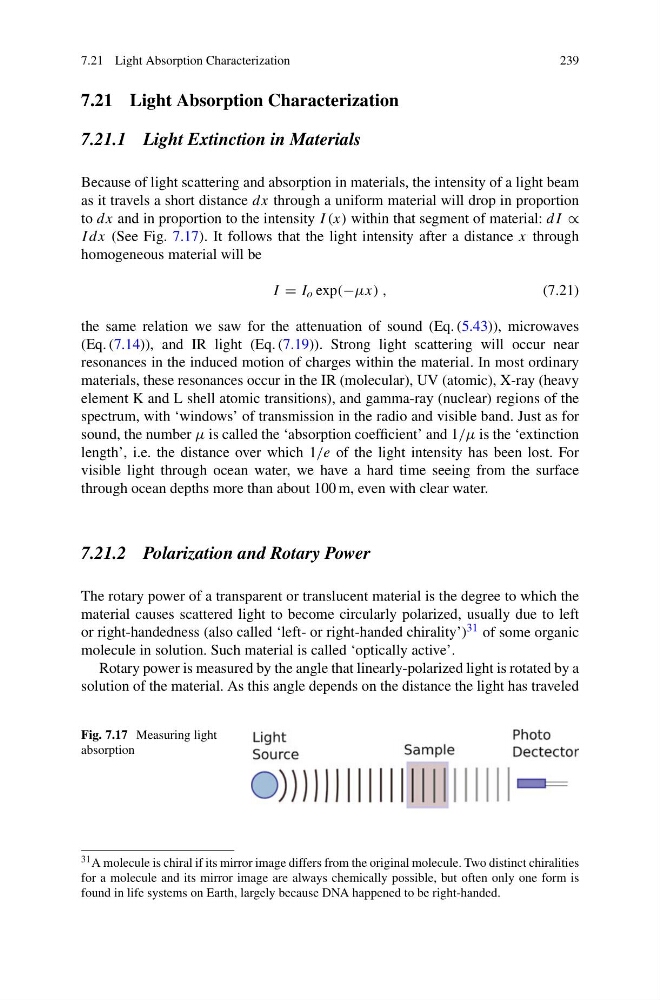
Because of light scattering and absorption in materials, the intensity of a light beam
as it travels a short distance dx through a uniform material will drop in proportion
to dx and in proportion to the intensity I (x) within that segment of material: dI ∝
I dx (See Fig. 7.17). It follows that the light intensity after a distance x through
homogeneous material will be
I = I o exp(−μx) ,
(7.21)
the same relation we saw for the attenuation of sound (Eq. (5.43)), microwaves
(Eq. (7.14)), and IR light (Eq. (7.19)). Strong light scattering will occur near
resonances in the induced motion of charges within the material. In most ordinary
materials, these resonances occur in the IR (molecular), UV (atomic), X-ray (heavy
element K and L shell atomic transitions), and gamma-ray (nuclear) regions of the
spectrum, with ‘windows’ of transmission in the radio and visible band. Just as for
sound, the number μ is called the ‘absorption coefficient’ and 1/μ is the ‘extinction
length’, i.e. the distance over which 1/e of the light intensity has been lost. For
visible light through ocean water, we have a hard time seeing from the surface
through ocean depths more than about 100 m, even with clear water.
7.21.2 Polarization and Rotary Power
The rotary power of a transparent or translucent material is the degree to which the
material causes scattered light to become circularly polarized, usually due to left
or right-handedness (also called ‘left- or right-handed chirality’) 31 of some organic
molecule in solution. Such material is called ‘optically active’.
Rotary power is measured by the angle that linearly-polarized light is rotated by a
solution of the material. As this angle depends on the distance the light has traveled
Fig. 7.17 Measuring light
absorption
31 A molecule is chiral if its mirror image differs from the original molecule. Two distinct chiralities
for a molecule and its mirror image are always chemically possible, but often only one form is
found in life systems on Earth, largely because DNA happened to be right-handed.
239
7.21 Light Absorption Characterization
7.21.1 Light Extinction in Materials
Because of light scattering and absorption in materials, the intensity of a light beam
as it travels a short distance dx through a uniform material will drop in proportion
to dx and in proportion to the intensity I (x) within that segment of material: dI ∝
I dx (See Fig. 7.17). It follows that the light intensity after a distance x through
homogeneous material will be
I = I o exp(−μx) ,
(7.21)
the same relation we saw for the attenuation of sound (Eq. (5.43)), microwaves
(Eq. (7.14)), and IR light (Eq. (7.19)). Strong light scattering will occur near
resonances in the induced motion of charges within the material. In most ordinary
materials, these resonances occur in the IR (molecular), UV (atomic), X-ray (heavy
element K and L shell atomic transitions), and gamma-ray (nuclear) regions of the
spectrum, with ‘windows’ of transmission in the radio and visible band. Just as for
sound, the number μ is called the ‘absorption coefficient’ and 1/μ is the ‘extinction
length’, i.e. the distance over which 1/e of the light intensity has been lost. For
visible light through ocean water, we have a hard time seeing from the surface
through ocean depths more than about 100 m, even with clear water.
7.21.2 Polarization and Rotary Power
The rotary power of a transparent or translucent material is the degree to which the
material causes scattered light to become circularly polarized, usually due to left
or right-handedness (also called ‘left- or right-handed chirality’) 31 of some organic
molecule in solution. Such material is called ‘optically active’.
Rotary power is measured by the angle that linearly-polarized light is rotated by a
solution of the material. As this angle depends on the distance the light has traveled
Fig. 7.17 Measuring light
absorption
31 A molecule is chiral if its mirror image differs from the original molecule. Two distinct chiralities
for a molecule and its mirror image are always chemically possible, but often only one form is
found in life systems on Earth, largely because DNA happened to be right-handed.