

238
7 Light in Biology and Medicine
7.19.3 Bioemitters and Bioluminescence
Bioluminescence has evolved over forty different times across the varieties of living
organisms, including certain species of fungi, bacteria, marine animals, worms, and
insects. All use a variety of light-emitting proteins called luciferin together with an
enzyme luciferase and an energy source. At one time, coal miners used dried fish
skins as a source of safe illumination.
Lightning bugs emit light from their lower abdomens within special cells containing luciferin. With the aid of the catalyst luciferase and the presence of a cofactor
of magnesium ions, luciferin uses ATP to make luciferyl adenylate and adenosine
pyrophosphate which, in turn, combines with oxygen to form oxyluciferin, carbon
dioxide and adenosine monophosphate with the emission of light of wavelength of
510–670 nm (yellow-green to red). The reaction sequence can be 80% efficient in
converting ATP energy to light.
More generally, the color of bioluminescent emission depends on the binding
of the luciferase with luciferin and any associated fluorescent proteins. Placing the
gene for producing luciferase in other organisms lets researchers use light to track
ATP usage.
7.20 Light Detectors
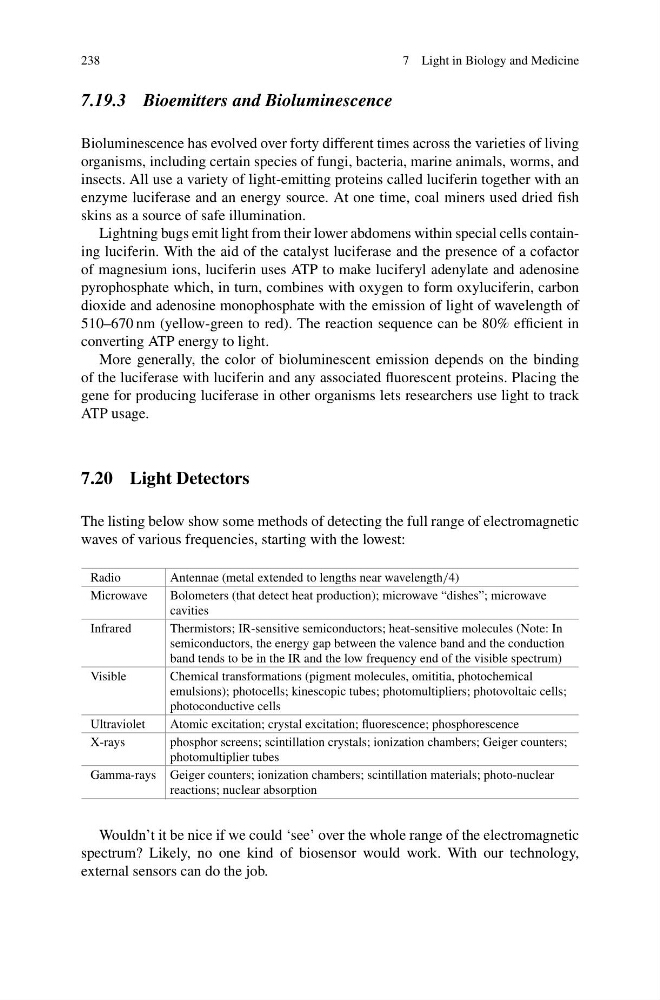
The listing below show some methods of detecting the full range of electromagnetic
waves of various frequencies, starting with the lowest:
Radio
Antennae (metal extended to lengths near wavelength/4)
Microwave
Bolometers (that detect heat production); microwave “dishes”; microwave
cavities
Infrared
Thermistors; IR-sensitive semiconductors; heat-sensitive molecules (Note: In
semiconductors, the energy gap between the valence band and the conduction
band tends to be in the IR and the low frequency end of the visible spectrum)
Visible
Chemical transformations (pigment molecules, omititia, photochemical
emulsions); photocells; kinescopic tubes; photomultipliers; photovoltaic cells;
photoconductive cells
Ultraviolet
Atomic excitation; crystal excitation; fluorescence; phosphorescence
X-rays
phosphor screens; scintillation crystals; ionization chambers; Geiger counters;
photomultiplier tubes
Gamma-rays Geiger counters; ionization chambers; scintillation materials; photo-nuclear
reactions; nuclear absorption
Wouldn’t it be nice if we could ‘see’ over the whole range of the electromagnetic
spectrum? Likely, no one kind of biosensor would work. With our technology,
external sensors can do the job.
7 Light in Biology and Medicine
7.19.3 Bioemitters and Bioluminescence
Bioluminescence has evolved over forty different times across the varieties of living
organisms, including certain species of fungi, bacteria, marine animals, worms, and
insects. All use a variety of light-emitting proteins called luciferin together with an
enzyme luciferase and an energy source. At one time, coal miners used dried fish
skins as a source of safe illumination.
Lightning bugs emit light from their lower abdomens within special cells containing luciferin. With the aid of the catalyst luciferase and the presence of a cofactor
of magnesium ions, luciferin uses ATP to make luciferyl adenylate and adenosine
pyrophosphate which, in turn, combines with oxygen to form oxyluciferin, carbon
dioxide and adenosine monophosphate with the emission of light of wavelength of
510–670 nm (yellow-green to red). The reaction sequence can be 80% efficient in
converting ATP energy to light.
More generally, the color of bioluminescent emission depends on the binding
of the luciferase with luciferin and any associated fluorescent proteins. Placing the
gene for producing luciferase in other organisms lets researchers use light to track
ATP usage.
7.20 Light Detectors
The listing below show some methods of detecting the full range of electromagnetic
waves of various frequencies, starting with the lowest:
Radio
Antennae (metal extended to lengths near wavelength/4)
Microwave
Bolometers (that detect heat production); microwave “dishes”; microwave
cavities
Infrared
Thermistors; IR-sensitive semiconductors; heat-sensitive molecules (Note: In
semiconductors, the energy gap between the valence band and the conduction
band tends to be in the IR and the low frequency end of the visible spectrum)
Visible
Chemical transformations (pigment molecules, omititia, photochemical
emulsions); photocells; kinescopic tubes; photomultipliers; photovoltaic cells;
photoconductive cells
Ultraviolet
Atomic excitation; crystal excitation; fluorescence; phosphorescence
X-rays
phosphor screens; scintillation crystals; ionization chambers; Geiger counters;
photomultiplier tubes
Gamma-rays Geiger counters; ionization chambers; scintillation materials; photo-nuclear
reactions; nuclear absorption
Wouldn’t it be nice if we could ‘see’ over the whole range of the electromagnetic
spectrum? Likely, no one kind of biosensor would work. With our technology,
external sensors can do the job.