

234
7 Light in Biology and Medicine
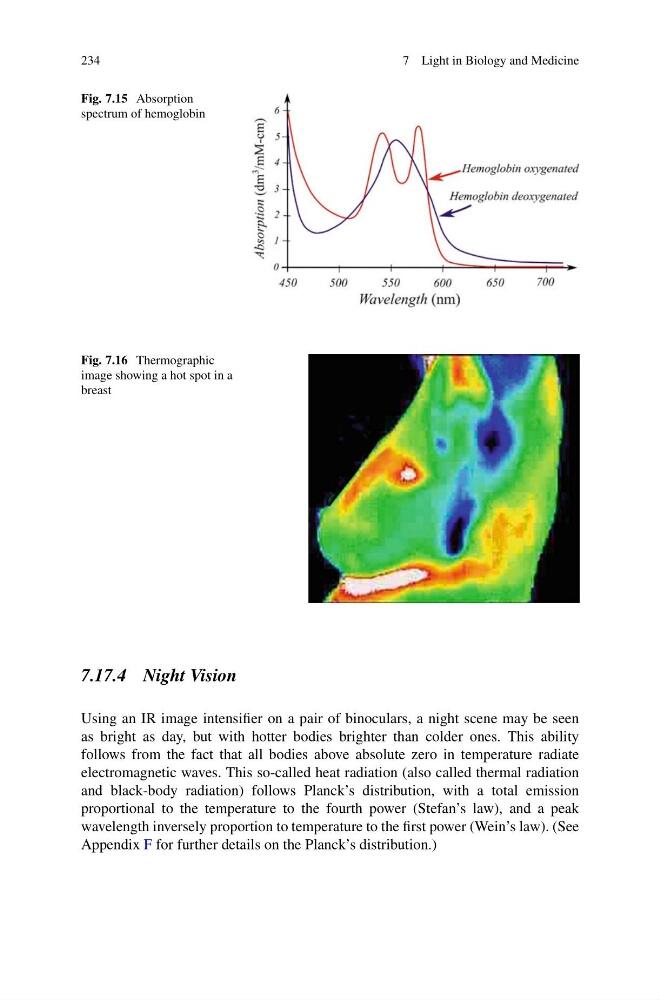
Fig. 7.15 Absorption
spectrum of hemoglobin
Fig. 7.16 Thermographic
image showing a hot spot in a
breast
7.17.4 Night Vision
Using an IR image intensifier on a pair of binoculars, a night scene may be seen
as bright as day, but with hotter bodies brighter than colder ones. This ability
follows from the fact that all bodies above absolute zero in temperature radiate
electromagnetic waves. This so-called heat radiation (also called thermal radiation
and black-body radiation) follows Planck’s distribution, with a total emission
proportional to the temperature to the fourth power (Stefan’s law), and a peak
wavelength inversely proportion to temperature to the first power (Wein’s law). (See
Appendix F for further details on the Planck’s distribution.)
7 Light in Biology and Medicine
Fig. 7.15 Absorption
spectrum of hemoglobin
Fig. 7.16 Thermographic
image showing a hot spot in a
breast
7.17.4 Night Vision
Using an IR image intensifier on a pair of binoculars, a night scene may be seen
as bright as day, but with hotter bodies brighter than colder ones. This ability
follows from the fact that all bodies above absolute zero in temperature radiate
electromagnetic waves. This so-called heat radiation (also called thermal radiation
and black-body radiation) follows Planck’s distribution, with a total emission
proportional to the temperature to the fourth power (Stefan’s law), and a peak
wavelength inversely proportion to temperature to the first power (Wein’s law). (See
Appendix F for further details on the Planck’s distribution.)