

230
7 Light in Biology and Medicine
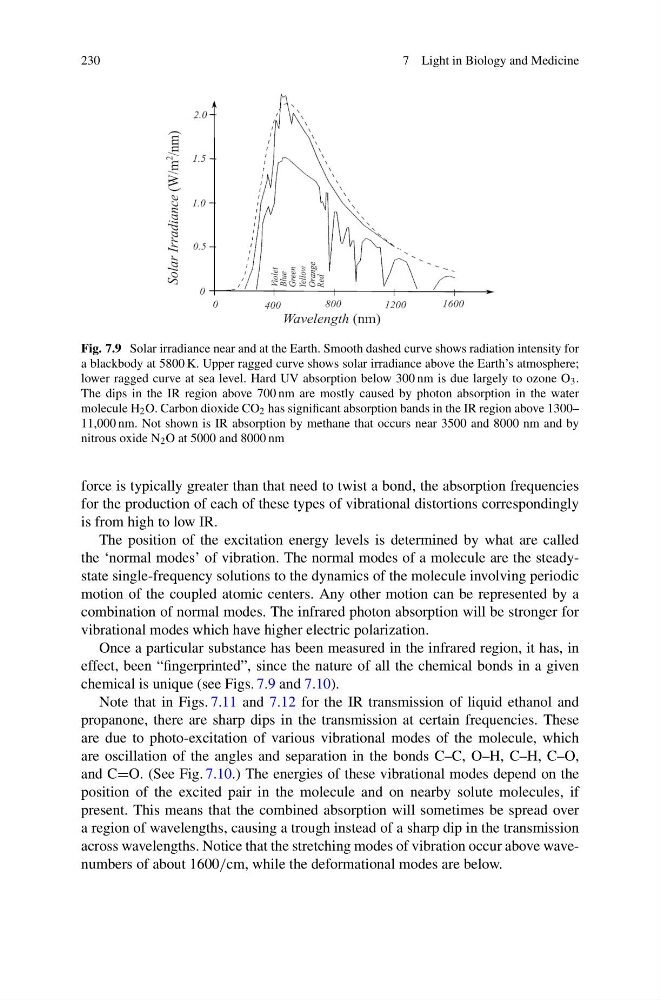
Fig. 7.9 Solar irradiance near and at the Earth. Smooth dashed curve shows radiation intensity for
a blackbody at 5800 K. Upper ragged curve shows solar irradiance above the Earth’s atmosphere;
lower ragged curve at sea level. Hard UV absorption below 300 nm is due largely to ozone O 3 .
The dips in the IR region above 700 nm are mostly caused by photon absorption in the water
molecule H 2 O. Carbon dioxide CO 2 has significant absorption bands in the IR region above 1300–
11,000 nm. Not shown is IR absorption by methane that occurs near 3500 and 8000 nm and by
nitrous oxide N 2 O at 5000 and 8000 nm
force is typically greater than that need to twist a bond, the absorption frequencies
for the production of each of these types of vibrational distortions correspondingly
is from high to low IR.
The position of the excitation energy levels is determined by what are called
the ‘normal modes’ of vibration. The normal modes of a molecule are the steadystate single-frequency solutions to the dynamics of the molecule involving periodic
motion of the coupled atomic centers. Any other motion can be represented by a
combination of normal modes. The infrared photon absorption will be stronger for
vibrational modes which have higher electric polarization.
Once a particular substance has been measured in the infrared region, it has, in
effect, been “fingerprinted”, since the nature of all the chemical bonds in a given
chemical is unique (see Figs. 7.9 and 7.10).
Note that in Figs. 7.11 and 7.12 for the IR transmission of liquid ethanol and
propanone, there are sharp dips in the transmission at certain frequencies. These
are due to photo-excitation of various vibrational modes of the molecule, which
are oscillation of the angles and separation in the bonds C–C, O–H, C–H, C–O,
and C=O. (See Fig. 7.10.) The energies of these vibrational modes depend on the
position of the excited pair in the molecule and on nearby solute molecules, if
present. This means that the combined absorption will sometimes be spread over
a region of wavelengths, causing a trough instead of a sharp dip in the transmission
across wavelengths. Notice that the stretching modes of vibration occur above wavenumbers of about 1600/cm, while the deformational modes are below.
7 Light in Biology and Medicine
Fig. 7.9 Solar irradiance near and at the Earth. Smooth dashed curve shows radiation intensity for
a blackbody at 5800 K. Upper ragged curve shows solar irradiance above the Earth’s atmosphere;
lower ragged curve at sea level. Hard UV absorption below 300 nm is due largely to ozone O 3 .
The dips in the IR region above 700 nm are mostly caused by photon absorption in the water
molecule H 2 O. Carbon dioxide CO 2 has significant absorption bands in the IR region above 1300–
11,000 nm. Not shown is IR absorption by methane that occurs near 3500 and 8000 nm and by
nitrous oxide N 2 O at 5000 and 8000 nm
force is typically greater than that need to twist a bond, the absorption frequencies
for the production of each of these types of vibrational distortions correspondingly
is from high to low IR.
The position of the excitation energy levels is determined by what are called
the ‘normal modes’ of vibration. The normal modes of a molecule are the steadystate single-frequency solutions to the dynamics of the molecule involving periodic
motion of the coupled atomic centers. Any other motion can be represented by a
combination of normal modes. The infrared photon absorption will be stronger for
vibrational modes which have higher electric polarization.
Once a particular substance has been measured in the infrared region, it has, in
effect, been “fingerprinted”, since the nature of all the chemical bonds in a given
chemical is unique (see Figs. 7.9 and 7.10).
Note that in Figs. 7.11 and 7.12 for the IR transmission of liquid ethanol and
propanone, there are sharp dips in the transmission at certain frequencies. These
are due to photo-excitation of various vibrational modes of the molecule, which
are oscillation of the angles and separation in the bonds C–C, O–H, C–H, C–O,
and C=O. (See Fig. 7.10.) The energies of these vibrational modes depend on the
position of the excited pair in the molecule and on nearby solute molecules, if
present. This means that the combined absorption will sometimes be spread over
a region of wavelengths, causing a trough instead of a sharp dip in the transmission
across wavelengths. Notice that the stretching modes of vibration occur above wavenumbers of about 1600/cm, while the deformational modes are below.