

7.17 Infrared Instruments
229
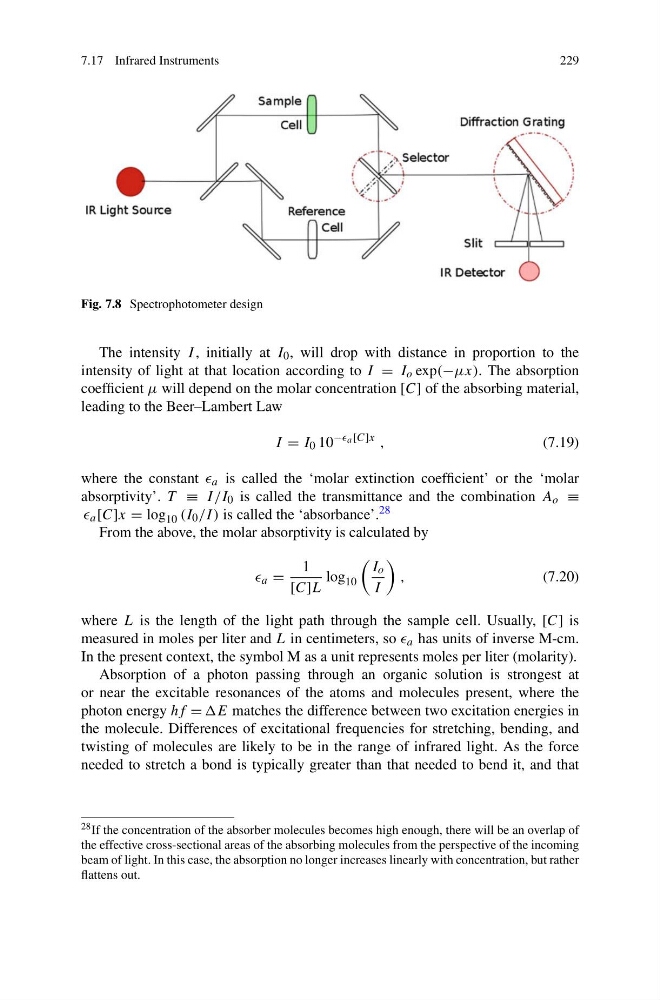
Fig. 7.8 Spectrophotometer design
The intensity I , initially at I 0 , will drop with distance in proportion to the
intensity of light at that location according to I = I o exp(−μx). The absorption
coefficient μ will depend on the molar concentration [C] of the absorbing material,
leading to the Beer–Lambert Law
I = I 0 10
− a [C]x ,
(7.19)
where the constant a is called the ‘molar extinction coefficient’ or the ‘molar
absorptivity’. T ≡ I/I 0 is called the transmittance and the combination A o ≡
a [C]x = log 10 (I 0 /I ) is called the ‘absorbance’. 28
From the above, the molar absorptivity is calculated by
a =
1
[C]L
log 10
I o
I
,
(7.20)
where L is the length of the light path through the sample cell. Usually, [C] is
measured in moles per liter and L in centimeters, so a has units of inverse M-cm.
In the present context, the symbol M as a unit represents moles per liter (molarity).
Absorption of a photon passing through an organic solution is strongest at
or near the excitable resonances of the atoms and molecules present, where the
photon energy hf = E matches the difference between two excitation energies in
the molecule. Differences of excitational frequencies for stretching, bending, and
twisting of molecules are likely to be in the range of infrared light. As the force
needed to stretch a bond is typically greater than that needed to bend it, and that
28 If the concentration of the absorber molecules becomes high enough, there will be an overlap of
the effective cross-sectional areas of the absorbing molecules from the perspective of the incoming
beam of light. In this case, the absorption no longer increases linearly with concentration, but rather
flattens out.
229
Fig. 7.8 Spectrophotometer design
The intensity I , initially at I 0 , will drop with distance in proportion to the
intensity of light at that location according to I = I o exp(−μx). The absorption
coefficient μ will depend on the molar concentration [C] of the absorbing material,
leading to the Beer–Lambert Law
I = I 0 10
− a [C]x ,
(7.19)
where the constant a is called the ‘molar extinction coefficient’ or the ‘molar
absorptivity’. T ≡ I/I 0 is called the transmittance and the combination A o ≡
a [C]x = log 10 (I 0 /I ) is called the ‘absorbance’. 28
From the above, the molar absorptivity is calculated by
a =
1
[C]L
log 10
I o
I
,
(7.20)
where L is the length of the light path through the sample cell. Usually, [C] is
measured in moles per liter and L in centimeters, so a has units of inverse M-cm.
In the present context, the symbol M as a unit represents moles per liter (molarity).
Absorption of a photon passing through an organic solution is strongest at
or near the excitable resonances of the atoms and molecules present, where the
photon energy hf = E matches the difference between two excitation energies in
the molecule. Differences of excitational frequencies for stretching, bending, and
twisting of molecules are likely to be in the range of infrared light. As the force
needed to stretch a bond is typically greater than that needed to bend it, and that
28 If the concentration of the absorber molecules becomes high enough, there will be an overlap of
the effective cross-sectional areas of the absorbing molecules from the perspective of the incoming
beam of light. In this case, the absorption no longer increases linearly with concentration, but rather
flattens out.