

7.6 Electromagnetic Waves in Materials
217
the size of this area called the ‘Fresnel zone’, i.e. the amplitude is proportional to the
wavelength squared, so that the intensity becomes proportional to wavelength to the
fourth power times the strength of radiation from a single molecule. But for each
molecule, the radiation intensity is proportional to frequency to the fourth power.
The two factors, wavelength to the fourth and frequency to the fourth, just cancel,
so that the color of the light reflected from the surface is not changed. A glass surface
reflects visible light with no discernible change in color.
The scattering of sunlight by molecules in our atmosphere is another good
example of Rayleigh scattering. Blue gets scattered by molecules in the atmosphere
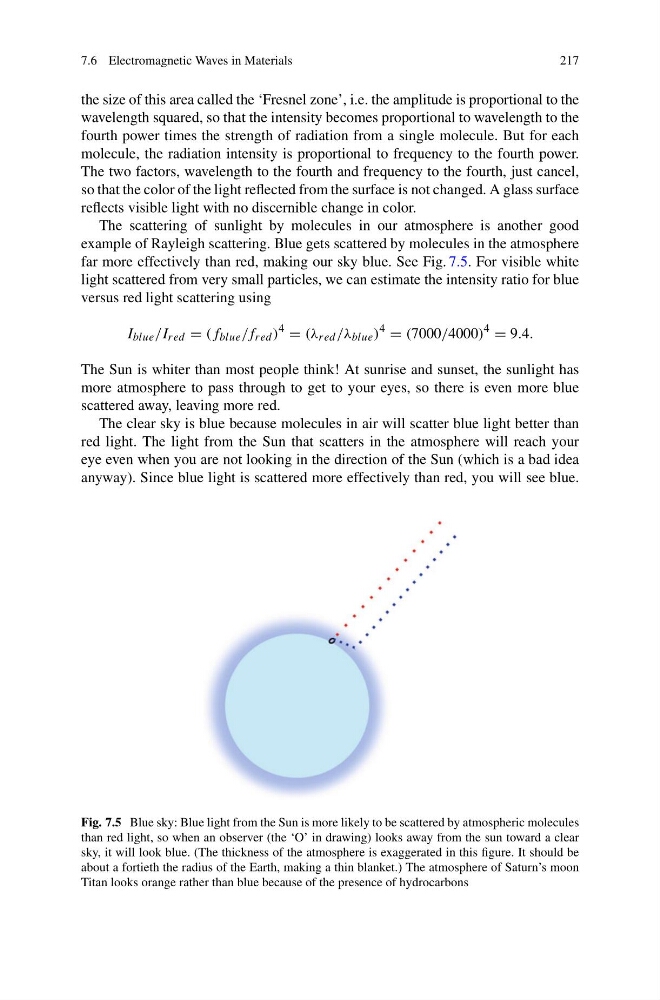
far more effectively than red, making our sky blue. See Fig. 7.5. For visible white
light scattered from very small particles, we can estimate the intensity ratio for blue
versus red light scattering using
I blue /I red = (f blue /f red )
4
= (λ red /λ blue )
4
= (7000/4000)
4
= 9.4.
The Sun is whiter than most people think! At sunrise and sunset, the sunlight has
more atmosphere to pass through to get to your eyes, so there is even more blue
scattered away, leaving more red.
The clear sky is blue because molecules in air will scatter blue light better than
red light. The light from the Sun that scatters in the atmosphere will reach your
eye even when you are not looking in the direction of the Sun (which is a bad idea
anyway). Since blue light is scattered more effectively than red, you will see blue.
Fig. 7.5 Blue sky: Blue light from the Sun is more likely to be scattered by atmospheric molecules
than red light, so when an observer (the ‘O’ in drawing) looks away from the sun toward a clear
sky, it will look blue. (The thickness of the atmosphere is exaggerated in this figure. It should be
about a fortieth the radius of the Earth, making a thin blanket.) The atmosphere of Saturn’s moon
Titan looks orange rather than blue because of the presence of hydrocarbons
217
the size of this area called the ‘Fresnel zone’, i.e. the amplitude is proportional to the
wavelength squared, so that the intensity becomes proportional to wavelength to the
fourth power times the strength of radiation from a single molecule. But for each
molecule, the radiation intensity is proportional to frequency to the fourth power.
The two factors, wavelength to the fourth and frequency to the fourth, just cancel,
so that the color of the light reflected from the surface is not changed. A glass surface
reflects visible light with no discernible change in color.
The scattering of sunlight by molecules in our atmosphere is another good
example of Rayleigh scattering. Blue gets scattered by molecules in the atmosphere
far more effectively than red, making our sky blue. See Fig. 7.5. For visible white
light scattered from very small particles, we can estimate the intensity ratio for blue
versus red light scattering using
I blue /I red = (f blue /f red )
4
= (λ red /λ blue )
4
= (7000/4000)
4
= 9.4.
The Sun is whiter than most people think! At sunrise and sunset, the sunlight has
more atmosphere to pass through to get to your eyes, so there is even more blue
scattered away, leaving more red.
The clear sky is blue because molecules in air will scatter blue light better than
red light. The light from the Sun that scatters in the atmosphere will reach your
eye even when you are not looking in the direction of the Sun (which is a bad idea
anyway). Since blue light is scattered more effectively than red, you will see blue.
Fig. 7.5 Blue sky: Blue light from the Sun is more likely to be scattered by atmospheric molecules
than red light, so when an observer (the ‘O’ in drawing) looks away from the sun toward a clear
sky, it will look blue. (The thickness of the atmosphere is exaggerated in this figure. It should be
about a fortieth the radius of the Earth, making a thin blanket.) The atmosphere of Saturn’s moon
Titan looks orange rather than blue because of the presence of hydrocarbons