

216
7 Light in Biology and Medicine
gives the limiting angular separation R , called the Rayleigh limit between the
objects which will still allow one to see two peaks in the light diffraction pattern,
and therefore be able to distinguish two objects. 16
7.6 Electromagnetic Waves in Materials
The behavior of electromagnetic waves in interaction with biological material can
be followed with solutions of the wave equation, a result of applying Maxwell’s
electromagnetic relations in regions with varying electric permittivity and magnetic
permeability but removed from the source charges and currents.
Another property of the wave solutions of Maxwell’s equations is that waves
scattered from a set of molecules can coherently add if those molecules are in
an ordered array. Scattering from dust or incoherently distributed molecules leads
to Rayleigh scattering, in which the intensity of scattering is proportional to the
frequency to the fourth power and the amplitude of the incoming wave squared.
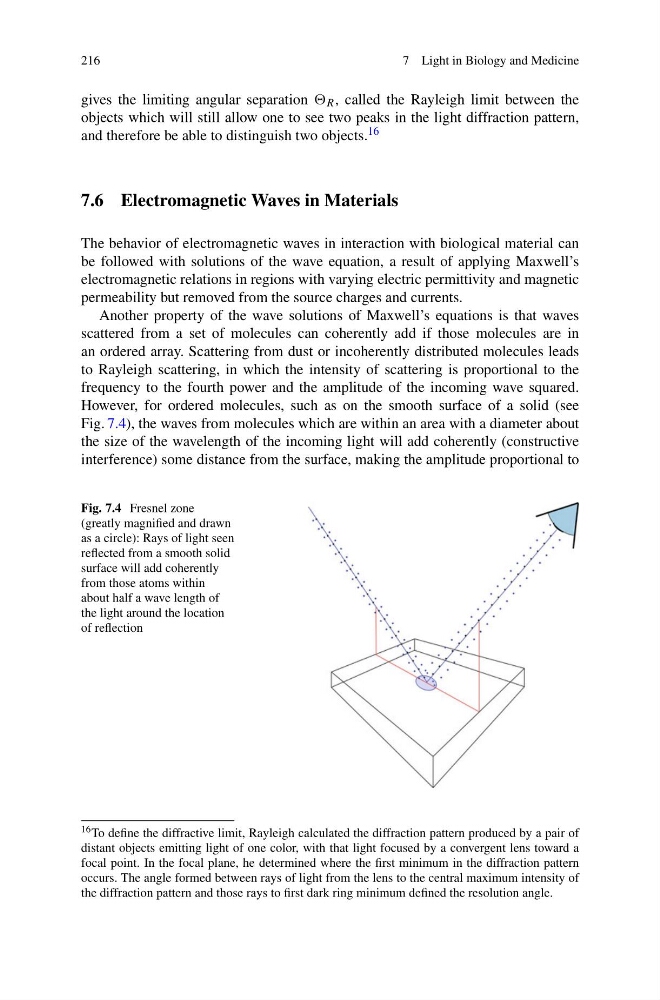
However, for ordered molecules, such as on the smooth surface of a solid (see
Fig. 7.4), the waves from molecules which are within an area with a diameter about
the size of the wavelength of the incoming light will add coherently (constructive
interference) some distance from the surface, making the amplitude proportional to
Fig. 7.4 Fresnel zone
(greatly magnified and drawn
as a circle): Rays of light seen
reflected from a smooth solid
surface will add coherently
from those atoms within
about half a wave length of
the light around the location
of reflection
16 To define the diffractive limit, Rayleigh calculated the diffraction pattern produced by a pair of
distant objects emitting light of one color, with that light focused by a convergent lens toward a
focal point. In the focal plane, he determined where the first minimum in the diffraction pattern
occurs. The angle formed between rays of light from the lens to the central maximum intensity of
the diffraction pattern and those rays to first dark ring minimum defined the resolution angle.
7 Light in Biology and Medicine
gives the limiting angular separation R , called the Rayleigh limit between the
objects which will still allow one to see two peaks in the light diffraction pattern,
and therefore be able to distinguish two objects. 16
7.6 Electromagnetic Waves in Materials
The behavior of electromagnetic waves in interaction with biological material can
be followed with solutions of the wave equation, a result of applying Maxwell’s
electromagnetic relations in regions with varying electric permittivity and magnetic
permeability but removed from the source charges and currents.
Another property of the wave solutions of Maxwell’s equations is that waves
scattered from a set of molecules can coherently add if those molecules are in
an ordered array. Scattering from dust or incoherently distributed molecules leads
to Rayleigh scattering, in which the intensity of scattering is proportional to the
frequency to the fourth power and the amplitude of the incoming wave squared.
However, for ordered molecules, such as on the smooth surface of a solid (see
Fig. 7.4), the waves from molecules which are within an area with a diameter about
the size of the wavelength of the incoming light will add coherently (constructive
interference) some distance from the surface, making the amplitude proportional to
Fig. 7.4 Fresnel zone
(greatly magnified and drawn
as a circle): Rays of light seen
reflected from a smooth solid
surface will add coherently
from those atoms within
about half a wave length of
the light around the location
of reflection
16 To define the diffractive limit, Rayleigh calculated the diffraction pattern produced by a pair of
distant objects emitting light of one color, with that light focused by a convergent lens toward a
focal point. In the focal plane, he determined where the first minimum in the diffraction pattern
occurs. The angle formed between rays of light from the lens to the central maximum intensity of
the diffraction pattern and those rays to first dark ring minimum defined the resolution angle.