

198
6 Electric and Magnetic Fields in Life
in addition to any other energy the system may hold. The magnetic dipole moment
μ comes from the motion of orbiting charge (just as the current in a coil of wire
creates a magnetic field), and from the intrinsic spin of the particles. Classically,
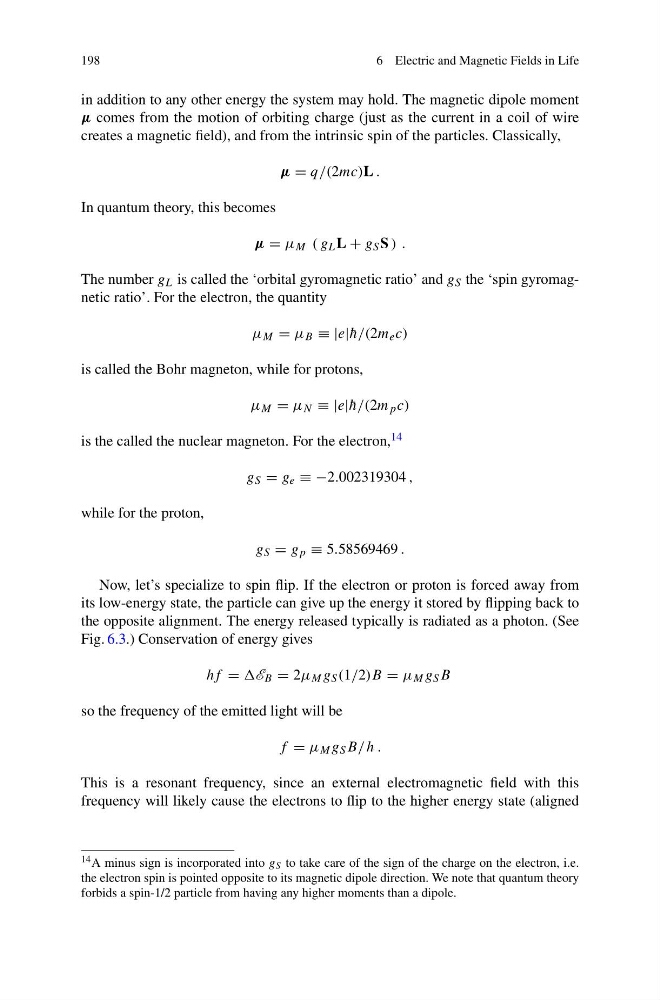
μ = q/(2mc)L .
In quantum theory, this becomes
μ = μ M ( g L L + g S S ) .
The number g L is called the ‘orbital gyromagnetic ratio’ and g S the ‘spin gyromagnetic ratio’. For the electron, the quantity
μ M = μ B ≡ |e| ¯
h/(2m e c)
is called the Bohr magneton, while for protons,
μ M = μ N ≡ |e| ¯
h/(2m p c)
is the called the nuclear magneton. For the electron, 14
g S = g e ≡ −2.002319304 ,
while for the proton,
g S = g p ≡ 5.58569469 .
Now, let’s specialize to spin flip. If the electron or proton is forced away from
its low-energy state, the particle can give up the energy it stored by flipping back to
the opposite alignment. The energy released typically is radiated as a photon. (See
Fig. 6.3.) Conservation of energy gives
hf = E B = 2μ M g S (1/2)B = μ M g S B
so the frequency of the emitted light will be
f = μ M g S B/ h .
This is a resonant frequency, since an external electromagnetic field with this
frequency will likely cause the electrons to flip to the higher energy state (aligned
14 A minus sign is incorporated into g S to take care of the sign of the charge on the electron, i.e.
the electron spin is pointed opposite to its magnetic dipole direction. We note that quantum theory
forbids a spin-1/2 particle from having any higher moments than a dipole.
6 Electric and Magnetic Fields in Life
in addition to any other energy the system may hold. The magnetic dipole moment
μ comes from the motion of orbiting charge (just as the current in a coil of wire
creates a magnetic field), and from the intrinsic spin of the particles. Classically,
μ = q/(2mc)L .
In quantum theory, this becomes
μ = μ M ( g L L + g S S ) .
The number g L is called the ‘orbital gyromagnetic ratio’ and g S the ‘spin gyromagnetic ratio’. For the electron, the quantity
μ M = μ B ≡ |e| ¯
h/(2m e c)
is called the Bohr magneton, while for protons,
μ M = μ N ≡ |e| ¯
h/(2m p c)
is the called the nuclear magneton. For the electron, 14
g S = g e ≡ −2.002319304 ,
while for the proton,
g S = g p ≡ 5.58569469 .
Now, let’s specialize to spin flip. If the electron or proton is forced away from
its low-energy state, the particle can give up the energy it stored by flipping back to
the opposite alignment. The energy released typically is radiated as a photon. (See
Fig. 6.3.) Conservation of energy gives
hf = E B = 2μ M g S (1/2)B = μ M g S B
so the frequency of the emitted light will be
f = μ M g S B/ h .
This is a resonant frequency, since an external electromagnetic field with this
frequency will likely cause the electrons to flip to the higher energy state (aligned
14 A minus sign is incorporated into g S to take care of the sign of the charge on the electron, i.e.
the electron spin is pointed opposite to its magnetic dipole direction. We note that quantum theory
forbids a spin-1/2 particle from having any higher moments than a dipole.