

6.6 Spin Resonance Devices
197
is bound with an orbital motion around some center, its angular momentum L is
also quantized, with magnitude
√
(( + 1 ¯
h, but now only the values 0, 1, 2, · · · are
allowed for .
We use the index s to label the particles. Relativistic quantum theory also requires
that the integer spin particles are ‘bosons’ (with any number in one quantum state)
and the half-odd integer spins are ‘fermions’ (with only one such particle permitted
in each quantum state). Electrons and protons carry an intrinsic spin with s = 1/2.
Because they also carry a charge, their spin gives them an intrinsic magnetic moment
μ. 13
Having a magnetic moment, the spins of electrons and protons will tend to
anti-align or align with an external magnetic field, just as toy magnets do. But
quantum theory makes the projection of the electron or proton spin along the
external field have only two values when s = 1/2, given by m s ¯
h = ±(1/2) ¯
h.
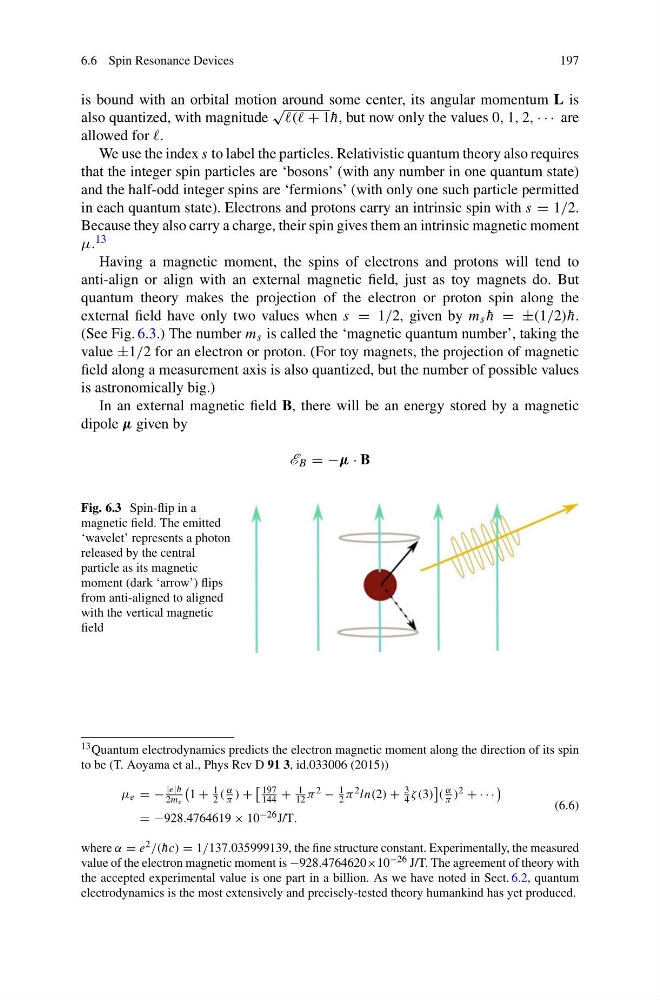
(See Fig. 6.3.) The number m s is called the ‘magnetic quantum number’, taking the
value ±1/2 for an electron or proton. (For toy magnets, the projection of magnetic
field along a measurement axis is also quantized, but the number of possible values
is astronomically big.)
In an external magnetic field B, there will be an energy stored by a magnetic
dipole μ given by
E B = −μ · B
Fig. 6.3 Spin-flip in a
magnetic field. The emitted
‘wavelet’ represents a photon
released by the central
particle as its magnetic
moment (dark ‘arrow’) flips
from anti-aligned to aligned
with the vertical magnetic
field
13 Quantum electrodynamics predicts the electron magnetic moment along the direction of its spin
to be (T. Aoyama et al., Phys Rev D 91 3, id.033006 (2015))
μ e = −
|e| ¯
h
2me
1 +
1
2 (
α
π ) +
197
144 +
1
12 π 2 −
1
2 π 2 ln(2) +
3
4 ζ(3)
(
α
π ) 2 + · · ·
= −928.4764619 × 10 −26 J/T.
(6.6)
where α = e 2 /( ¯
hc) = 1/137.035999139, the fine structure constant. Experimentally, the measured
value of the electron magnetic moment is −928.4764620×10 −26 J/T. The agreement of theory with
the accepted experimental value is one part in a billion. As we have noted in Sect. 6.2, quantum
electrodynamics is the most extensively and precisely-tested theory humankind has yet produced.
197
is bound with an orbital motion around some center, its angular momentum L is
also quantized, with magnitude
√
(( + 1 ¯
h, but now only the values 0, 1, 2, · · · are
allowed for .
We use the index s to label the particles. Relativistic quantum theory also requires
that the integer spin particles are ‘bosons’ (with any number in one quantum state)
and the half-odd integer spins are ‘fermions’ (with only one such particle permitted
in each quantum state). Electrons and protons carry an intrinsic spin with s = 1/2.
Because they also carry a charge, their spin gives them an intrinsic magnetic moment
μ. 13
Having a magnetic moment, the spins of electrons and protons will tend to
anti-align or align with an external magnetic field, just as toy magnets do. But
quantum theory makes the projection of the electron or proton spin along the
external field have only two values when s = 1/2, given by m s ¯
h = ±(1/2) ¯
h.
(See Fig. 6.3.) The number m s is called the ‘magnetic quantum number’, taking the
value ±1/2 for an electron or proton. (For toy magnets, the projection of magnetic
field along a measurement axis is also quantized, but the number of possible values
is astronomically big.)
In an external magnetic field B, there will be an energy stored by a magnetic
dipole μ given by
E B = −μ · B
Fig. 6.3 Spin-flip in a
magnetic field. The emitted
‘wavelet’ represents a photon
released by the central
particle as its magnetic
moment (dark ‘arrow’) flips
from anti-aligned to aligned
with the vertical magnetic
field
13 Quantum electrodynamics predicts the electron magnetic moment along the direction of its spin
to be (T. Aoyama et al., Phys Rev D 91 3, id.033006 (2015))
μ e = −
|e| ¯
h
2me
1 +
1
2 (
α
π ) +
197
144 +
1
12 π 2 −
1
2 π 2 ln(2) +
3
4 ζ(3)
(
α
π ) 2 + · · ·
= −928.4764619 × 10 −26 J/T.
(6.6)
where α = e 2 /( ¯
hc) = 1/137.035999139, the fine structure constant. Experimentally, the measured
value of the electron magnetic moment is −928.4764620×10 −26 J/T. The agreement of theory with
the accepted experimental value is one part in a billion. As we have noted in Sect. 6.2, quantum
electrodynamics is the most extensively and precisely-tested theory humankind has yet produced.