

192
6 Electric and Magnetic Fields in Life
small stresses, and for facilitating blood flow. However, since the effects is weak,
caution is advised until careful science evidence is collected.
6.5.3 Electric Fields in the Atmosphere and Lightning
The electric field on a clear day is about 100 V/m downward. At 10 km up in clear
air, the field may be only 5 V/m. Now, you ask, why do we not feel this electric field
of almost 200 V standing in an open field? The answer is that with salty water in
our bodies, we are a fairly good conductor. Electrons come from the ground into our
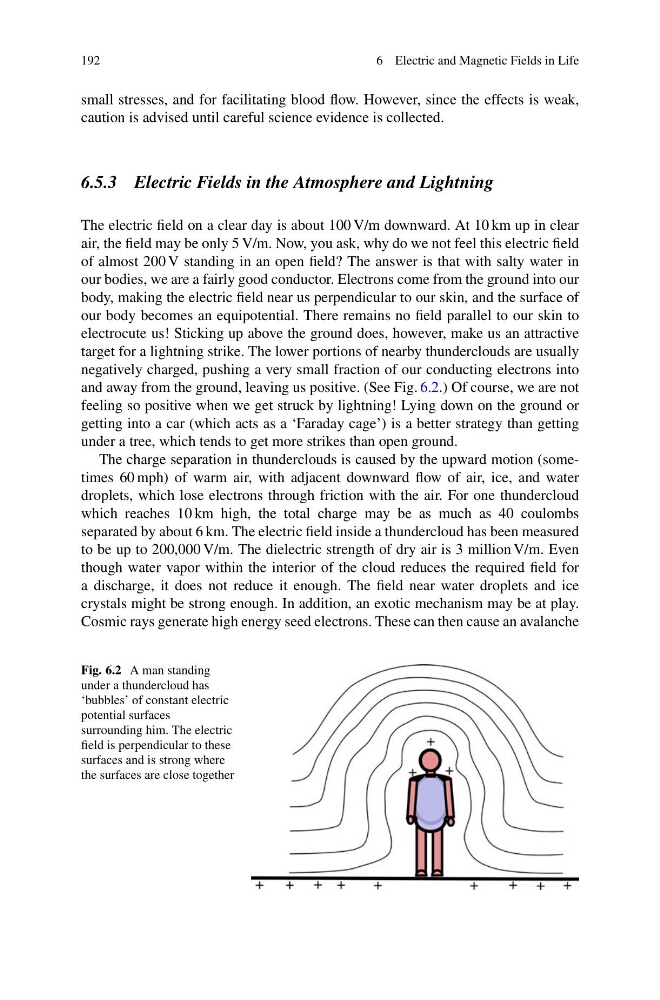
body, making the electric field near us perpendicular to our skin, and the surface of
our body becomes an equipotential. There remains no field parallel to our skin to
electrocute us! Sticking up above the ground does, however, make us an attractive
target for a lightning strike. The lower portions of nearby thunderclouds are usually
negatively charged, pushing a very small fraction of our conducting electrons into
and away from the ground, leaving us positive. (See Fig. 6.2.) Of course, we are not
feeling so positive when we get struck by lightning! Lying down on the ground or
getting into a car (which acts as a ‘Faraday cage’) is a better strategy than getting
under a tree, which tends to get more strikes than open ground.
The charge separation in thunderclouds is caused by the upward motion (sometimes 60 mph) of warm air, with adjacent downward flow of air, ice, and water
droplets, which lose electrons through friction with the air. For one thundercloud
which reaches 10 km high, the total charge may be as much as 40 coulombs
separated by about 6 km. The electric field inside a thundercloud has been measured
to be up to 200,000 V/m. The dielectric strength of dry air is 3 million V/m. Even
though water vapor within the interior of the cloud reduces the required field for
a discharge, it does not reduce it enough. The field near water droplets and ice
crystals might be strong enough. In addition, an exotic mechanism may be at play.
Cosmic rays generate high energy seed electrons. These can then cause an avalanche
Fig. 6.2 A man standing
under a thundercloud has
‘bubbles’ of constant electric
potential surfaces
surrounding him. The electric
field is perpendicular to these
surfaces and is strong where
the surfaces are close together
6 Electric and Magnetic Fields in Life
small stresses, and for facilitating blood flow. However, since the effects is weak,
caution is advised until careful science evidence is collected.
6.5.3 Electric Fields in the Atmosphere and Lightning
The electric field on a clear day is about 100 V/m downward. At 10 km up in clear
air, the field may be only 5 V/m. Now, you ask, why do we not feel this electric field
of almost 200 V standing in an open field? The answer is that with salty water in
our bodies, we are a fairly good conductor. Electrons come from the ground into our
body, making the electric field near us perpendicular to our skin, and the surface of
our body becomes an equipotential. There remains no field parallel to our skin to
electrocute us! Sticking up above the ground does, however, make us an attractive
target for a lightning strike. The lower portions of nearby thunderclouds are usually
negatively charged, pushing a very small fraction of our conducting electrons into
and away from the ground, leaving us positive. (See Fig. 6.2.) Of course, we are not
feeling so positive when we get struck by lightning! Lying down on the ground or
getting into a car (which acts as a ‘Faraday cage’) is a better strategy than getting
under a tree, which tends to get more strikes than open ground.
The charge separation in thunderclouds is caused by the upward motion (sometimes 60 mph) of warm air, with adjacent downward flow of air, ice, and water
droplets, which lose electrons through friction with the air. For one thundercloud
which reaches 10 km high, the total charge may be as much as 40 coulombs
separated by about 6 km. The electric field inside a thundercloud has been measured
to be up to 200,000 V/m. The dielectric strength of dry air is 3 million V/m. Even
though water vapor within the interior of the cloud reduces the required field for
a discharge, it does not reduce it enough. The field near water droplets and ice
crystals might be strong enough. In addition, an exotic mechanism may be at play.
Cosmic rays generate high energy seed electrons. These can then cause an avalanche
Fig. 6.2 A man standing
under a thundercloud has
‘bubbles’ of constant electric
potential surfaces
surrounding him. The electric
field is perpendicular to these
surfaces and is strong where
the surfaces are close together