

6.5 Measuring Electric and Magnetic Fields
191
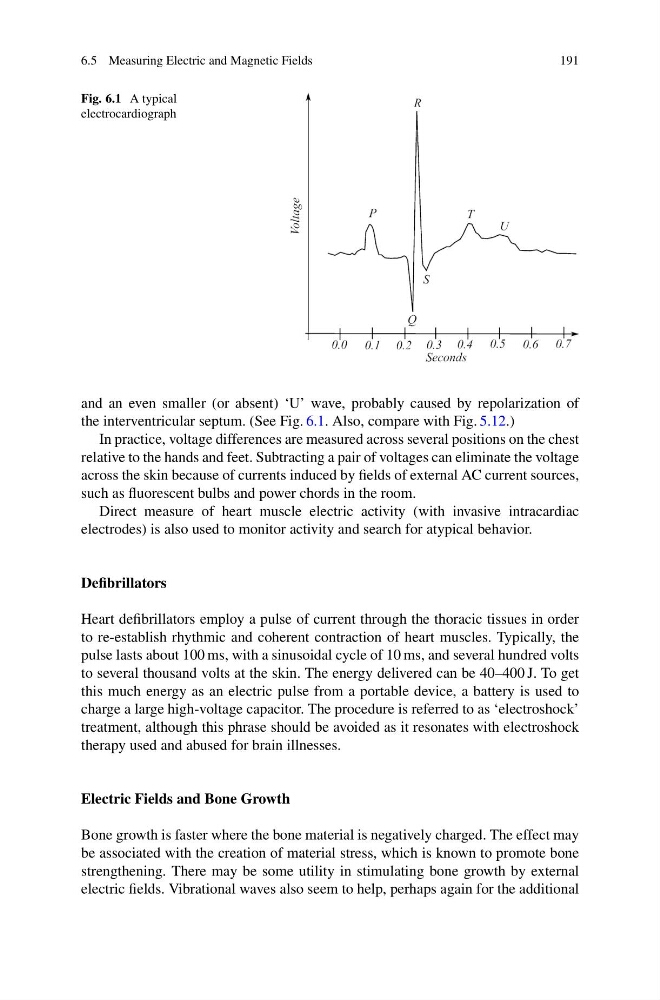
Fig. 6.1 A typical
electrocardiograph
and an even smaller (or absent) ‘U’ wave, probably caused by repolarization of
the interventricular septum. (See Fig. 6.1. Also, compare with Fig. 5.12.)
In practice, voltage differences are measured across several positions on the chest
relative to the hands and feet. Subtracting a pair of voltages can eliminate the voltage
across the skin because of currents induced by fields of external AC current sources,
such as fluorescent bulbs and power chords in the room.
Direct measure of heart muscle electric activity (with invasive intracardiac
electrodes) is also used to monitor activity and search for atypical behavior.
Defibrillators
Heart defibrillators employ a pulse of current through the thoracic tissues in order
to re-establish rhythmic and coherent contraction of heart muscles. Typically, the
pulse lasts about 100 ms, with a sinusoidal cycle of 10 ms, and several hundred volts
to several thousand volts at the skin. The energy delivered can be 40–400 J. To get
this much energy as an electric pulse from a portable device, a battery is used to
charge a large high-voltage capacitor. The procedure is referred to as ‘electroshock’
treatment, although this phrase should be avoided as it resonates with electroshock
therapy used and abused for brain illnesses.
Electric Fields and Bone Growth
Bone growth is faster where the bone material is negatively charged. The effect may
be associated with the creation of material stress, which is known to promote bone
strengthening. There may be some utility in stimulating bone growth by external
electric fields. Vibrational waves also seem to help, perhaps again for the additional
191
Fig. 6.1 A typical
electrocardiograph
and an even smaller (or absent) ‘U’ wave, probably caused by repolarization of
the interventricular septum. (See Fig. 6.1. Also, compare with Fig. 5.12.)
In practice, voltage differences are measured across several positions on the chest
relative to the hands and feet. Subtracting a pair of voltages can eliminate the voltage
across the skin because of currents induced by fields of external AC current sources,
such as fluorescent bulbs and power chords in the room.
Direct measure of heart muscle electric activity (with invasive intracardiac
electrodes) is also used to monitor activity and search for atypical behavior.
Defibrillators
Heart defibrillators employ a pulse of current through the thoracic tissues in order
to re-establish rhythmic and coherent contraction of heart muscles. Typically, the
pulse lasts about 100 ms, with a sinusoidal cycle of 10 ms, and several hundred volts
to several thousand volts at the skin. The energy delivered can be 40–400 J. To get
this much energy as an electric pulse from a portable device, a battery is used to
charge a large high-voltage capacitor. The procedure is referred to as ‘electroshock’
treatment, although this phrase should be avoided as it resonates with electroshock
therapy used and abused for brain illnesses.
Electric Fields and Bone Growth
Bone growth is faster where the bone material is negatively charged. The effect may
be associated with the creation of material stress, which is known to promote bone
strengthening. There may be some utility in stimulating bone growth by external
electric fields. Vibrational waves also seem to help, perhaps again for the additional