

174
5 Acoustics in Biology and Medicine
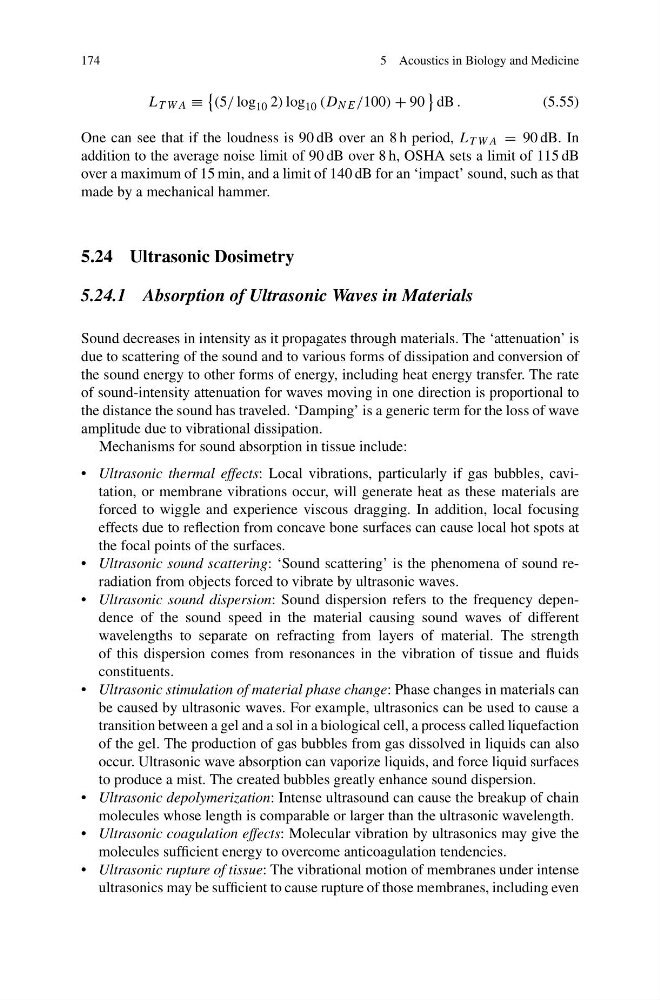
L T WA ≡
(5/ log 10 2) log 10 (D NE /100) + 90
dB .
(5.55)
One can see that if the loudness is 90 dB over an 8 h period, L T WA = 90 dB. In
addition to the average noise limit of 90 dB over 8 h, OSHA sets a limit of 115 dB
over a maximum of 15 min, and a limit of 140 dB for an ‘impact’ sound, such as that
made by a mechanical hammer.
5.24 Ultrasonic Dosimetry
5.24.1 Absorption of Ultrasonic Waves in Materials
Sound decreases in intensity as it propagates through materials. The ‘attenuation’ is
due to scattering of the sound and to various forms of dissipation and conversion of
the sound energy to other forms of energy, including heat energy transfer. The rate
of sound-intensity attenuation for waves moving in one direction is proportional to
the distance the sound has traveled. ‘Damping’ is a generic term for the loss of wave
amplitude due to vibrational dissipation.
Mechanisms for sound absorption in tissue include:
• Ultrasonic thermal effects: Local vibrations, particularly if gas bubbles, cavitation, or membrane vibrations occur, will generate heat as these materials are
forced to wiggle and experience viscous dragging. In addition, local focusing
effects due to reflection from concave bone surfaces can cause local hot spots at
the focal points of the surfaces.
• Ultrasonic sound scattering: ‘Sound scattering’ is the phenomena of sound reradiation from objects forced to vibrate by ultrasonic waves.
• Ultrasonic sound dispersion: Sound dispersion refers to the frequency dependence of the sound speed in the material causing sound waves of different
wavelengths to separate on refracting from layers of material. The strength
of this dispersion comes from resonances in the vibration of tissue and fluids
constituents.
• Ultrasonic stimulation of material phase change: Phase changes in materials can
be caused by ultrasonic waves. For example, ultrasonics can be used to cause a
transition between a gel and a sol in a biological cell, a process called liquefaction
of the gel. The production of gas bubbles from gas dissolved in liquids can also
occur. Ultrasonic wave absorption can vaporize liquids, and force liquid surfaces
to produce a mist. The created bubbles greatly enhance sound dispersion.
• Ultrasonic depolymerization: Intense ultrasound can cause the breakup of chain
molecules whose length is comparable or larger than the ultrasonic wavelength.
• Ultrasonic coagulation effects: Molecular vibration by ultrasonics may give the
molecules sufficient energy to overcome anticoagulation tendencies.
• Ultrasonic rupture of tissue: The vibrational motion of membranes under intense
ultrasonics may be sufficient to cause rupture of those membranes, including even
5 Acoustics in Biology and Medicine
L T WA ≡
(5/ log 10 2) log 10 (D NE /100) + 90
dB .
(5.55)
One can see that if the loudness is 90 dB over an 8 h period, L T WA = 90 dB. In
addition to the average noise limit of 90 dB over 8 h, OSHA sets a limit of 115 dB
over a maximum of 15 min, and a limit of 140 dB for an ‘impact’ sound, such as that
made by a mechanical hammer.
5.24 Ultrasonic Dosimetry
5.24.1 Absorption of Ultrasonic Waves in Materials
Sound decreases in intensity as it propagates through materials. The ‘attenuation’ is
due to scattering of the sound and to various forms of dissipation and conversion of
the sound energy to other forms of energy, including heat energy transfer. The rate
of sound-intensity attenuation for waves moving in one direction is proportional to
the distance the sound has traveled. ‘Damping’ is a generic term for the loss of wave
amplitude due to vibrational dissipation.
Mechanisms for sound absorption in tissue include:
• Ultrasonic thermal effects: Local vibrations, particularly if gas bubbles, cavitation, or membrane vibrations occur, will generate heat as these materials are
forced to wiggle and experience viscous dragging. In addition, local focusing
effects due to reflection from concave bone surfaces can cause local hot spots at
the focal points of the surfaces.
• Ultrasonic sound scattering: ‘Sound scattering’ is the phenomena of sound reradiation from objects forced to vibrate by ultrasonic waves.
• Ultrasonic sound dispersion: Sound dispersion refers to the frequency dependence of the sound speed in the material causing sound waves of different
wavelengths to separate on refracting from layers of material. The strength
of this dispersion comes from resonances in the vibration of tissue and fluids
constituents.
• Ultrasonic stimulation of material phase change: Phase changes in materials can
be caused by ultrasonic waves. For example, ultrasonics can be used to cause a
transition between a gel and a sol in a biological cell, a process called liquefaction
of the gel. The production of gas bubbles from gas dissolved in liquids can also
occur. Ultrasonic wave absorption can vaporize liquids, and force liquid surfaces
to produce a mist. The created bubbles greatly enhance sound dispersion.
• Ultrasonic depolymerization: Intense ultrasound can cause the breakup of chain
molecules whose length is comparable or larger than the ultrasonic wavelength.
• Ultrasonic coagulation effects: Molecular vibration by ultrasonics may give the
molecules sufficient energy to overcome anticoagulation tendencies.
• Ultrasonic rupture of tissue: The vibrational motion of membranes under intense
ultrasonics may be sufficient to cause rupture of those membranes, including even