

5.23 Acoustical Dosimetry
173
have amplified sound above 120 dB) and even movie theaters will have diminished
response to the corresponding frequencies of high-level sound. The loss mechanism
is breakage of the auditory hairs (stereocilia) and loss of the hair cells in the inner
ear (cochlea), usually first at the high-frequency end. However, even infrasound
above 120 dB can damage hair cells. These hair cells do not appear to regenerate in
mammals (although they do seem to get repaired in birds and fish).
Hand-held acoustical dosimeters measure sound decibel levels over a range of
frequencies. A-weighting emphasizes the middle range of frequencies from about
200 Hz to 2 kHz. B-weighting includes more low tones down to about 50 Hz. The
C-weighting accounts for all frequencies from 30 Hz to 10 Hz about equally. A Dweighting is like B, but is made more sensitive in the frequencies 2–8 kHz where
aircraft jet engines have a peaked emission. If no weighting is used, the meter is on
a Z (for zero weighting) setting. 28
For persistent sound, such as in a workplace, standards are set by both national
and international committees. For the United States, the Occupational Safety and
Health Administration (OSHA) sets limits on exposure to noise to be 90 dB over
an 8-h period, using an ‘A’ filter on the sound level. 29 For each increase in
loudness by 5 dB, the maximum exposure time is halved. Taking these limits
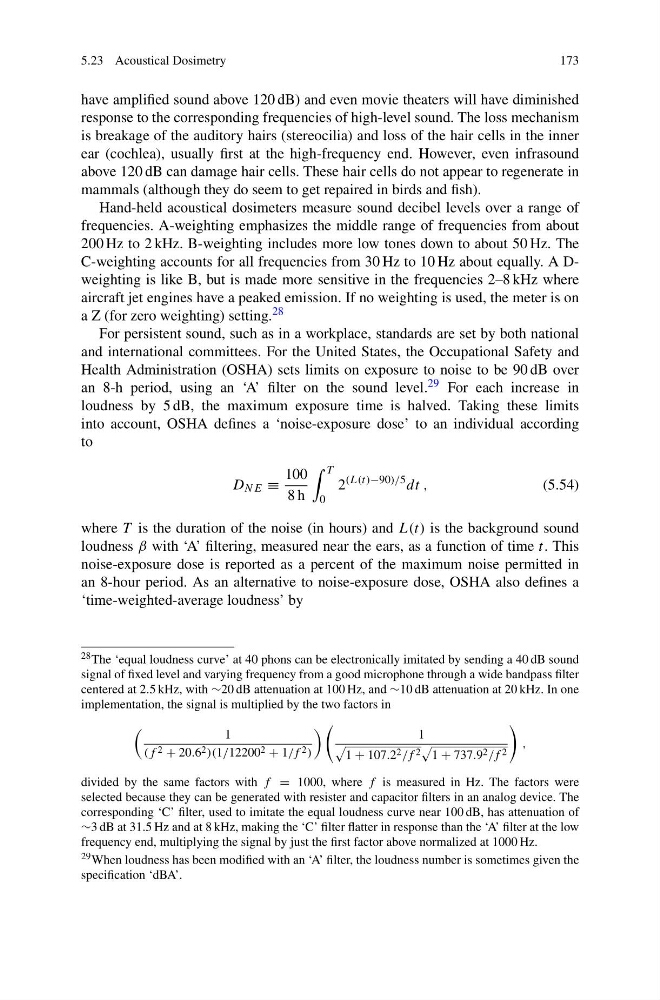
into account, OSHA defines a ‘noise-exposure dose’ to an individual according
to
D NE ≡
100
8 h
T
0
2
(L(t)−90)/5 dt ,
(5.54)
where T is the duration of the noise (in hours) and L(t) is the background sound
loudness β with ‘A’ filtering, measured near the ears, as a function of time t. This
noise-exposure dose is reported as a percent of the maximum noise permitted in
an 8-hour period. As an alternative to noise-exposure dose, OSHA also defines a
‘time-weighted-average loudness’ by
28 The ‘equal loudness curve’ at 40 phons can be electronically imitated by sending a 40 dB sound
signal of fixed level and varying frequency from a good microphone through a wide bandpass filter
centered at 2.5 kHz, with ∼20 dB attenuation at 100 Hz, and ∼10 dB attenuation at 20 kHz. In one
implementation, the signal is multiplied by the two factors in
1
(f 2 + 20.6 2 )(1/12200 2 + 1/f 2 )
1
1 + 107.2 2 /f 2
1 + 737.9 2 /f 2
,
divided by the same factors with f = 1000, where f is measured in Hz. The factors were
selected because they can be generated with resister and capacitor filters in an analog device. The
corresponding ‘C’ filter, used to imitate the equal loudness curve near 100 dB, has attenuation of
∼3 dB at 31.5 Hz and at 8 kHz, making the ‘C’ filter flatter in response than the ‘A’ filter at the low
frequency end, multiplying the signal by just the first factor above normalized at 1000 Hz.
29 When loudness has been modified with an ‘A’ filter, the loudness number is sometimes given the
specification ‘dBA’.
173
have amplified sound above 120 dB) and even movie theaters will have diminished
response to the corresponding frequencies of high-level sound. The loss mechanism
is breakage of the auditory hairs (stereocilia) and loss of the hair cells in the inner
ear (cochlea), usually first at the high-frequency end. However, even infrasound
above 120 dB can damage hair cells. These hair cells do not appear to regenerate in
mammals (although they do seem to get repaired in birds and fish).
Hand-held acoustical dosimeters measure sound decibel levels over a range of
frequencies. A-weighting emphasizes the middle range of frequencies from about
200 Hz to 2 kHz. B-weighting includes more low tones down to about 50 Hz. The
C-weighting accounts for all frequencies from 30 Hz to 10 Hz about equally. A Dweighting is like B, but is made more sensitive in the frequencies 2–8 kHz where
aircraft jet engines have a peaked emission. If no weighting is used, the meter is on
a Z (for zero weighting) setting. 28
For persistent sound, such as in a workplace, standards are set by both national
and international committees. For the United States, the Occupational Safety and
Health Administration (OSHA) sets limits on exposure to noise to be 90 dB over
an 8-h period, using an ‘A’ filter on the sound level. 29 For each increase in
loudness by 5 dB, the maximum exposure time is halved. Taking these limits
into account, OSHA defines a ‘noise-exposure dose’ to an individual according
to
D NE ≡
100
8 h
T
0
2
(L(t)−90)/5 dt ,
(5.54)
where T is the duration of the noise (in hours) and L(t) is the background sound
loudness β with ‘A’ filtering, measured near the ears, as a function of time t. This
noise-exposure dose is reported as a percent of the maximum noise permitted in
an 8-hour period. As an alternative to noise-exposure dose, OSHA also defines a
‘time-weighted-average loudness’ by
28 The ‘equal loudness curve’ at 40 phons can be electronically imitated by sending a 40 dB sound
signal of fixed level and varying frequency from a good microphone through a wide bandpass filter
centered at 2.5 kHz, with ∼20 dB attenuation at 100 Hz, and ∼10 dB attenuation at 20 kHz. In one
implementation, the signal is multiplied by the two factors in
1
(f 2 + 20.6 2 )(1/12200 2 + 1/f 2 )
1
1 + 107.2 2 /f 2
1 + 737.9 2 /f 2
,
divided by the same factors with f = 1000, where f is measured in Hz. The factors were
selected because they can be generated with resister and capacitor filters in an analog device. The
corresponding ‘C’ filter, used to imitate the equal loudness curve near 100 dB, has attenuation of
∼3 dB at 31.5 Hz and at 8 kHz, making the ‘C’ filter flatter in response than the ‘A’ filter at the low
frequency end, multiplying the signal by just the first factor above normalized at 1000 Hz.
29 When loudness has been modified with an ‘A’ filter, the loudness number is sometimes given the
specification ‘dBA’.