

5.22 Medical Applications of Ultrasonics
169
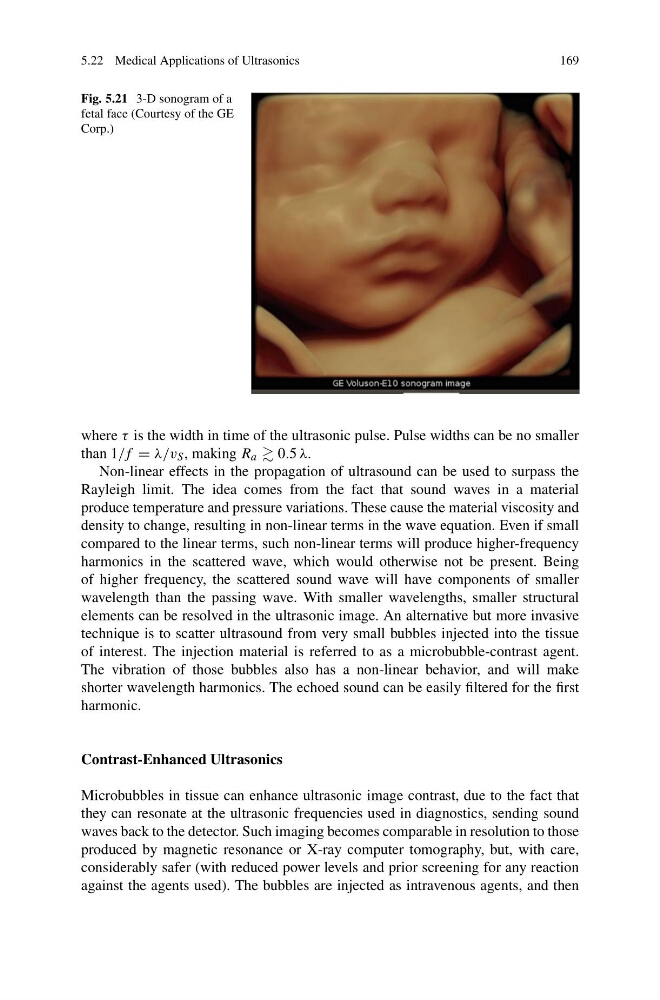
Fig. 5.21 3-D sonogram of a
fetal face (Courtesy of the GE
Corp.)
where τ is the width in time of the ultrasonic pulse. Pulse widths can be no smaller
than 1/f = λ/v S , making R a 0.5 λ.
Non-linear effects in the propagation of ultrasound can be used to surpass the
Rayleigh limit. The idea comes from the fact that sound waves in a material
produce temperature and pressure variations. These cause the material viscosity and
density to change, resulting in non-linear terms in the wave equation. Even if small
compared to the linear terms, such non-linear terms will produce higher-frequency
harmonics in the scattered wave, which would otherwise not be present. Being
of higher frequency, the scattered sound wave will have components of smaller
wavelength than the passing wave. With smaller wavelengths, smaller structural
elements can be resolved in the ultrasonic image. An alternative but more invasive
technique is to scatter ultrasound from very small bubbles injected into the tissue
of interest. The injection material is referred to as a microbubble-contrast agent.
The vibration of those bubbles also has a non-linear behavior, and will make
shorter wavelength harmonics. The echoed sound can be easily filtered for the first
harmonic.
Contrast-Enhanced Ultrasonics
Microbubbles in tissue can enhance ultrasonic image contrast, due to the fact that
they can resonate at the ultrasonic frequencies used in diagnostics, sending sound
waves back to the detector. Such imaging becomes comparable in resolution to those
produced by magnetic resonance or X-ray computer tomography, but, with care,
considerably safer (with reduced power levels and prior screening for any reaction
against the agents used). The bubbles are injected as intravenous agents, and then
169
Fig. 5.21 3-D sonogram of a
fetal face (Courtesy of the GE
Corp.)
where τ is the width in time of the ultrasonic pulse. Pulse widths can be no smaller
than 1/f = λ/v S , making R a 0.5 λ.
Non-linear effects in the propagation of ultrasound can be used to surpass the
Rayleigh limit. The idea comes from the fact that sound waves in a material
produce temperature and pressure variations. These cause the material viscosity and
density to change, resulting in non-linear terms in the wave equation. Even if small
compared to the linear terms, such non-linear terms will produce higher-frequency
harmonics in the scattered wave, which would otherwise not be present. Being
of higher frequency, the scattered sound wave will have components of smaller
wavelength than the passing wave. With smaller wavelengths, smaller structural
elements can be resolved in the ultrasonic image. An alternative but more invasive
technique is to scatter ultrasound from very small bubbles injected into the tissue
of interest. The injection material is referred to as a microbubble-contrast agent.
The vibration of those bubbles also has a non-linear behavior, and will make
shorter wavelength harmonics. The echoed sound can be easily filtered for the first
harmonic.
Contrast-Enhanced Ultrasonics
Microbubbles in tissue can enhance ultrasonic image contrast, due to the fact that
they can resonate at the ultrasonic frequencies used in diagnostics, sending sound
waves back to the detector. Such imaging becomes comparable in resolution to those
produced by magnetic resonance or X-ray computer tomography, but, with care,
considerably safer (with reduced power levels and prior screening for any reaction
against the agents used). The bubbles are injected as intravenous agents, and then