

166
5 Acoustics in Biology and Medicine
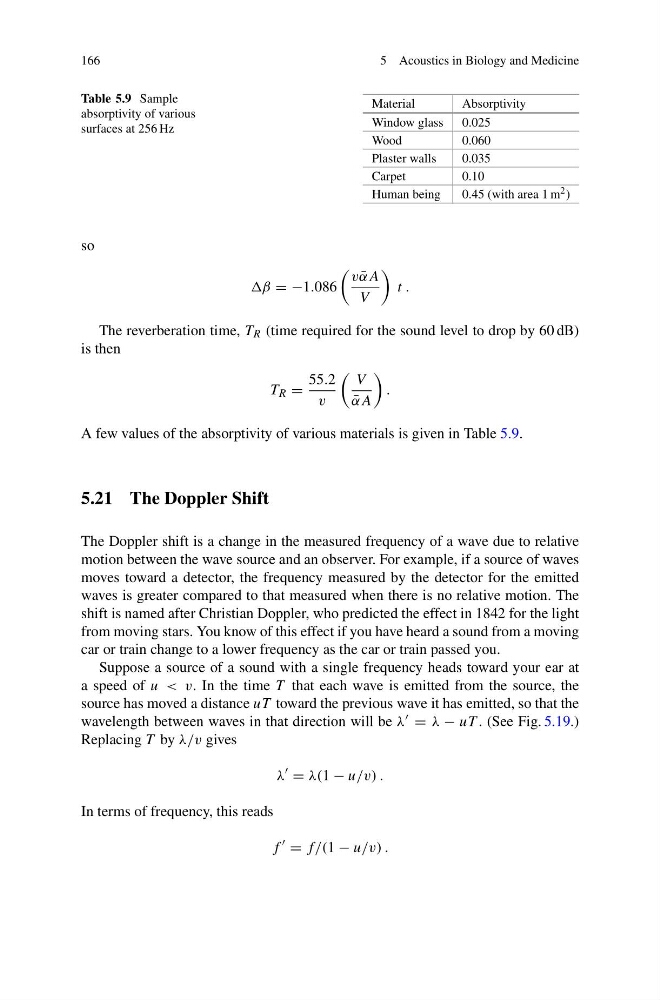
Table 5.9 Sample
absorptivity of various
surfaces at 256 Hz
Material
Absorptivity
Window glass 0.025
Wood
0.060
Plaster walls
0.035
Carpet
0.10
Human being
0.45 (with area 1 m 2 )
so
β = −1.086
v ¯
αA
V
t .
The reverberation time, T R (time required for the sound level to drop by 60 dB)
is then
T R =
55.2
v
V
¯
αA
.
A few values of the absorptivity of various materials is given in Table 5.9.
5.21 The Doppler Shift
The Doppler shift is a change in the measured frequency of a wave due to relative
motion between the wave source and an observer. For example, if a source of waves
moves toward a detector, the frequency measured by the detector for the emitted
waves is greater compared to that measured when there is no relative motion. The
shift is named after Christian Doppler, who predicted the effect in 1842 for the light
from moving stars. You know of this effect if you have heard a sound from a moving
car or train change to a lower frequency as the car or train passed you.
Suppose a source of a sound with a single frequency heads toward your ear at
a speed of u < v. In the time T that each wave is emitted from the source, the
source has moved a distance uT toward the previous wave it has emitted, so that the
wavelength between waves in that direction will be λ = λ − uT . (See Fig. 5.19.)
Replacing T by λ/v gives
λ
= λ(1 − u/v) .
In terms of frequency, this reads
f
= f/(1 − u/v) .
5 Acoustics in Biology and Medicine
Table 5.9 Sample
absorptivity of various
surfaces at 256 Hz
Material
Absorptivity
Window glass 0.025
Wood
0.060
Plaster walls
0.035
Carpet
0.10
Human being
0.45 (with area 1 m 2 )
so
β = −1.086
v ¯
αA
V
t .
The reverberation time, T R (time required for the sound level to drop by 60 dB)
is then
T R =
55.2
v
V
¯
αA
.
A few values of the absorptivity of various materials is given in Table 5.9.
5.21 The Doppler Shift
The Doppler shift is a change in the measured frequency of a wave due to relative
motion between the wave source and an observer. For example, if a source of waves
moves toward a detector, the frequency measured by the detector for the emitted
waves is greater compared to that measured when there is no relative motion. The
shift is named after Christian Doppler, who predicted the effect in 1842 for the light
from moving stars. You know of this effect if you have heard a sound from a moving
car or train change to a lower frequency as the car or train passed you.
Suppose a source of a sound with a single frequency heads toward your ear at
a speed of u < v. In the time T that each wave is emitted from the source, the
source has moved a distance uT toward the previous wave it has emitted, so that the
wavelength between waves in that direction will be λ = λ − uT . (See Fig. 5.19.)
Replacing T by λ/v gives
λ
= λ(1 − u/v) .
In terms of frequency, this reads
f
= f/(1 − u/v) .