

152
5 Acoustics in Biology and Medicine
the skin of a patient. The chamber is designed to approximately match the sound
impedance of the epidermis to that of the air in the chamber, permitting the skin,
which ordinarily reflects most of the internal sounds, to send some sound energy
into the chamber. In turn, the chamber connects to two air tubes (usually made
from flexible rubber), carrying the sound to the physician’s ear canals. Sounds from
the heart, lung, and gastrointestinal canal are evident. By thumping on the body, a
pulsed sound with a wide range of frequencies is generated by body organs and
cavities near the thumping location. This pulsed wave can reflect off and cause
resonant vibration of internal hard and soft interfaces. An experienced and good
physician can recognize the character of such sounds, such as from trapped gas,
enlarged organs, or possible tumors.
Because the passive stethoscope has no sound amplification, the physician can
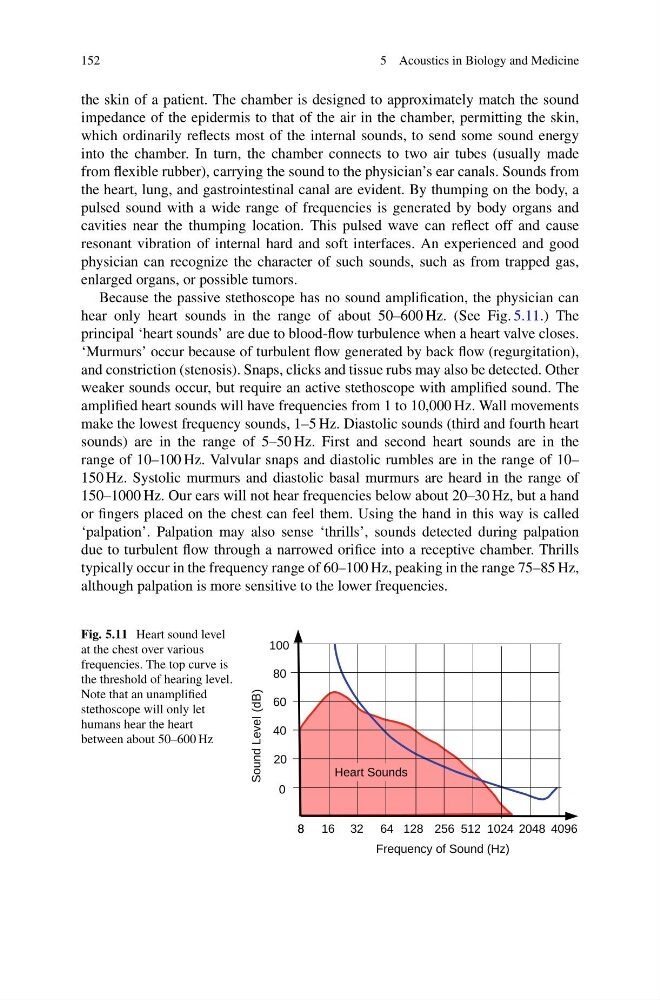
hear only heart sounds in the range of about 50–600 Hz. (See Fig. 5.11.) The
principal ‘heart sounds’ are due to blood-flow turbulence when a heart valve closes.
‘Murmurs’ occur because of turbulent flow generated by back flow (regurgitation),
and constriction (stenosis). Snaps, clicks and tissue rubs may also be detected. Other
weaker sounds occur, but require an active stethoscope with amplified sound. The
amplified heart sounds will have frequencies from 1 to 10,000 Hz. Wall movements
make the lowest frequency sounds, 1–5 Hz. Diastolic sounds (third and fourth heart
sounds) are in the range of 5–50 Hz. First and second heart sounds are in the
range of 10–100 Hz. Valvular snaps and diastolic rumbles are in the range of 10–
150 Hz. Systolic murmurs and diastolic basal murmurs are heard in the range of
150–1000 Hz. Our ears will not hear frequencies below about 20–30 Hz, but a hand
or fingers placed on the chest can feel them. Using the hand in this way is called
‘palpation’. Palpation may also sense ‘thrills’, sounds detected during palpation
due to turbulent flow through a narrowed orifice into a receptive chamber. Thrills
typically occur in the frequency range of 60–100 Hz, peaking in the range 75–85 Hz,
although palpation is more sensitive to the lower frequencies.
Fig. 5.11 Heart sound level
at the chest over various
frequencies. The top curve is
the threshold of hearing level.
Note that an unamplified
stethoscope will only let
humans hear the heart
between about 50–600 Hz
5 Acoustics in Biology and Medicine
the skin of a patient. The chamber is designed to approximately match the sound
impedance of the epidermis to that of the air in the chamber, permitting the skin,
which ordinarily reflects most of the internal sounds, to send some sound energy
into the chamber. In turn, the chamber connects to two air tubes (usually made
from flexible rubber), carrying the sound to the physician’s ear canals. Sounds from
the heart, lung, and gastrointestinal canal are evident. By thumping on the body, a
pulsed sound with a wide range of frequencies is generated by body organs and
cavities near the thumping location. This pulsed wave can reflect off and cause
resonant vibration of internal hard and soft interfaces. An experienced and good
physician can recognize the character of such sounds, such as from trapped gas,
enlarged organs, or possible tumors.
Because the passive stethoscope has no sound amplification, the physician can
hear only heart sounds in the range of about 50–600 Hz. (See Fig. 5.11.) The
principal ‘heart sounds’ are due to blood-flow turbulence when a heart valve closes.
‘Murmurs’ occur because of turbulent flow generated by back flow (regurgitation),
and constriction (stenosis). Snaps, clicks and tissue rubs may also be detected. Other
weaker sounds occur, but require an active stethoscope with amplified sound. The
amplified heart sounds will have frequencies from 1 to 10,000 Hz. Wall movements
make the lowest frequency sounds, 1–5 Hz. Diastolic sounds (third and fourth heart
sounds) are in the range of 5–50 Hz. First and second heart sounds are in the
range of 10–100 Hz. Valvular snaps and diastolic rumbles are in the range of 10–
150 Hz. Systolic murmurs and diastolic basal murmurs are heard in the range of
150–1000 Hz. Our ears will not hear frequencies below about 20–30 Hz, but a hand
or fingers placed on the chest can feel them. Using the hand in this way is called
‘palpation’. Palpation may also sense ‘thrills’, sounds detected during palpation
due to turbulent flow through a narrowed orifice into a receptive chamber. Thrills
typically occur in the frequency range of 60–100 Hz, peaking in the range 75–85 Hz,
although palpation is more sensitive to the lower frequencies.
Fig. 5.11 Heart sound level
at the chest over various
frequencies. The top curve is
the threshold of hearing level.
Note that an unamplified
stethoscope will only let
humans hear the heart
between about 50–600 Hz