

5.18 Medical Instruments for Detecting Sound
151
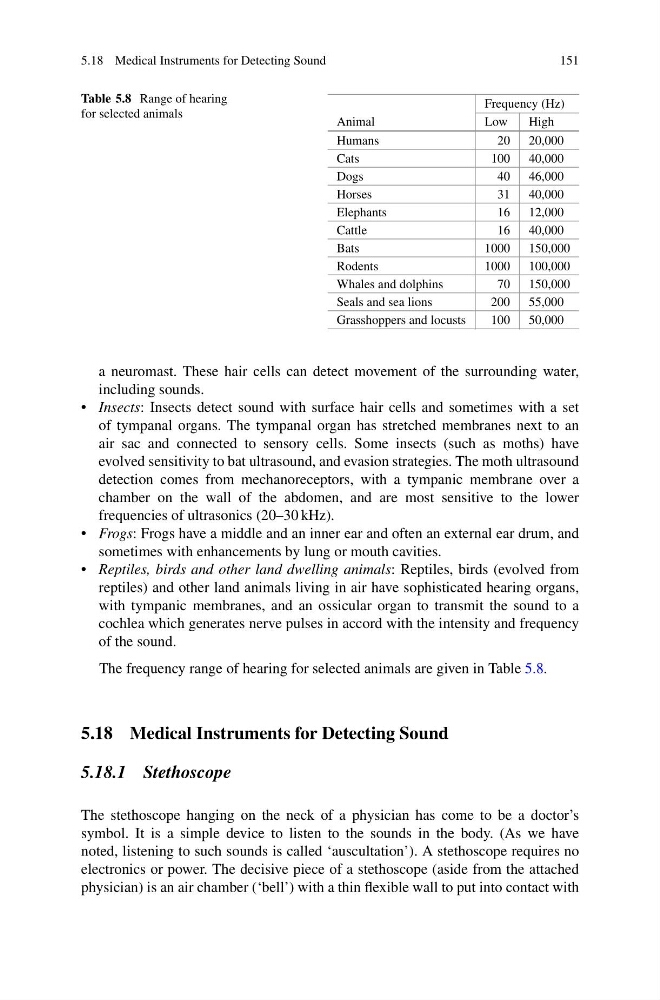
Table 5.8 Range of hearing
for selected animals
Frequency (Hz)
Animal
Low
High
Humans
20 20,000
Cats
100 40,000
Dogs
40 46,000
Horses
31 40,000
Elephants
16 12,000
Cattle
16 40,000
Bats
1000 150,000
Rodents
1000 100,000
Whales and dolphins
70 150,000
Seals and sea lions
200 55,000
Grasshoppers and locusts
100 50,000
a neuromast. These hair cells can detect movement of the surrounding water,
including sounds.
• Insects: Insects detect sound with surface hair cells and sometimes with a set
of tympanal organs. The tympanal organ has stretched membranes next to an
air sac and connected to sensory cells. Some insects (such as moths) have
evolved sensitivity to bat ultrasound, and evasion strategies. The moth ultrasound
detection comes from mechanoreceptors, with a tympanic membrane over a
chamber on the wall of the abdomen, and are most sensitive to the lower
frequencies of ultrasonics (20–30 kHz).
• Frogs: Frogs have a middle and an inner ear and often an external ear drum, and
sometimes with enhancements by lung or mouth cavities.
• Reptiles, birds and other land dwelling animals: Reptiles, birds (evolved from
reptiles) and other land animals living in air have sophisticated hearing organs,
with tympanic membranes, and an ossicular organ to transmit the sound to a
cochlea which generates nerve pulses in accord with the intensity and frequency
of the sound.
The frequency range of hearing for selected animals are given in Table 5.8.
5.18 Medical Instruments for Detecting Sound
5.18.1 Stethoscope
The stethoscope hanging on the neck of a physician has come to be a doctor’s
symbol. It is a simple device to listen to the sounds in the body. (As we have
noted, listening to such sounds is called ‘auscultation’). A stethoscope requires no
electronics or power. The decisive piece of a stethoscope (aside from the attached
physician) is an air chamber (‘bell’) with a thin flexible wall to put into contact with
151
Table 5.8 Range of hearing
for selected animals
Frequency (Hz)
Animal
Low
High
Humans
20 20,000
Cats
100 40,000
Dogs
40 46,000
Horses
31 40,000
Elephants
16 12,000
Cattle
16 40,000
Bats
1000 150,000
Rodents
1000 100,000
Whales and dolphins
70 150,000
Seals and sea lions
200 55,000
Grasshoppers and locusts
100 50,000
a neuromast. These hair cells can detect movement of the surrounding water,
including sounds.
• Insects: Insects detect sound with surface hair cells and sometimes with a set
of tympanal organs. The tympanal organ has stretched membranes next to an
air sac and connected to sensory cells. Some insects (such as moths) have
evolved sensitivity to bat ultrasound, and evasion strategies. The moth ultrasound
detection comes from mechanoreceptors, with a tympanic membrane over a
chamber on the wall of the abdomen, and are most sensitive to the lower
frequencies of ultrasonics (20–30 kHz).
• Frogs: Frogs have a middle and an inner ear and often an external ear drum, and
sometimes with enhancements by lung or mouth cavities.
• Reptiles, birds and other land dwelling animals: Reptiles, birds (evolved from
reptiles) and other land animals living in air have sophisticated hearing organs,
with tympanic membranes, and an ossicular organ to transmit the sound to a
cochlea which generates nerve pulses in accord with the intensity and frequency
of the sound.
The frequency range of hearing for selected animals are given in Table 5.8.
5.18 Medical Instruments for Detecting Sound
5.18.1 Stethoscope
The stethoscope hanging on the neck of a physician has come to be a doctor’s
symbol. It is a simple device to listen to the sounds in the body. (As we have
noted, listening to such sounds is called ‘auscultation’). A stethoscope requires no
electronics or power. The decisive piece of a stethoscope (aside from the attached
physician) is an air chamber (‘bell’) with a thin flexible wall to put into contact with