

144
5 Acoustics in Biology and Medicine
5.15.2 Vibration of Elastic Biomembranes
Purposeful biosounds are produced by vibration of specialized elastic biomembranes and organs, as well as noise-generating turbulence. For loud sounds, these
vibrations must be strongly coupled to the sound medium (air for land animals,
water for aquatic animals). Coupling can be achieved by impedance matching the
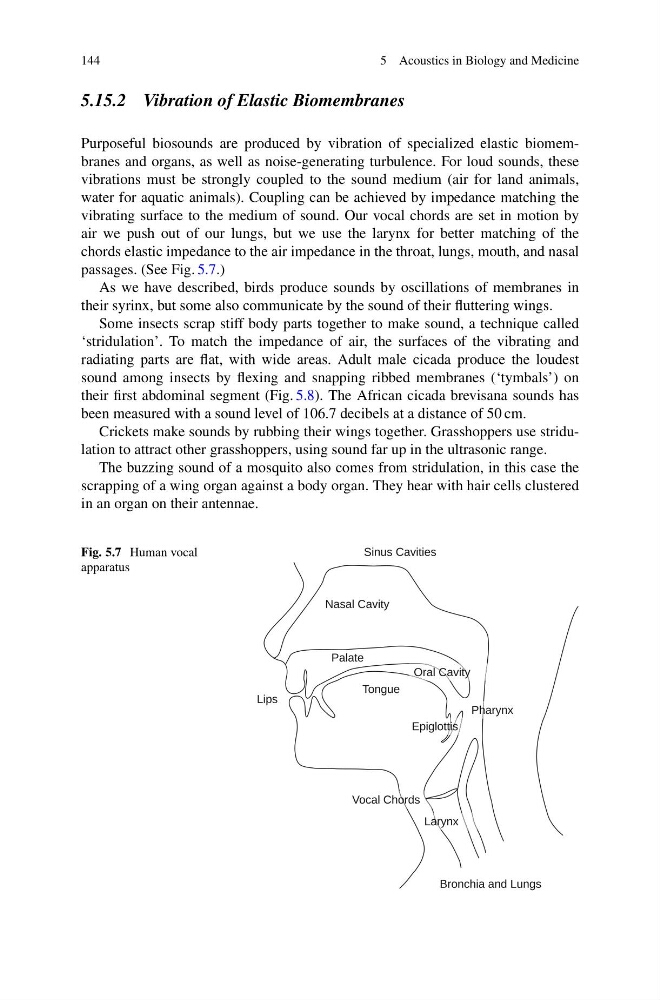
vibrating surface to the medium of sound. Our vocal chords are set in motion by
air we push out of our lungs, but we use the larynx for better matching of the
chords elastic impedance to the air impedance in the throat, lungs, mouth, and nasal
passages. (See Fig. 5.7.)
As we have described, birds produce sounds by oscillations of membranes in
their syrinx, but some also communicate by the sound of their fluttering wings.
Some insects scrap stiff body parts together to make sound, a technique called
‘stridulation’. To match the impedance of air, the surfaces of the vibrating and
radiating parts are flat, with wide areas. Adult male cicada produce the loudest
sound among insects by flexing and snapping ribbed membranes (‘tymbals’) on
their first abdominal segment (Fig. 5.8). The African cicada brevisana sounds has
been measured with a sound level of 106.7 decibels at a distance of 50 cm.
Crickets make sounds by rubbing their wings together. Grasshoppers use stridulation to attract other grasshoppers, using sound far up in the ultrasonic range.
The buzzing sound of a mosquito also comes from stridulation, in this case the
scrapping of a wing organ against a body organ. They hear with hair cells clustered
in an organ on their antennae.
Fig. 5.7 Human vocal
apparatus
5 Acoustics in Biology and Medicine
5.15.2 Vibration of Elastic Biomembranes
Purposeful biosounds are produced by vibration of specialized elastic biomembranes and organs, as well as noise-generating turbulence. For loud sounds, these
vibrations must be strongly coupled to the sound medium (air for land animals,
water for aquatic animals). Coupling can be achieved by impedance matching the
vibrating surface to the medium of sound. Our vocal chords are set in motion by
air we push out of our lungs, but we use the larynx for better matching of the
chords elastic impedance to the air impedance in the throat, lungs, mouth, and nasal
passages. (See Fig. 5.7.)
As we have described, birds produce sounds by oscillations of membranes in
their syrinx, but some also communicate by the sound of their fluttering wings.
Some insects scrap stiff body parts together to make sound, a technique called
‘stridulation’. To match the impedance of air, the surfaces of the vibrating and
radiating parts are flat, with wide areas. Adult male cicada produce the loudest
sound among insects by flexing and snapping ribbed membranes (‘tymbals’) on
their first abdominal segment (Fig. 5.8). The African cicada brevisana sounds has
been measured with a sound level of 106.7 decibels at a distance of 50 cm.
Crickets make sounds by rubbing their wings together. Grasshoppers use stridulation to attract other grasshoppers, using sound far up in the ultrasonic range.
The buzzing sound of a mosquito also comes from stridulation, in this case the
scrapping of a wing organ against a body organ. They hear with hair cells clustered
in an organ on their antennae.
Fig. 5.7 Human vocal
apparatus